Relations and Functions: CBSE Class 11 Assessment Guide
CBSEMathematicsRelations and Functions
This CBSE Class 11 Mathematics assessment moves from ordered pairs and relations to function graphs, operations and composition. Use the five topic-wise sets to pinpoint gaps, then use the chapter practice and worked solutions to check whether you can apply the ideas when topics are mixed.
How the assessment is organised
The PDF covers Chapter 2, Relations and Functions. Its five topic-wise assessments focus on Cartesian products; relations; functions, domain and range; standard functions and graphs; and algebra of real functions. A separate chapter practice set brings these topics together. The chapter set includes objective, very short, short and long answer questions, so it gives you practice both in recognising a correct representation and in explaining how you arrived at one.
The clickable index separates questions from solutions, and individual questions point to their solution pages. Since numbering starts again in each assessment, note the assessment title as well as the question number when you mark an item for review. That makes it easier to return to the right problem after checking your reasoning.
Relations and Functions | Class 11 | CBSE Assessment
In the StudentCurio app
Assessment questions and worked solutions cover Cartesian products, relations, domains and ranges, function types and operations, composition, and graphs including piecewise functions. Helps Class 11 students practise chapter concepts and check their reasoning.
Cartesian products: match each coordinate to its set
In , the first coordinate of each pair comes from and the second from . Swapping the factors changes which set supplies each coordinate, so you should not assume the two products are equal. Likewise, when comparing two ordered pairs, match first coordinate with first and second with second; having the same entries in reverse order is not enough.
The first assessment uses lists, arrow diagrams and coordinate plots to represent products. Connecting these forms helps you see what stays the same: a listed pair, an arrow from the first set to the second, and a plotted point can all represent the same ordered pair. When a product involves a union or intersection, identify the set supplying each coordinate before listing pairs.
Relations: start with all pairs, then apply the rule
A relation from to is a subset of . The product supplies every possible pair, while a condition such as divisibility selects the pairs that belong to the relation. When moving from set-builder notation to roster form, keep both parts of the definition in view: a pair must come from the specified sets as well as satisfy the rule.
The counting questions use the same idea from a different angle. For finite sets, each possible pair can be included or left out; the choice to leave every pair out gives the empty relation. Check whether the question counts all relations or only non-empty ones. Once you have the pairs, read the domain from the first coordinates and the range from the second. An inverse relation reverses each pair, exchanging those two sets.
Quick self-check: what do the arrows tell you?
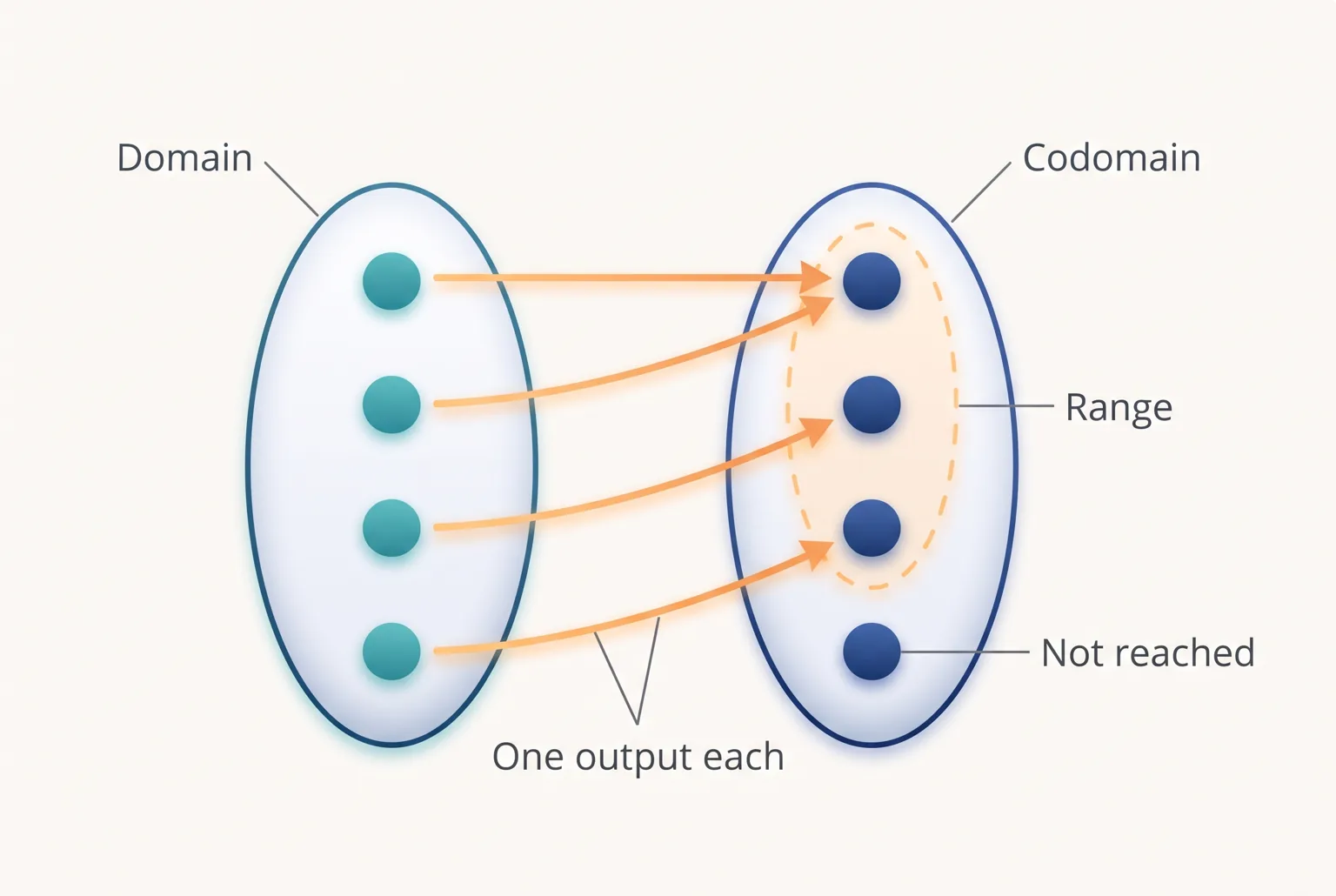
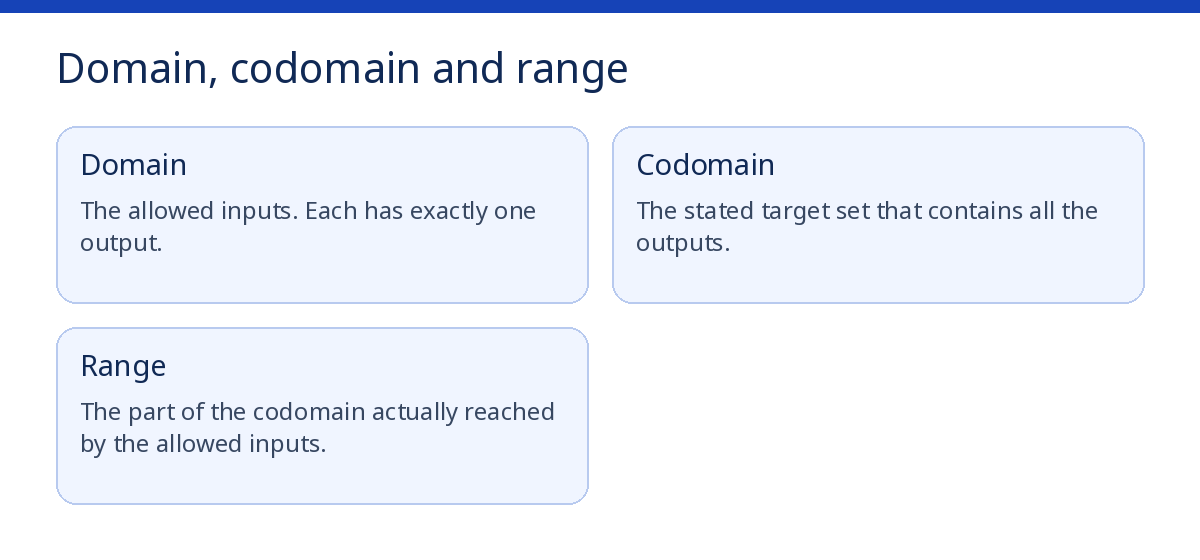
A function from a specified domain must assign exactly one output to each input. Two inputs sharing an output do not break that rule. In an arrow diagram, check the arrows leaving each input, rather than counting the arrows arriving at each output. The codomain is the stated target set; the range contains only the values actually reached. That is why a value can belong to the codomain without appearing in the range.
As you look at a mapping, ask: Which inputs are allowed? Which target values receive an arrow? If I start with a target value, which inputs map to it? That last question asks for a pre-image set. It can contain several inputs or none, without violating the one-output-per-input rule.
Graphs: the formula does not tell the whole story
The graph assessment asks you to recognise and sketch functions, including constant, modulus and piecewise rules. Start with the stated domain. When no domain is given, the assessment uses the natural real domain: a denominator cannot be zero, and a real square root requires a non-negative radicand. A stated restriction can narrow the domain further, so the same formula need not give the same graph or range under two different domain choices.
For a piecewise function, sketch each rule only where its condition holds. At a boundary, check which condition includes equality, or whether the boundary has a rule of its own. Once the allowed parts are drawn, read the range from the vertical values the graph actually attains, rather than from the shape suggested by an unrestricted formula.
When an operation or composition is defined
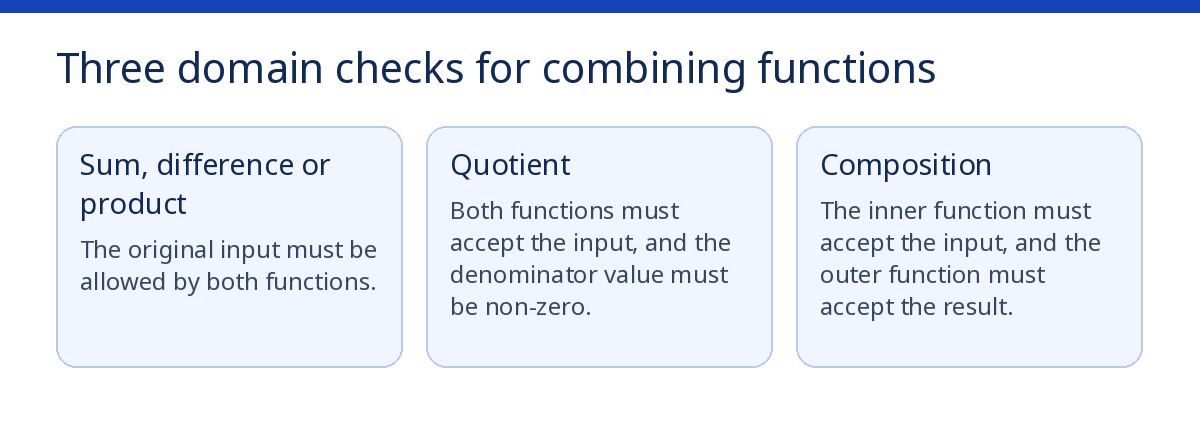
Sums, differences and products evaluate both functions at the same input, so they use the intersection of the two domains. A quotient also excludes inputs where its denominator function is zero. Find these restrictions before simplifying: cancellation can change how a formula looks, but it does not restore an input excluded by the original operation.
Composition works differently. In , first check that belongs to the domain of , then check that belongs to the domain of . Unlike a product, the outer function receives the inner function’s output, not the original input. This distinction matters when a nested expression simplifies to a formula that no longer shows all its restrictions.
Use chapter practice to diagnose the first wrong step
Try the chapter practice without the topic headings as cues. Before calculating, identify what the question asks you to produce: a set of pairs, an allowed input set, a set of attained outputs or a graph. If you compare your work with a solution, look for the first point where your reasoning diverges. For instance, a range error might begin with using inputs outside a stated domain, not with the final calculation. Use the index to return to the relevant topic-wise assessment and test that specific distinction again.
Spotted an error? Report a correction. Practise this in the app: notes, formula sheets and mind maps.









Loading comments…