Case Study Guide to CBSE Class 11 Relations and Functions
CBSEMathematicsSets, Relations and Functions
Master the fundamental connections between sets and functions through case-based assessments focusing on Cartesian products, mapping diagrams, and vertical-line tests.
Foundations of Relations and Cartesian Products
Chapter 2 of the CBSE Class 11 Mathematics curriculum serves as the essential bridge between basic Set Theory and the advanced study of Calculus. This resource focuses on the Cartesian product of sets, which provides the framework for all relations. A Cartesian product is the set of all possible ordered pairs where the first element is from set and the second is from set . The material emphasizes the fundamental counting principle: if set contains elements and set contains elements, the resulting product will contain exactly elements.
Learners are often required to 'reverse engineer' these sets. For example, if given a list of ordered pairs from a product, you can recover the original sets by collecting all distinct first components to form set and all distinct second components to form set . This logic is critical for identifying the domain of a relation. The resource also covers the Cartesian square, , where a single set is paired with itself. Understanding the cardinality of these products is the first step toward calculating the total number of possible relations between any two sets.
Relations and FunctionsClass 11 | Maths| CBSE Case Based Assessment
In the StudentCurio app
Case-study-based questions for Class 11 and 12 Maths on Relations and Functions, covering Cartesian products, domain, range, and function identification with step-by-step solutions.
Visualizing Relations through Mapping Diagrams
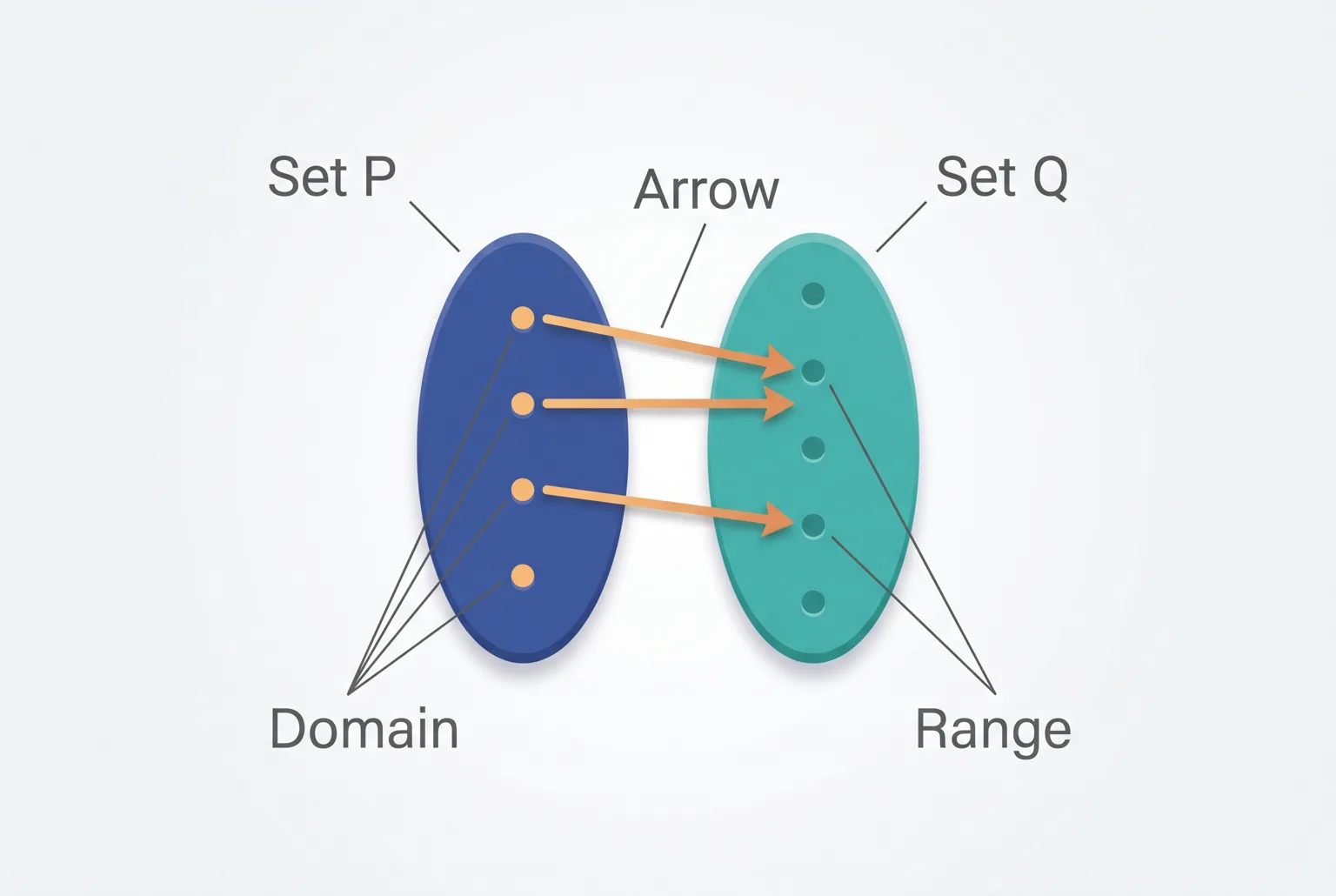
A relation is formally defined as any subset of a Cartesian product. This means that a relation from to is simply a collection of ordered pairs that satisfy a specific condition. The resource uses mapping diagrams (arrow diagrams) to visualize these connections. In these diagrams, set is the starting set and set is the target set. Arrows are drawn from elements in to their related counterparts in .
These visual tools help students transition between different mathematical representations. You may be asked to convert a diagram into 'Roster form'—a literal list of ordered pairs—or into 'Set-builder form,' which uses a logical rule to describe the relationship. For instance, a diagram showing 9 connected to 3 and -3 describes the rule (where is the square of ). Mastering these conversions is vital for CBSE assessments, as it demonstrates a deep understanding of how variables interact within a defined system.
Defining Domain and Range
In any relation , the Domain is specifically the set consisting of all first components of the ordered pairs. It is important to note that the domain may not necessarily include every element in the starting set ; it only includes those elements from which an arrow originates. Conversely, the Range is the set of all second components—the actual values in the target set that are 'hit' by an arrow.
Distinguishing between the target set (often called the co-domain in broader contexts) and the range is a common area of evaluation. For example, if set contains the numbers but arrows only point to , then the range is strictly . The resource provides practice in identifying these sets from both coordinate lists and visual diagrams, ensuring learners can isolate the active participants in a relation from the inactive ones.
Transitioning from Relations to Functions
The material provides a clear distinction between a general relation and a specific function. According to the CBSE curriculum, a relation from set to set is called a function if every element of set has exactly one image in set . This definition carries two strict requirements: first, every element in the domain must be used, and second, no single element from the domain can point to two different results.
In terms of ordered pairs, a function is a set where no two distinct pairs share the same first component. This logic is tested through graph analysis using the Vertical-line Test. If any vertical line intersects a graph at more than one point, it means a single -value has multiple -values, which violates the definition of a function. The assessment includes examples of right-opening curves (which are merely relations) and V-shaped curves (which qualify as functions) to help learners recognize these properties visually.
Function Evaluation and Symbolic Substitution
Once a function is identified, the focus shifts to evaluation and algebraic manipulation. Evaluating a function involves substituting a specific value into the functional expression to find its corresponding output. The resource provides examples such as , where students must calculate and compare values like , , and to determine maximums or minimums.
Advanced assessment tasks involve symbolic substitution, where the input itself is an algebraic expression. For instance, if you are given a rule for , and you need to find the value of , you must perform a strategic substitution. By setting , you find that . Substituting this new value of into the original function rule requires careful expansion of quadratic terms. This skill is essential for solving complex function problems in higher-level mathematics.
Logic and Assertion-Reasoning Skills
The final section of the resource introduces Assertion-Reason questions, a staple of modern CBSE examinations. These questions require learners to evaluate two statements: an 'Assertion' (a claim about a mathematical fact) and a 'Reason' (a theorem or rule that supposedly explains the claim).
An example provided involves reconstructing a set from just two elements of its Cartesian square and the knowledge that the square has 9 elements. By applying the formula , we determine that must have 3 elements. If the given pairs contain the elements , we can conclude these are the only three elements in set . This level of logical deduction combines counting principles, set theory, and relation properties into a single evaluative task.
Frequently asked questions
What is the difference between a relation in Roster form and Set-builder form?
Roster form is a explicit list of all ordered pairs, such as . Set-builder form describes the property that the pairs must satisfy, such as .
How do I find the domain of a relation from a set of ordered pairs?
The domain is the set of all unique first elements from each ordered pair. For example, in the relation , the domain is .
Can a function have more than one arrow pointing to the same element in the target set?
Yes. A function can have many-to-one mapping (different inputs sharing the same output), but it cannot have one-to-many mapping (one input having multiple outputs).
Spotted an error? Report a correction. Practise this in the app: notes, formula sheets and mind maps.
Loading comments…