CBSE Class 11 Trigonometric Functions Case-Based Assessment
CBSEMathematicsTrigonometric Functions
This CBSE Class 11 Mathematics assessment uses four cases to connect circular motion and radian measure with quadrant signs and compound-angle identities. Its linked solutions let you check not only the arithmetic but also the choice of unit, sign or identity behind each result.
What the four cases cover
This Chapter 3 assessment file contains four case studies and 16 subparts. The pinwheel and acute-angle cases use short-answer questions, while the radian-measure and quadrant-sign cases use multiple-choice questions. The first two cases focus on turns, angle units and distances on a circle. The last two shift to trigonometric ratios, signs and expressions involving sums or differences of angles.
The case introductions supply information that matters for the calculations. The pinwheel’s rotation rate determines how its turn count changes with time, while the named quadrant in the assignment case determines the signs of missing ratios. Read those conditions before focusing on the individual questions. The file includes worked solutions but no separate chapter-practice section, so use it for the skills tested in these four cases.
Trigonometric Functions | Class 11 | Case-based Assessment
In the StudentCurio app
Case-based questions with worked solutions on revolutions, degree–radian conversions, arc length, quadrant signs, trigonometric ratios and compound-angle identities. Helps Class 11 students practise trigonometric functions through contextual problems.
From a rotation rate to an angle
The pinwheel case distinguishes a rate of rotation from a number of revolutions. A rate stated in revolutions per minute cannot be multiplied directly by a time measured in seconds. First express the rate and elapsed time on the same time basis. Once you have a turn count, you can express the total angle turned through in degrees or radians. One full revolution corresponds to or radians.
The wheel question in the next case uses the same connection but asks for angular motion in radians. In both cases, distinguish the angle turned through from the final orientation. An object can return to its starting orientation after a full turn, but it has still turned through a full revolution. Reducing the angle to describe only where the object ends would miss the quantity the question asks for.
When the arc-length formula applies
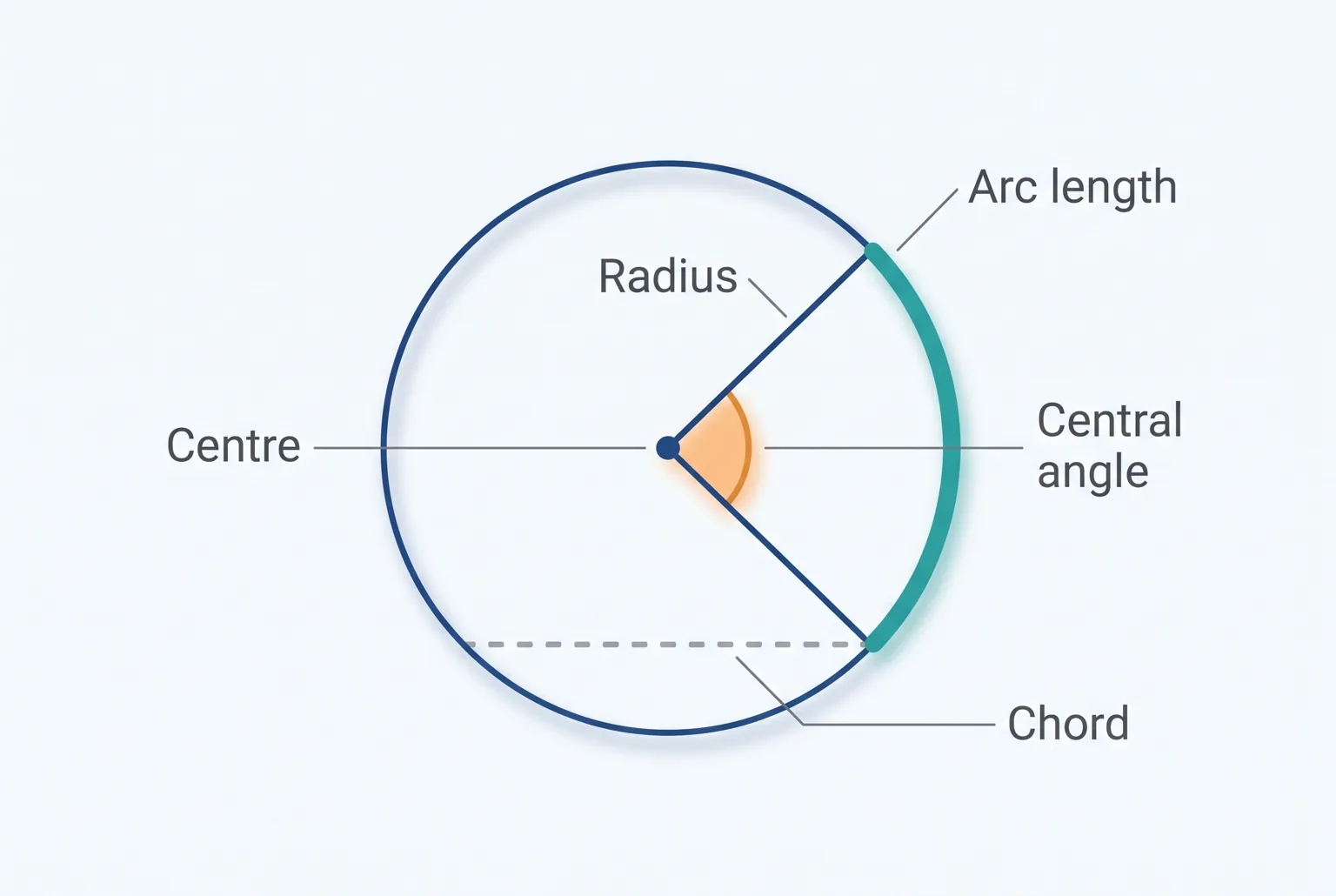
The radian-measure case starts with a unit circle: because its radius is one unit, the arc length in those units is numerically equal to the radian measure of the central angle. For a circle of radius , the relationship is , where is the intercepted arc length and is the corresponding central angle in radians. A degree measure must be converted before it is used in this formula.
The radius questions give the arc length and angle, whereas the minute-hand question uses the length of the hand as the radius and asks about the distance travelled by its tip. That distance follows the circular arc; it is not the straight-line distance between the tip’s starting and ending positions. In either setup, the arc length and radius use the same length unit. The angle is a different kind of quantity and does not carry that length unit.
Keep precision in degree–radian conversions
The conversion in either direction rests on radians. Multiply the numerical degree measure by to obtain radians, or the numerical radian measure by to obtain degrees. If the result is needed in degrees, minutes and seconds, convert the fractional degree to minutes, then convert only the fractional part of those minutes to seconds.
Keep intermediate values unrounded where possible. The radius questions explicitly prescribe ; that instruction does not automatically carry over to other subparts. In particular, the file’s accuracy note flags the radians-to-degrees multiple-choice item: none of its printed options matches the conversion using . The worked notes explain the discrepancy, so use them to check your method rather than treating the absence of a matching option as evidence that your conversion is wrong.
Common mistake: choosing a sign from the square alone
The quadrant-sign case gives a trigonometric ratio and the quadrant of its angle. The identity determines the square of the missing ratio, not its sign. Taking the square root gives its magnitude; the quadrant then tells you which sign to use. In the second quadrant, sine is positive and cosine is negative. In the acute-angle case, both ratios are positive because each given angle lies strictly between zero and a right angle.
Those conditions describe the individual angles. They do not tell you that their sum is acute or that their difference is positive. Keep the signs of the individual ratios when you substitute into a compound-angle identity, rather than assigning the resulting expression a sign based on the individual angles alone.
A useful distinction: adding ratios and adding angles
The last two cases use compound-angle identities to combine ratios of individual angles. The quadrant case includes both recognition of a sine identity and its use in calculation. It also asks for an exact trigonometric value, where writing an angle as a sum of familiar angles makes it possible to work with known ratios instead of decimal approximations.
The acute-angle case puts ordinary addition of ratios alongside the cosine of a sum and the sine of a difference. In ordinary addition, the function has already been applied to each angle. In a compound expression, the sum or difference is inside the function. Check the function and the operation inside its argument before choosing an identity; adding or subtracting the separate ratios is not a general substitute.
Quick self-check before opening a solution
Use the clickable index to select a case, attempt a subpart, then open its individual solution link. Before you compare the final lines, ask: What quantity is the question asking me to find? Which unit or angle condition determines my next step? If my answer differs, can I identify the first line where the two methods diverge?
The return links let you go back to the relevant question and retry it without keeping the working in view. For a multiple-choice item, write down your result before relying on the options. For a short-answer item, check whether your working makes the decisive conversion, sign choice or identity visible.
Spotted an error? Report a correction. Practise this in the app: notes, formula sheets and mind maps.
Loading comments…