Three-Dimensional Geometry: CBSE Class 11 Assessment
CBSEMathematicsThree-Dimensional Geometry
This CBSE Class 11 Mathematics assessment moves from locating points in space to using distances to test geometric claims. Two topic-wise assessments and a mixed chapter practice set let you try the questions before consulting the linked worked solutions.
How the assessment is organised
The file covers Chapter 12, Introduction to Three Dimensional Geometry. The first assessment, starting on page 4, focuses on coordinate axes and planes. The second, starting on page 7, develops the distance formula and its applications. Chapter practice starts on page 10 and mixes these topics with questions on midpoints and centroids. The topic-wise sets include objective, very short-answer and short-answer questions; the chapter practice also includes case-based questions.
The separate question and solution indexes make it possible to practise one topic at a time without opening the worked steps in advance. Question numbers are reused, so identify an item by its assessment or chapter practice section as well as its number. Each worked solution links back to its matching question.
Three-Dimensional Geometry | Class 11 | CBSE Assessment
In the StudentCurio app
Chapter-wise assessment questions cover coordinates, axes and planes in three-dimensional space, along with distance and section formula applications. Includes objective, short-answer and case-based practice, with worked solutions to help Class 11 students review their methods.
Read coordinates as directions as well as magnitudes
An ordered triple locates a point relative to three mutually perpendicular axes. The coordinates are the signed perpendicular distances from the -, - and -planes, respectively. The sign tells you which side of the corresponding plane the point is on; the magnitude tells you how far away it is. The first assessment uses this distinction in octant questions and in sketches that locate a point by moving in the three coordinate directions.
The coordinate planes divide space into eight octants. For a point with three nonzero coordinates, the sign pattern identifies its octant. If a coordinate is zero, the point is on the corresponding coordinate plane, not in the interior of an octant. Two zero coordinates locate a point on an axis; three locate the origin.
Common mistake: confusing the foot with the distance
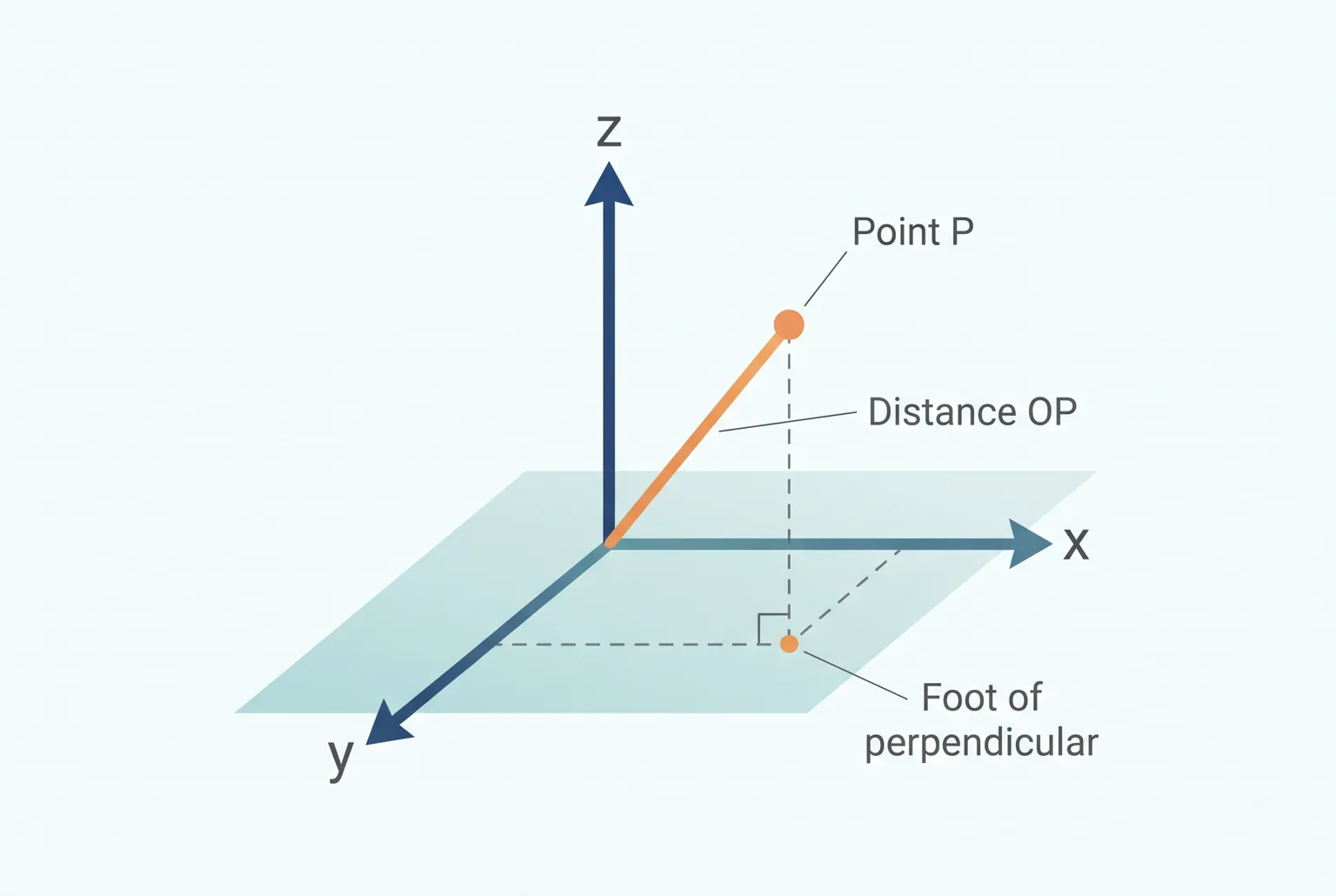
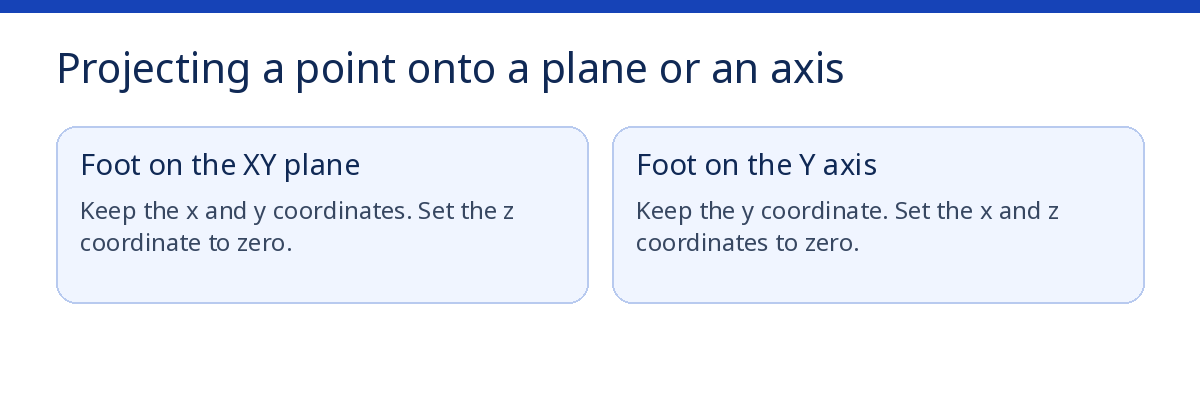
The foot of a perpendicular is a point, while the perpendicular distance is a nonnegative length. Projecting onto the -plane keeps the first two coordinates and sets the third to zero. The foot is , and the distance to the plane is . Taking the absolute value matters: a negative coordinate indicates direction, not a negative length.
A projection onto a coordinate axis retains only the coordinate along that axis. For instance, projection onto the -axis gives the foot . The distance to that axis is because the displacement to the foot has two perpendicular components. In the projection questions, identify where the foot lies before deciding whether the prompt calls for a triple or a length.
When squared distances are enough
For points and , the distance is . Pair coordinates in the same positions before subtracting. The cover’s distance-from-origin diagram shows the special case in which the other endpoint is the origin, so the coordinate differences reduce to the coordinates of the point itself.
Because distances are nonnegative, equal squared distances imply equal distances. That makes it possible to compare sides or set up an equidistance condition without simplifying radicals. The right-angle test also uses squared lengths: in a nondegenerate triangle, compare the largest squared side with the sum of the other two. The collinearity test is different: for three distinct points, check whether the longest length equals the sum of the other two lengths, not whether their squares add.
Turn geometric conditions into equations
The second assessment asks for points that meet a location constraint and a distance condition at the same time. When a point must lie in the -plane, write it as before setting up its distances. This builds the plane constraint into the calculation and avoids treating all three coordinates as unknown. In an equidistance problem involving several fixed points, compare the distances from the same unknown point to those fixed points.
A locus question asks for the set of all points meeting a condition, rather than one example that works. Keep an equal-distance condition separate from a fixed sum of distances. Squared distances can be compared directly for equality, but replacing each distance in a sum by its square changes the condition.
Midpoints and centroids in the mixed practice
A midpoint divides a segment into two equal parts, and its coordinates are the averages of the corresponding endpoint coordinates. A triangle’s centroid, where its medians meet, instead uses the coordinate-wise average of all three vertices. Both rules give a location, not a distance. The distinction matters in chapter practice, which includes centroid questions involving side midpoints as well as a question that gives the centroid and asks for a missing vertex.
For a missing vertex, read the average relationship in reverse: the centroid and the known vertices constrain each coordinate of the unknown vertex. Before choosing a formula, label which triples describe vertices, which describe midpoints and which describe the centroid.
Use the chapter practice to test method choice
Try the mixed questions after working through both topic-wise sets. The case-based items describe positions in words, so first identify which triples represent points and what the question asks you to compare. A ribbon between two positions represents a segment length; a position equidistant from several others calls for comparing distances from a single unknown point.
When checking a response, compare your initial setup with the worked solution before looking at the arithmetic. This helps distinguish a wrong coordinate restriction from a calculation slip. This guide leaves out individual answer options with unclear extracted notation and the isolated circumcentre and rhombus items whose printed coordinates do not support their stated claims.
Spotted an error? Report a correction. Practise this in the app: notes, formula sheets and mind maps.
Loading comments…