CBSE Class 11 Straight Lines: Case-Based Assessment
CBSEMathematicsStraight Lines
This CBSE Class 11 Mathematics assessment uses four cases to connect distances, slopes and line equations with internal division and triangle geometry. Its worked solutions let you check not just the result, but also whether you chose the right points and geometric conditions.
What the four cases test
The file contains 16 subparts across four case studies. The first and third use multiple-choice questions on internal division and triangle lines, respectively. The second combines short-answer questions on distances, slopes and a triangle angle. The fourth uses a triangular park and a separate triangle to practise finding a vertex and writing equations of sides.
The common task is to translate the wording into a coordinate relationship. Finding a distance uses two endpoints; finding a median also requires identifying a midpoint. Even within one case, the points may change from one subpart to the next. The assessment therefore tests which information you use as well as how you calculate with it.
Straight Lines | Class 11 | Case-based Assessment
In the StudentCurio app
Case-based questions and worked solutions cover straight-line equations, slopes, distances, angles, section formula, and applications involving medians and altitudes. Helps Class 11 students practise coordinate-geometry problem solving in a CBSE-style format.
Internal division: connect the ratio to the lengths
The first case starts with two endpoints and a point between them. It asks for the full distance, the equation of the line, the dividing point and the two shorter distances. These are different descriptions of the same configuration: the equation describes the whole line, while the ratio and the phrase between the endpoints locate a point on the segment.
If divides internally with , both ratio terms are positive. The section formula weights the coordinates of by and those of by , then divides each weighted sum by . Reversing the weights while keeping the endpoints fixed generally gives a different point. An independent check is that and the two shorter lengths have the stated ratio. Checking that the point lies on the line alone would not verify either its position between the endpoints or the ratio.
Common mistakes: mixing point pairs and angle types
The second case gives two different pairs for its distance and slope questions. Use the same pair for both calculations within each subpart, and subtract the coordinates in the same endpoint order when finding slope. The solution notes identify the slope calculations that were exchanged in earlier working and give the calculation for each requested pair. They also flag that the stated plot vertices do not form a square. No square property is needed to calculate the requested distances or slopes.
The angle question gives its own triangle. Use the two sides meeting at the named vertex, not the pairs from the plot questions. The absolute-value slope formula gives the smaller angle between the lines when both slopes are finite and the denominator is nonzero. The interior angle is between the two rays pointing from the vertex toward the other vertices, so it may instead be the supplement. The worked solution checks the directions with a dot product: a positive value means the interior angle is acute.
Triangle lines: identify what fixes each equation
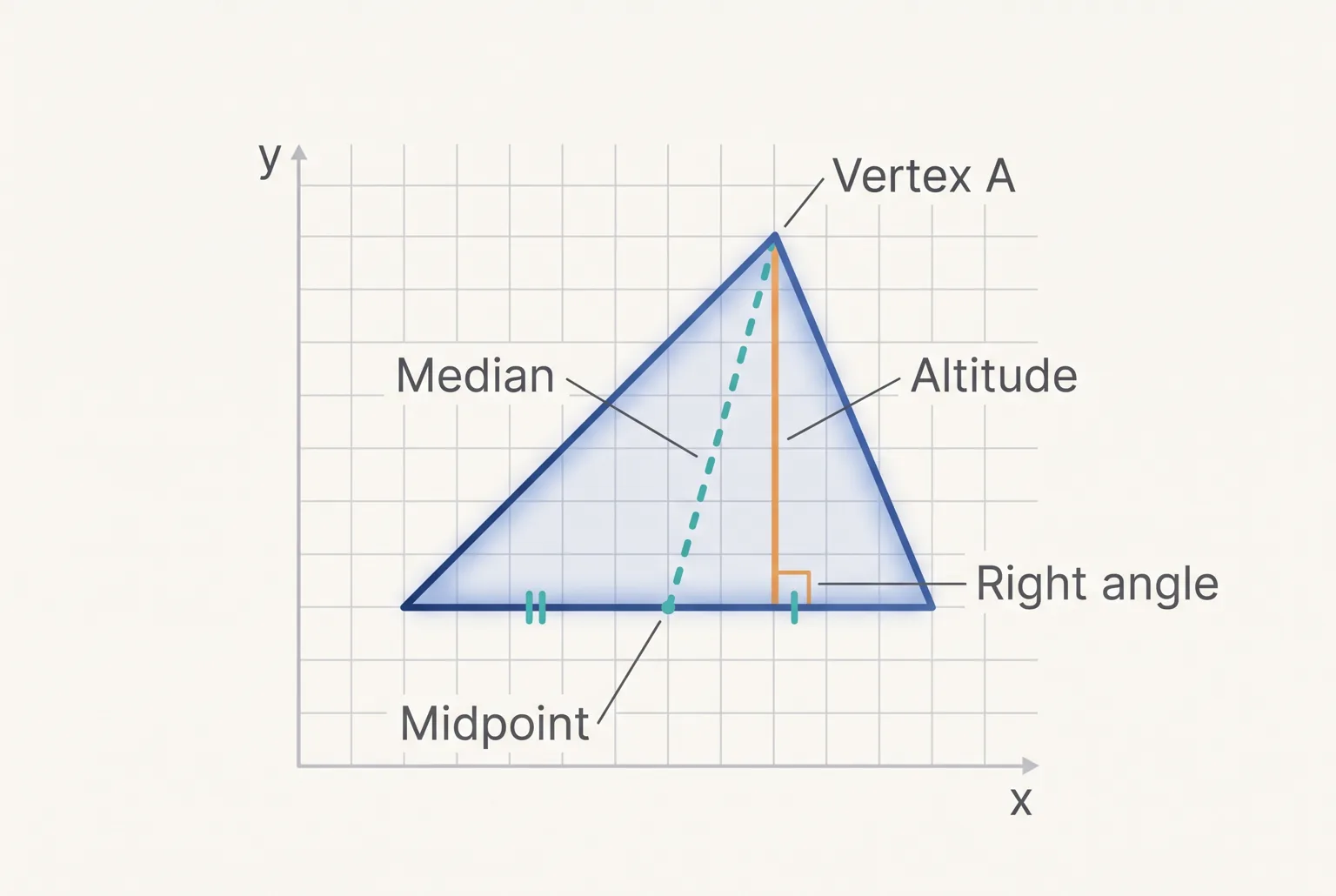
In the third case, the positions of Rani, Mansi and Sneha define a triangle. A side is fixed by its two vertices. A median is fixed by a vertex and the midpoint of the opposite side; it need not be perpendicular to that side. An altitude passes through a vertex and is perpendicular to the line containing the opposite side; it need not pass through the midpoint. For the requested parallel line, take the direction of the named side but use the specified vertex to fix the line's position.
Once a point and a finite slope are known, point-slope form gives the equation. A negative reciprocal gives a perpendicular slope only when the original slope is finite and nonzero. A horizontal line instead has a vertical perpendicular; a vertical line through a point is written by fixing its -coordinate. The triangle diagram is schematic, so use coordinates and geometric conditions rather than estimating slopes or angles from its appearance.
The triangular park: track which vertices belong together
The fourth case uses two auxiliary endpoints to locate the park's third vertex by internal division. The solution calls these endpoints and to distinguish them from the park's vertices and . The next subpart asks for the line through the two stated park vertices, so finding the third vertex is not a prerequisite for that equation.
The final subpart supplies a separate triangle. Its vertex labels repeat, but its coordinates are different. For each side, select the matching pair from that subpart and form its equation. To check a rearranged equation, substitute both endpoints: each must satisfy it. This also helps you recognise that equations differing only by multiplication by a nonzero constant describe the same line.
Quick self-check before opening a solution
For a multiple-choice line question, name the defining condition before comparing options: which point must the line contain, and what determines its direction? For a short answer, write down the coordinates given in that subpart before choosing a formula. Then ask whether a wrong result would come from the point selection, the geometric condition or the algebra. That distinction tells you which step to revisit.
The clickable index takes you to individual subparts, and the question and solution pages link to one another. After attempting a subpart, use its worked solution to compare the setup first and the arithmetic second. The file does not contain a separate chapter-practice section, so you can use the index to revisit a specific skill, such as choosing between the midpoint and perpendicularity conditions.
Spotted an error? Report a correction. Practise this in the app: notes, formula sheets and mind maps.
Loading comments…