Sets Case-Based Assessment for CBSE Class 11 Mathematics
CBSEMathematicsSets, Relations and Functions
This CBSE Class 11 Mathematics file contains two case studies on Sets, with eight subparts and linked worked solutions. It connects finite-set counting with a three-set library problem in which the wording determines which Venn regions to count.
What the two cases assess
The file focuses on Sets, not on relations or functions. The first case has five multiple-choice subparts. It starts with information about two finite sets and their power sets, then asks about possible union sizes and what happens to the intersection under a subset condition. The second case has three short-answer subparts. It uses readership data for Mathematics, Physics and Chemistry to ask about single-subject readers, readers of at least one subject and readers of none.
The distinction between the formats is useful. In the first case, an option is only worth choosing once you know which quantity it represents. In the second, writing the set expression before doing the arithmetic makes your interpretation visible.
Sets | Class 11 | Case-based Assessment
In the StudentCurio app
Includes case-study questions and worked solutions on set cardinality, power sets, subsets, unions and intersections, and inclusion–exclusion, with Venn-diagram checks. Useful for Class 11 students practising CBSE case-based assessments.
A useful connection: elements and subsets
The cardinality of a finite set counts its distinct elements. The cardinality of its power set counts its subsets instead. For a finite set with elements, each element can independently be included in or excluded from a subset. Those two choices per element produce subsets, including the empty set and the full set. Here the set size is the exponent, not a multiplier.
This distinction explains why the first passage gives two different kinds of information. A sum of set cardinalities concerns the original sets directly, while a ratio of power-set cardinalities compares powers of two. When powers with the same base are divided, the exponents are subtracted. Labelling which count belongs to which set helps you keep the order of the ratio straight.
When a union reaches its bounds
For two finite sets, adding their cardinalities counts common elements twice. The identity subtracts the overlap once so that each common element is counted once in the union. With both set sizes fixed, changing the overlap changes the union in the opposite direction.
A disjoint arrangement gives the largest union if disjointness is possible. The smallest union occurs when one set can be contained in the other, so the overlap is as large as the smaller set. The attainment condition matters: a specified universal set or a required overlap can prevent an arrangement that the sizes alone would allow. In a subset statement, read the direction of containment before deciding which elements are shared.
Common mistake: reading “both” as “only those two”
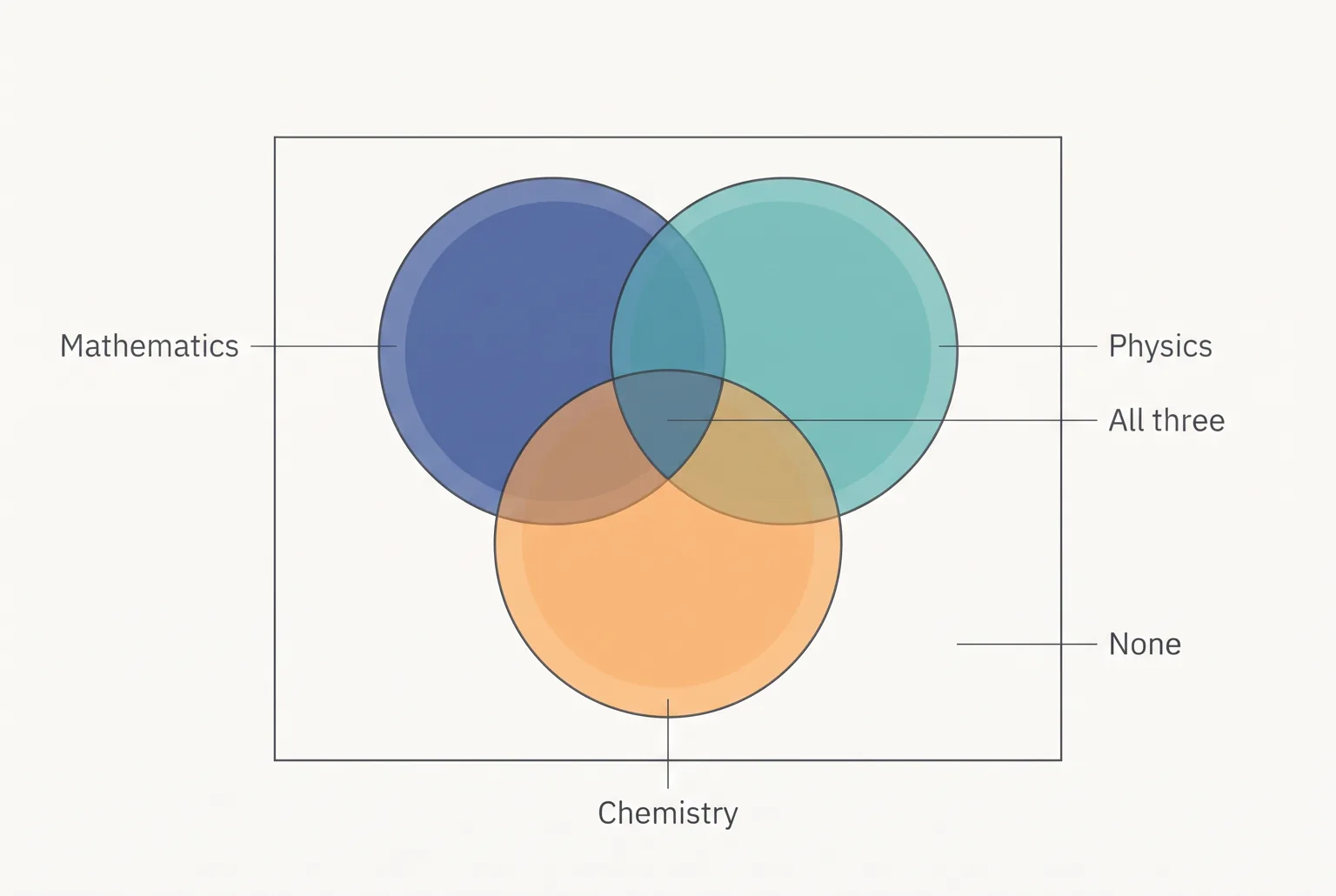
In the library case, a count for students reading both of two subjects is a pairwise intersection. Unless the wording excludes the third subject, that intersection also includes students who read all three. By contrast, the region for exactly those two subjects leaves out the central region. The two descriptions therefore do not generally name the same group.
A similar distinction applies to a single subject. A subject’s total includes its overlaps, whereas only that subject means being inside its set and outside both other sets. When counting readers to exclude from that total, treat them as one group: a reader who belongs to both other sets should not be removed twice. This is why the triple overlap matters even in a question about a single-subject region.
At least one, none and the reference group
At least one is inclusive: membership in two or three of the sets still qualifies. In three-set inclusion–exclusion, the three set totals are added, the pairwise intersections are subtracted, and the triple intersection is added back. An element in all three was counted three times and then subtracted three times, so the final addition is needed to count it once.
None means outside all three subject sets, but still inside the universal set. The library passage’s opening wording can sound as though everyone in the stated total reads a listed subject. The file’s accuracy note specifies how its solution reads the data: the stated total is the entire library group being counted, not a count already restricted to readers of the listed subjects. That distinction is essential when taking a complement.
Quick self-check: can you explain each Venn region?
Before opening the worked solutions, sketch three overlapping circles inside a rectangle and label the subjects. Pick one pairwise intersection and point to every region it covers. Then ask: which region would have to be left out if the wording changed to exactly those two? Next, identify where a student who reads none of the listed subjects would appear. You can check these interpretations without calculating any of the assessment’s answers.
After attempting the questions, use the labelled Venn diagram to check whether your regions are mutually exclusive and whether they account for the whole reference group. A useful second check is to look at each circle individually: its regions together should reproduce the stated total for that subject.
Use the linked solutions to trace an error
The clickable index lets you go directly to a subpart, and each question links to its solution and back. Attempt a subpart first, then compare your first set expression with the worked reasoning before checking the arithmetic. In the multiple-choice case, this can reveal that you counted subsets instead of elements or found an intersection when the question asked for a union. In the library case, it can show whether an error came from translating the wording or from counting an overlap twice.
The file includes accuracy notes on notation in the supplied working. Read those notes alongside the relevant solution rather than treating every printed expression as a rule to memorise.
Spotted an error? Report a correction. Practise this in the app: notes, formula sheets and mind maps.
Loading comments…