CBSE Class 11 Sequences and Series: Assessment Guide
CBSEMathematicsSequence and Series
This CBSE Class 11 Mathematics assessment pairs six topic-wise sets with mixed chapter practice and worked solutions. Use it to distinguish terms from sums, recognise arithmetic and geometric patterns, and check when their formulas apply.
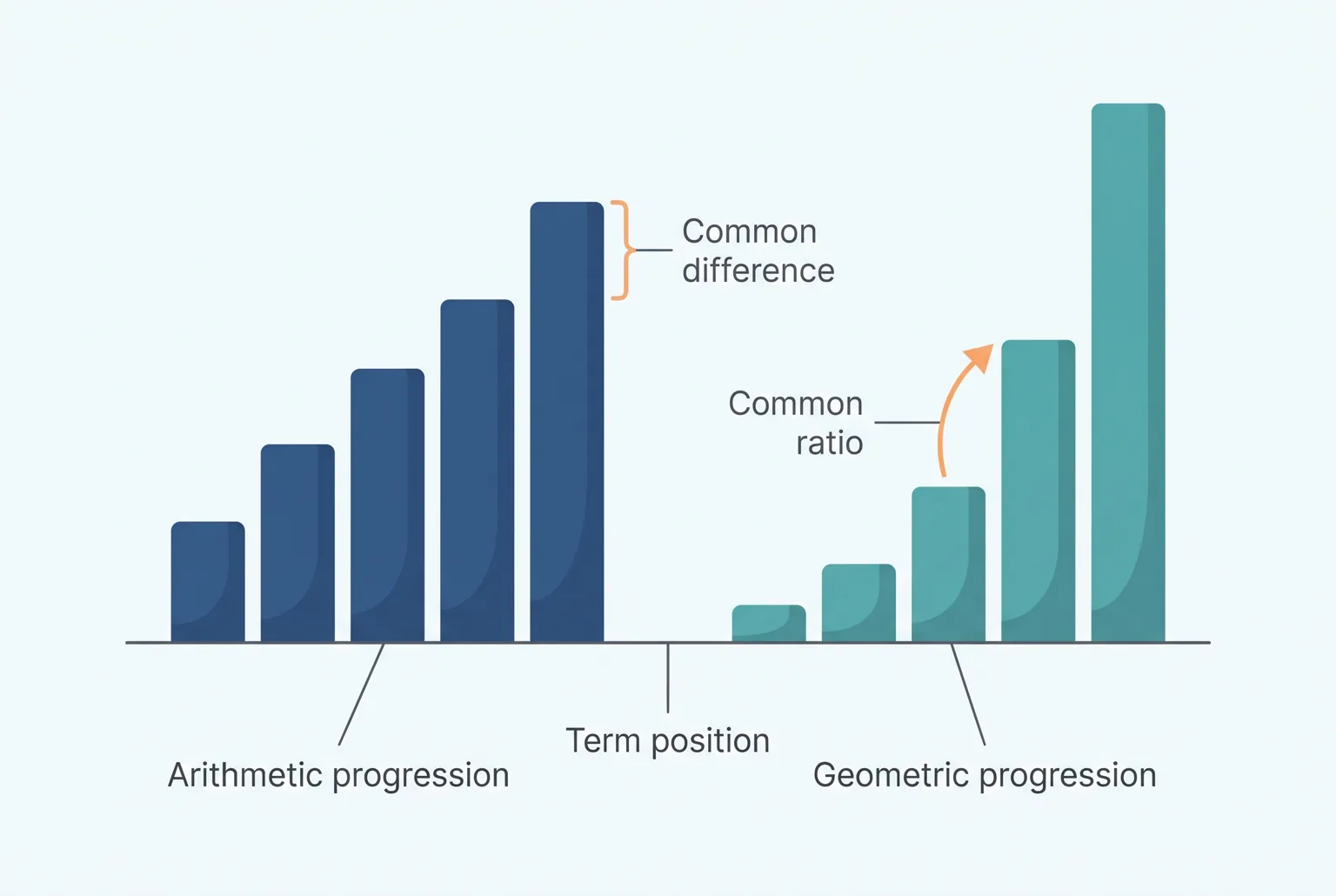
Start with a term, then build a series
A sequence lists terms in order; a series adds those terms. The first assessment tests that distinction by asking you to generate terms and then write a corresponding series. Keep the notation tied to the task: refers to the term at position , while is the sum of the first terms. In sigma notation, the index limits tell you exactly which terms to include.
The opening set also gives you two ways to describe a sequence. An explicit rule lets you substitute a position directly. A recurrence tells you how to use earlier terms, so you need the stated starting value or values before you can continue. Reading those starting conditions matters as much as reading the recurrence itself.
Sequence and Series | Class 11 | CBSE Assessment
In the StudentCurio app
This assessment covers arithmetic and geometric progressions, including terms, sums, inserted means, and case-based applications. It provides objective and written practice with worked solutions for Class 11 students.
Arithmetic progressions: track the difference and the position
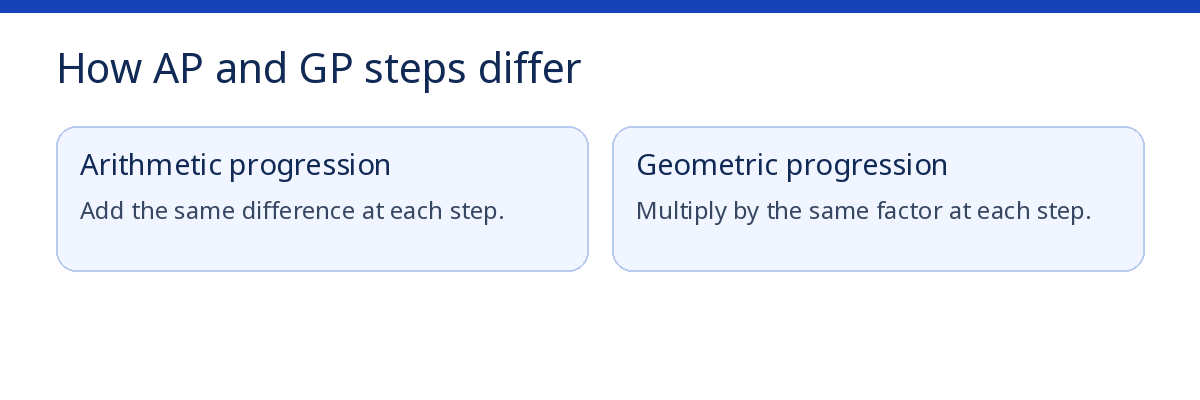
In an arithmetic progression (AP), each term differs from the preceding one by the same amount. With first term and common difference , the general term is . The multiplier is one less than the position because no step has been taken at the first term. If the progression decreases, keep the common difference negative; using its magnitude alone would reverse the direction of change.
The AP terms assessment goes beyond finding a term at a given position. It also asks whether a value belongs to a progression and includes questions about middle terms and positions counted from the end. When you solve for a position, an algebraic result is only a valid index if it is a positive integer and, for a finite list, falls within its length.
AP sums: identify what is being totalled
For the first terms of an AP, use when the first term and difference are known. If the first and last terms of that same block are known, use , where is the last term. This second form reads as the number of terms multiplied by the average of the endpoints.
The sums assessment includes consecutive blocks, multiples in an interval, and quantities that change by a fixed amount over time. For an interval, check whether its endpoints are included before counting eligible terms. In a word problem, decide whether the question asks for a quantity in one period or a total across several periods. The model can be the same AP even though the calculation is different.
Geometric progressions: compare factors, not differences
In a geometric progression (GP), each step multiplies the preceding term by the same factor . To test the ratio by division, the preceding term must be nonzero. With first term , the general term is : the exponent counts the number of multiplications from the first term. A negative ratio can produce alternating signs, so alternating signs alone are not a reason to rule out a GP.
The GP terms assessment includes recognising a geometric pattern, finding a term counted from the end, and recovering a progression from terms at specified positions. When two positions are known, mark the gap between them before setting up an equation. That gap counts the multiplications between the given terms, not the number of listed positions including both endpoints.
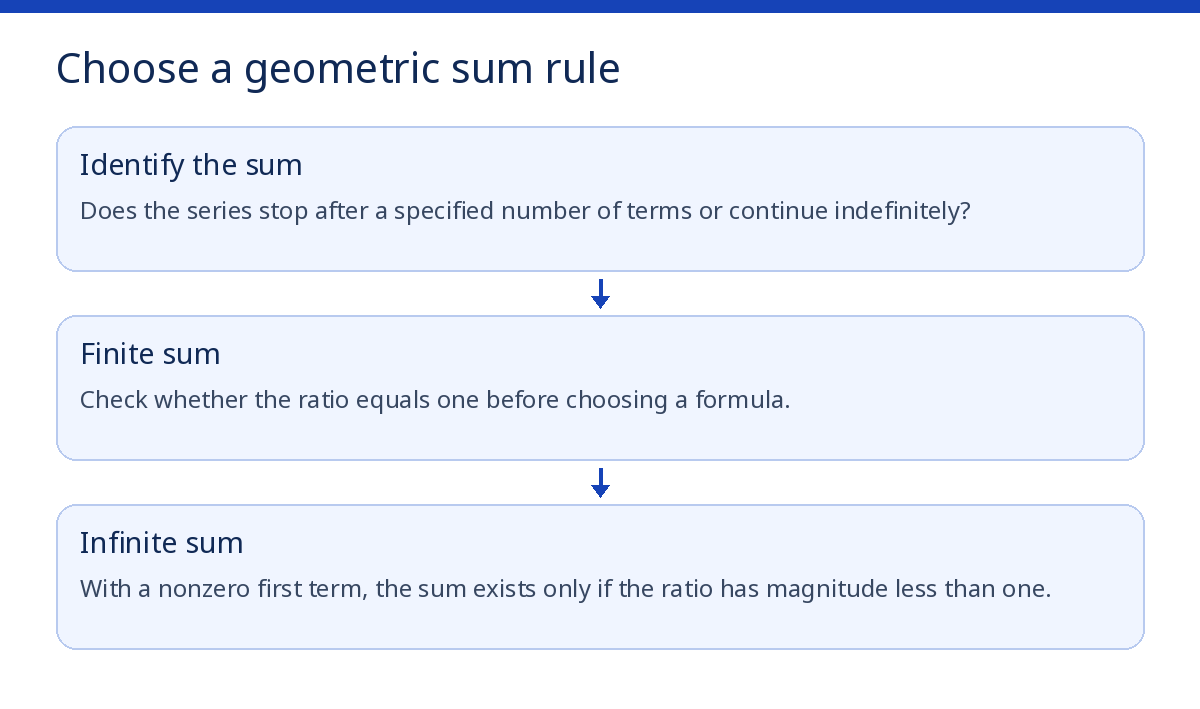
When the infinite GP formula applies
The fifth assessment is indexed under finite and infinite GP sums. A finite sum has a specified last term. For , the sum of the first terms is . If , every term equals , so the finite sum is instead. Substituting that ratio into the fraction would make its denominator zero.
An infinite sum asks whether the partial sums approach a limit as more terms are included. For a GP with nonzero first term, this happens only when , and the limit is . In that range, tends to zero even if the signs alternate. Check the magnitude of the ratio, not just whether it is less than one.
A useful connection: means preserve the pattern
The AP sums set includes inserting arithmetic means, and the sixth set is indexed under Geometric Mean and AM–GM. An arithmetic mean between two endpoints is their average and creates equal additive steps. If you insert terms between two endpoints, count steps, not : the final step reaches the second endpoint.
For positive endpoints and , their positive geometric mean is . It gives the same multiplicative factor from the first endpoint to the mean as from the mean to the second endpoint. AM–GM compares these two means for positive inputs: the arithmetic mean is at least the geometric mean, with equality precisely when the inputs are equal. The comparison is distinct from the task of inserting a term.
Use the clickable indexes to diagnose mistakes
The file has separate clickable indexes for questions and solutions. Start with the topic set that matches what you want to check. Objective and very short questions let you practise recognising notation and conditions; written questions give you room to show why a model or formula applies. After attempting a question, use its solution reference to compare the setup as well as the result.
The chapter practice brings the topics together and includes case-based questions. When you try that mixed set, name the quantity that changes, decide whether the change is additive or multiplicative, and identify what the question asks you to report. If the worked solution takes a different route, find the first difference in reasoning and use the topic index to revisit that skill.
Spotted an error? Report a correction. Practise this in the app: notes, formula sheets and mind maps.
Loading comments…