CBSE Class 11 Sequences and Series: Case-Based Assessment
CBSEMathematicsSequence and Series
This Class 11 CBSE Mathematics assessment uses four case studies to practise choosing between term and sum formulas, checking when a geometric series converges, and applying AM–GM. The linked solutions include accuracy notes for questions whose wording or notation can mislead.
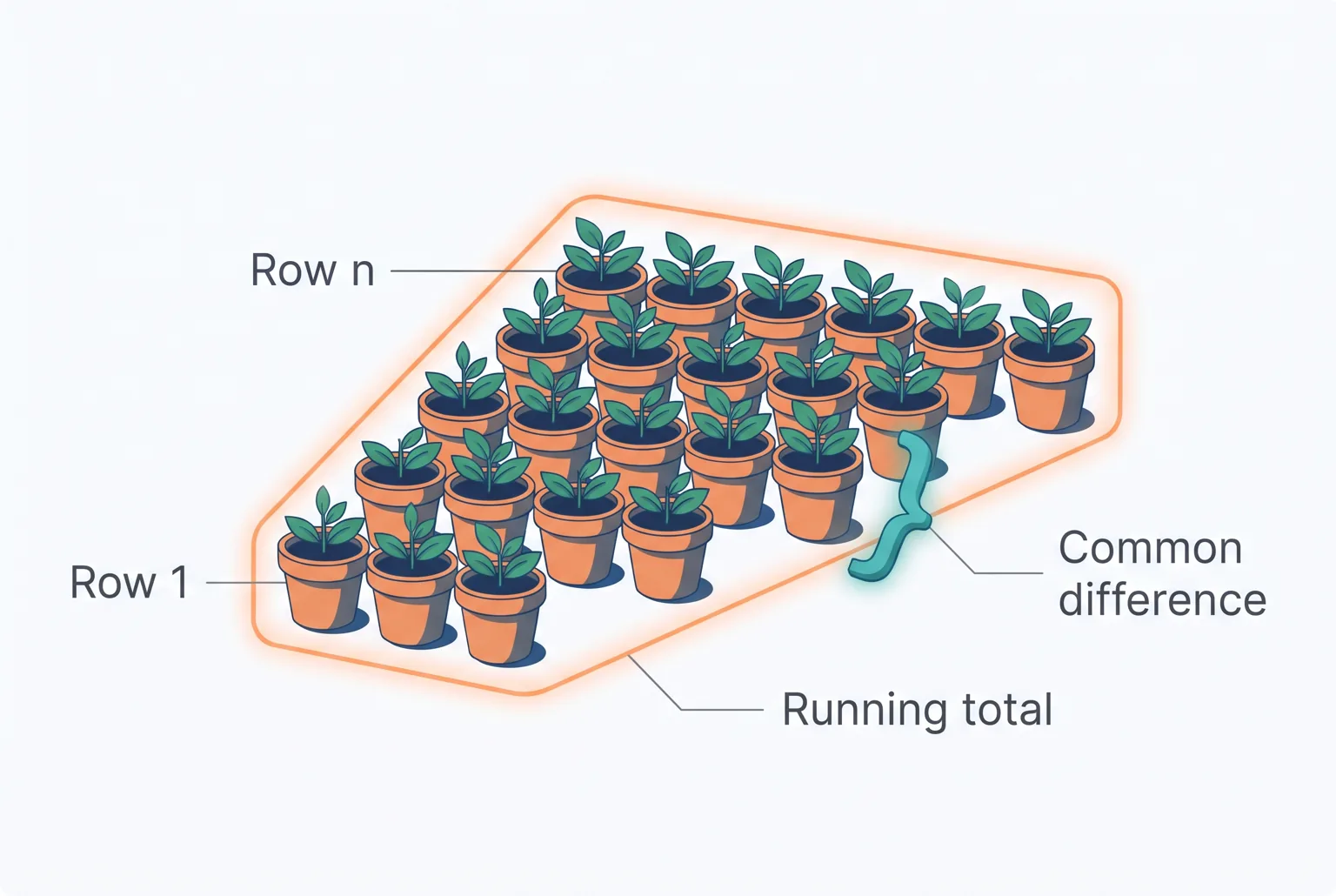
What the four case studies cover
The file contains four cases and 16 subparts, numbered as in the original material: 1, 2, 3 and 12. The first case starts with the arithmetic mean–geometric mean inequality, then moves through short-answer tasks on a product expression, minimum values and an infinite geometric progression. The nursery and daily-wage cases use multiple-choice questions to test how a stated pattern translates into terms and totals. The wages case also includes a separate assertion–reason item about three terms in a geometric progression.
The final case returns to short answers, with sums of natural numbers, squares and cubes, and a question on the geometric mean. This is a case-based assessment rather than a separate set of chapter drills. Use the prompts to practise identifying what each subpart asks for, even when several subparts refer to the same passage.
Sequence and Series | Class 11 | Case-based Assessment
In the StudentCurio app
Case-study questions and worked solutions cover arithmetic and geometric progressions, sums, and arithmetic and geometric means. Useful for Class 11 students practising CBSE-style sequence-and-series assessments.
One row, two rows or a running total?
The nursery and wage contexts both start with quantities that increase, but an increase alone does not identify the rule. In an arithmetic progression, consecutive terms have a constant difference. In the file’s definition of a geometric progression, the terms are nonzero and the ratio of each term to the preceding one is constant. Compare successive differences or successive ratios rather than relying on the first pair of values.
The nursery case asks for a count in one row, a difference between two row counts and a total across several rows. These are distinct requests. A term describes one position; subtracting two terms compares two positions; a partial sum includes every term from the first through the stated position. When the total is given and the number of rows is unknown, the total belongs in the sum equation. The row count is the unknown index, not the number of pots in the last row.
When the geometric sum formulas apply
For a geometric progression with first term and common ratio , the first terms have sum when . If , every term equals the first term, so the finite sum is . The exclusion in the fraction prevents division by zero; it does not mean a finite sum is unavailable.
An infinite geometric sum has a stricter condition. For the nonzero first term considered in the file, applies only if . In the first case, a second term and an infinite sum are supplied. Treat the second term as a term, not as a two-term sum, and check the convergence condition on any ratio obtained. This is a different decision from summing a fixed number of rows in the nursery.
A lower bound is not automatically a minimum
For positive real numbers and , the arithmetic mean is and the geometric mean is . AM–GM says that the arithmetic mean is at least the geometric mean, with equality exactly when the two numbers are equal. The case passage also gives the version for several positive numbers. Before applying the inequality, check positivity for the expressions being averaged, not merely for the variables that appear in them.
The minimum-value questions make the equality condition important. An inequality gives a lower bound; establishing a minimum also requires showing that the bound can be attained under the original constraints. In the product subpart, the wording asks for a value without fixing the variables or specifying that a minimum is wanted. The solution note distinguishes the bound established by the working from a unique numerical value, which the question as written does not determine.
Keep the special sums distinct
The final case distinguishes adding natural numbers from adding their squares or their cubes. In each sum, the power applies to the individual terms before addition. This is not the same operation as raising the completed natural-number sum to that power. The unpowered sum also gives a connection to arithmetic progression: its terms advance by a fixed difference, which is why the arithmetic sum formula applies to it.
Read the accuracy note before using the printed cube-sum expression as a revision formula. The passage prints an outer exponent of three on the natural-number sum, whereas the identity for the sum of cubes uses an outer exponent of two. The solution note explicitly separates what the printed definition gives from what the cube-sum identity gives.
Quick self-check before opening a solution
For the assertion–reason item, ask two separate questions: Is each statement true, and does the reason actually establish the assertion? If your argument equates ratios, check that the denominators are nonzero before cross-multiplying. If a square arises, test candidate signs against the original progression rather than discarding a sign by habit.
Use the clickable index to open a case and the individual solution link only after writing down what the subpart asks for and which rule applies. Compare that setup with the worked steps before checking your calculation. The return link takes you back to the prompt so you can try it again without the working in view.
Spotted an error? Report a correction. Practise this in the app: notes, formula sheets and mind maps.
Loading comments…