Probability: Class 11 CBSE Case-Based Questions and Key Ideas
CBSEMathematicsStatistics and Probability
This guide to the Class 11 CBSE case-based assessment on Probability (Chapter 14) explains the ideas its three cases test. It covers counting cards in an equally likely deck, the addition rule for mutually exclusive events, complements and neither–nor events, and sample spaces for coin, die and coloured-dice experiments.
Counting favourable cards in a 52-card deck
The first case draws one card from a well-shuffled deck of 52 and states that every outcome is equally likely. That sentence is what allows the classical formula used throughout the solutions:
The denominator is always 52, so each sub-part becomes a counting task. The deck has four suits of 13 cards each: hearts and diamonds are red, while clubs and spades are black. Face cards are the king, queen and jack. Every suit has one of each, so the face-card count is the number of suits multiplied by the cards per suit.
The five multiple-choice parts move in a clear order. They start with one whole suit, then a colour that combines two suits, then one specific card. Next comes a card fixed by two features, a rank and a colour, and finally a category that spreads across all suits. “A king of red colour” limits both rank and suit, so read each description carefully. Reduce each fraction before matching it to the options.
Probability Class 11 Maths| CBSE Case Based Assessment
In the StudentCurio app
This resource provides case-based assessment questions for CBSE Probability, featuring real-world scenarios like playing cards and surgery ratings with detailed step-by-step solutions.
Mutually exclusive ratings and the addition rule
The second case gives a table of surgery ratings at a hospital: very complex, complex, routine, simple and very simple, with probabilities 0.15, 0.20, 0.31, 0.26 and 0.08. The solutions name these to in that order.
Two facts make the table usable. The ratings are mutually exclusive, because a surgery receives only one rating. So for different ratings. They are also exhaustive, which you can check: the five probabilities add to exactly 1.
An “or” question asks for a union. The general addition rule is The solutions write the rule in full and then set the intersection to zero. Your answer should show the same step, because it explains why simple addition is allowed.
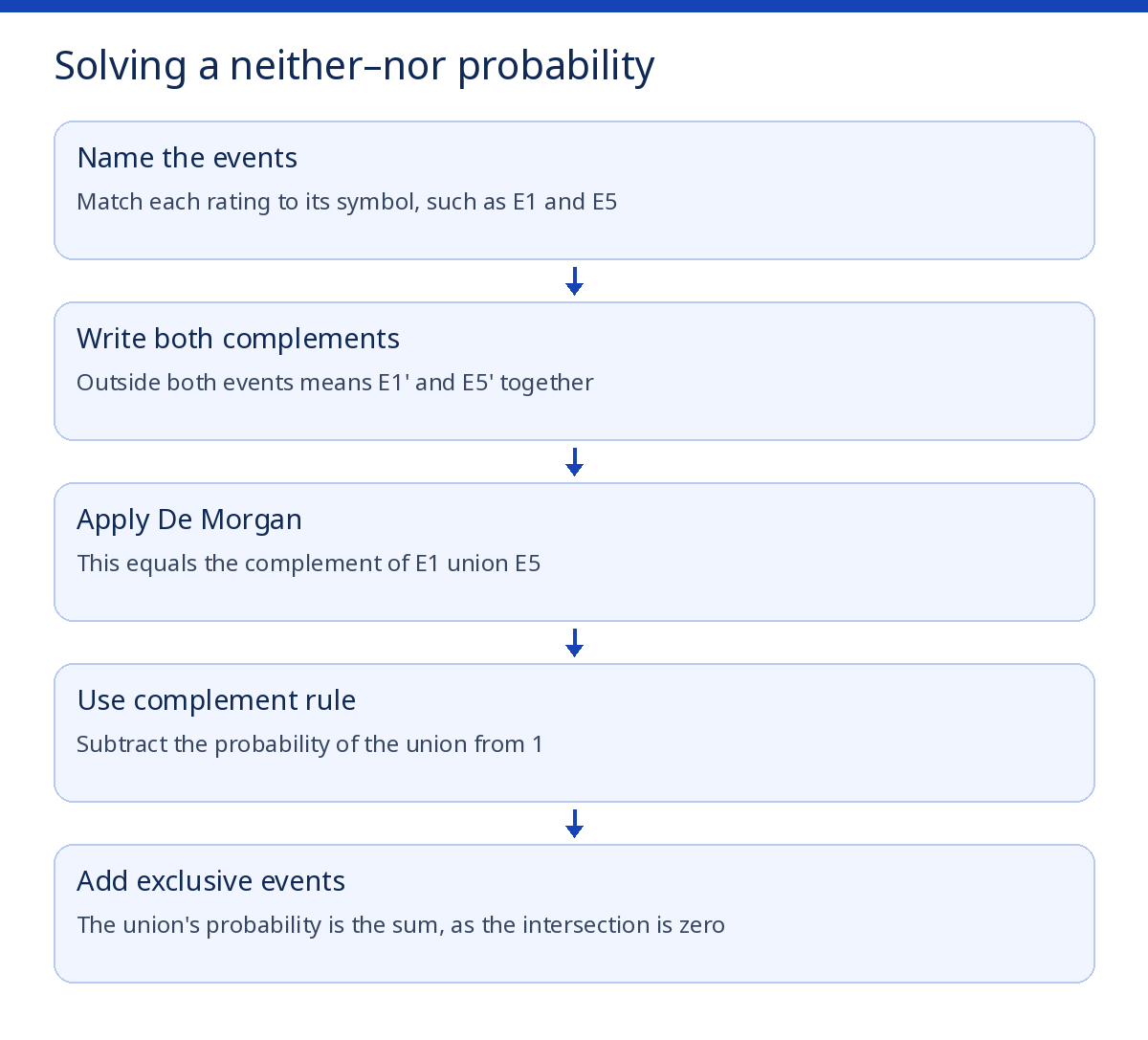
Turning a neither–nor condition into a complement
“Neither very complex nor very simple” means the surgery lies outside both events. In set notation this is , which by De Morgan's law equals . The complement rule then gives Because the ratings are mutually exclusive, .
You can also add the probabilities of the three remaining ratings, since the five ratings are exhaustive. Both routes must give the same result, so one checks the other.
The third sub-part tests the complement idea on its own. A separate event is given with , and you find using . This is not one of the surgery ratings.
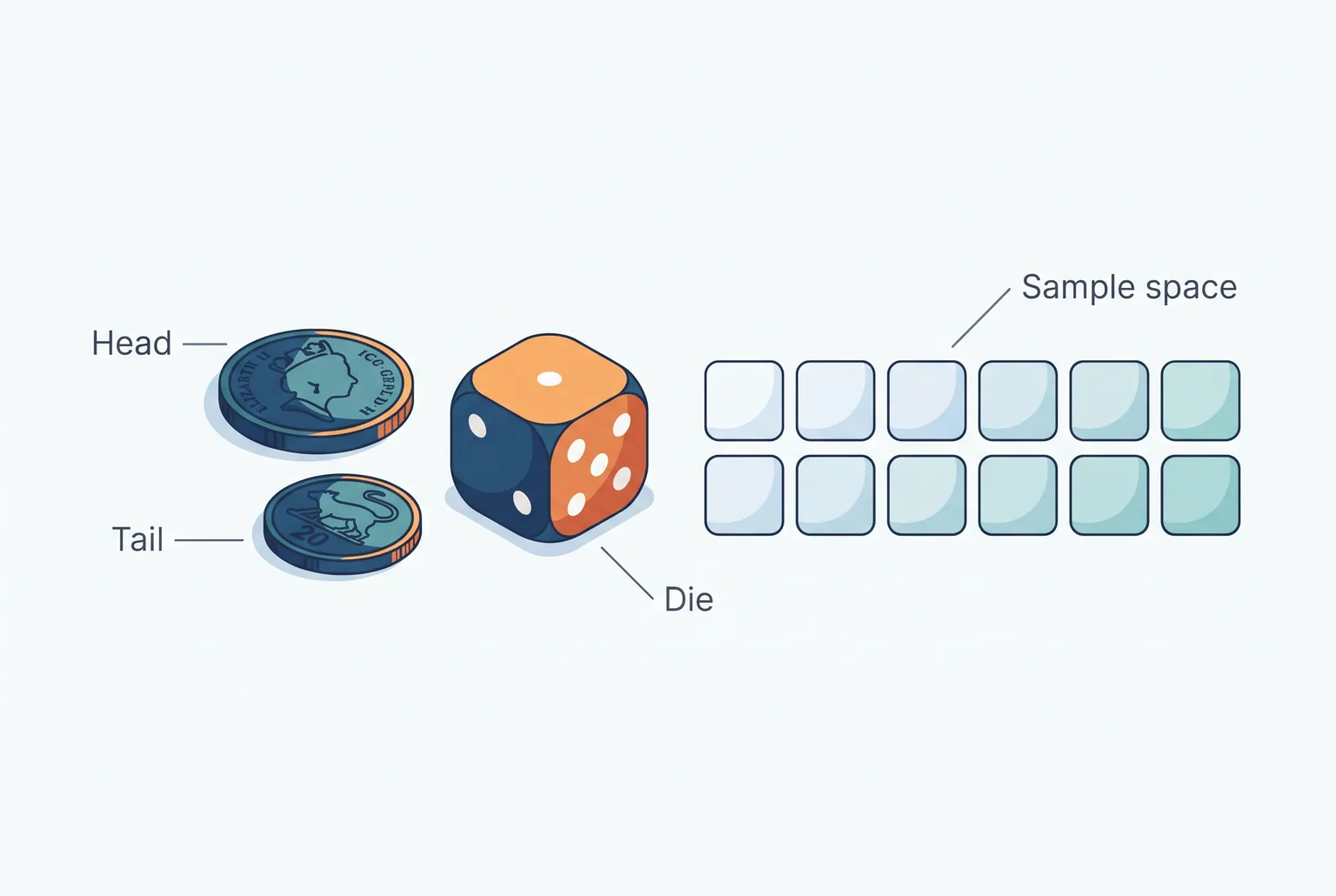
Listing a coin-and-die sample space before counting
The third case is set on Diwali night, when a family's Ludo game begins with the head of the family tossing a coin and throwing a die. Most of the passage is setting. The mathematics is a compound experiment.
The solutions use compact notation: H1 means a head on the coin and 1 on the die. Pair every coin face with every die face to list the sample space. Its size follows from the multiplication principle. After that, each probability is a count from the list. An event such as “head” or “odd number” selects the matching sample points. A joint condition such as “a head and an even number” needs both features in the same sample point.
The solutions add one caution. Treating these outcomes as equally likely assumes a fair coin, a fair die and independent results, and the question does not say this. State the assumption in your answer.
Writing ordered pairs for the coloured-dice bag
The last sub-part uses a different experiment. Red, white and blue dice are placed in a bag. One die is drawn at random and rolled, and both its colour and its uppermost number are recorded. Because two pieces of information are noted, each outcome is an ordered pair (colour, number), with R, W and B standing for the colours.
“Describe the sample space” asks for a full roster in set notation, not just a count. Work row by row: all six numbers for red, then for white, then for blue. This keeps outcomes from being skipped or repeated. Then state how many sample points the set contains. The solutions point out that the source phrase “total number of sample space” means the number of sample points. There is one sample space, and it contains many outcomes.
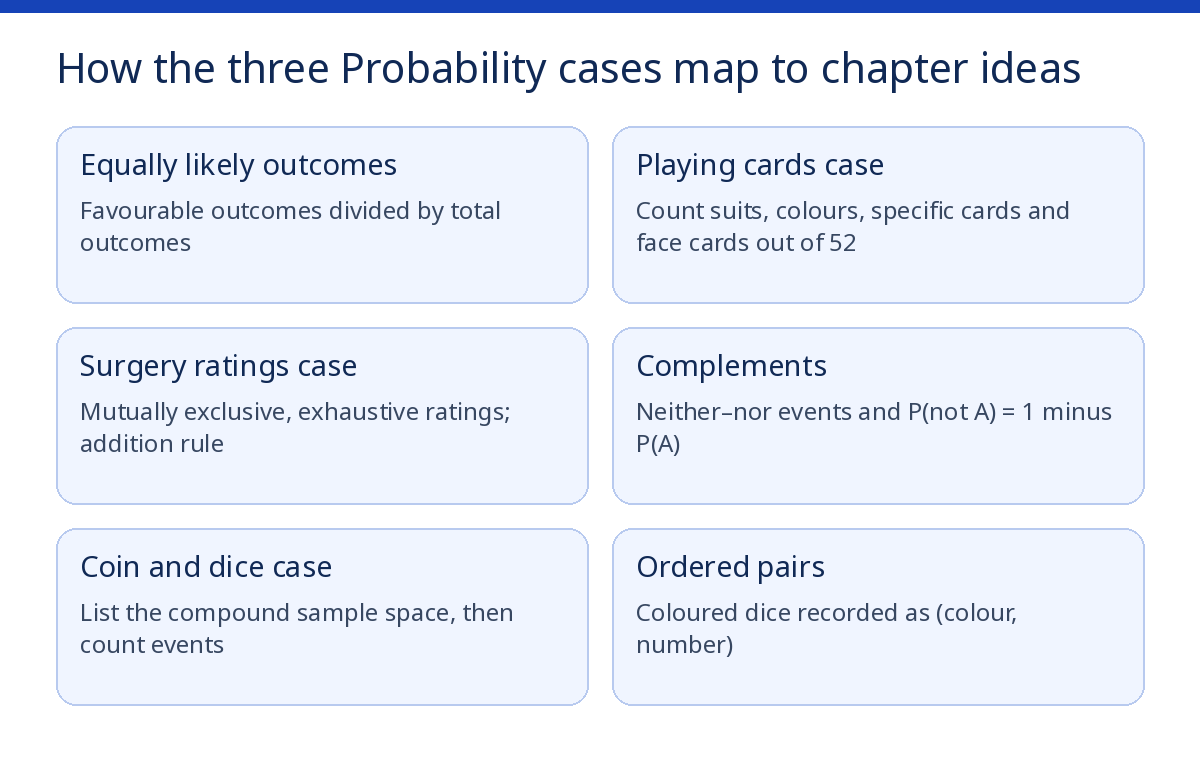
How the three probability cases are framed
Each case opens with a short passage that fixes the setting, and every sub-part reuses it. Case 1 has five multiple-choice parts. Cases 2 and 3 are short-answer, with three parts each, giving 11 sub-parts in total.
The solutions are on separate pages, linked from each question through a clickable index, and are set out as numbered steps. Attempt all three cases first. Write the sample space or rule you are using before any arithmetic, then compare your steps with the solution layout.
Common mistakes the solutions correct
- Wrong event label. The printed solution for the neither–nor part first writes . An accuracy note corrects the subscript to 5, because very simple is . Check that every symbol matches the rating it names.
- Unstated fairness. Counting coin-and-die outcomes as equally likely assumes a fair coin and a fair die, so state this.
- Unjustified addition. You can add the rating probabilities directly only because the ratings are mutually exclusive.
- Sample space versus its size. A description needs the listed outcomes, not just a number.
Quick self-check on events and sample spaces
- Why must the five surgery probabilities add to 1?
- Can you rewrite “neither nor ” as the complement of a union?
- Why should every coloured-dice outcome follow the same (colour, number) order?
- Which card descriptions combine two features, and how does that reduce the count?
Frequently asked questions
Which class and curriculum is this Probability assessment for?
It is a CBSE Class 11 Mathematics case-based assessment on Chapter 14, Probability. It has three case studies with 11 sub-parts in total.
Does the file include solutions?
Yes. Each sub-part links to a step-by-step solution, and accuracy notes flag a mislabelled event subscript and the unstated assumption of a fair coin and die.
Spotted an error? Report a correction. Practise this in the app: notes, formula sheets and mind maps.
Loading comments…