CBSE Class 11 Probability Assessment: A Practice Guide
CBSEMathematicsProbability
This CBSE Class 11 Mathematics assessment moves from describing events to assigning probabilities and calculating the chance that at least one event occurs. Its topic-wise sets, mixed chapter practice and linked worked solutions help you check how you set up a problem, not just whether you got the final number.
How the assessment is organised
The PDF divides Chapter 16, Probability, into three topic-wise assessments: Event and Algebra of Events, Axiomatic Approach to Probability, and Addition Rule of Probability. A separate chapter practice set brings the topics together. The index lists objective and written-response questions, including short and long answers. It places case-based questions in the chapter practice set.
Use the topic-wise sets when you know which skill needs work. For instance, if you can calculate a probability once the event is defined but struggle to translate phrases such as “at least one” or “but not”, start with event algebra. Use the chapter practice to see whether you can identify the right method without relying on the assessment heading to tell you which rule to use.
Probability | Class 11 | CBSE Assessment
In the StudentCurio app
This assessment covers sample spaces, event operations, complements, mutually exclusive and exhaustive events, and probability rules through objective, written-response, and case-based questions. Worked solutions help Class 11 students practise probability calculations and check their methods.
Describe the outcomes before counting them
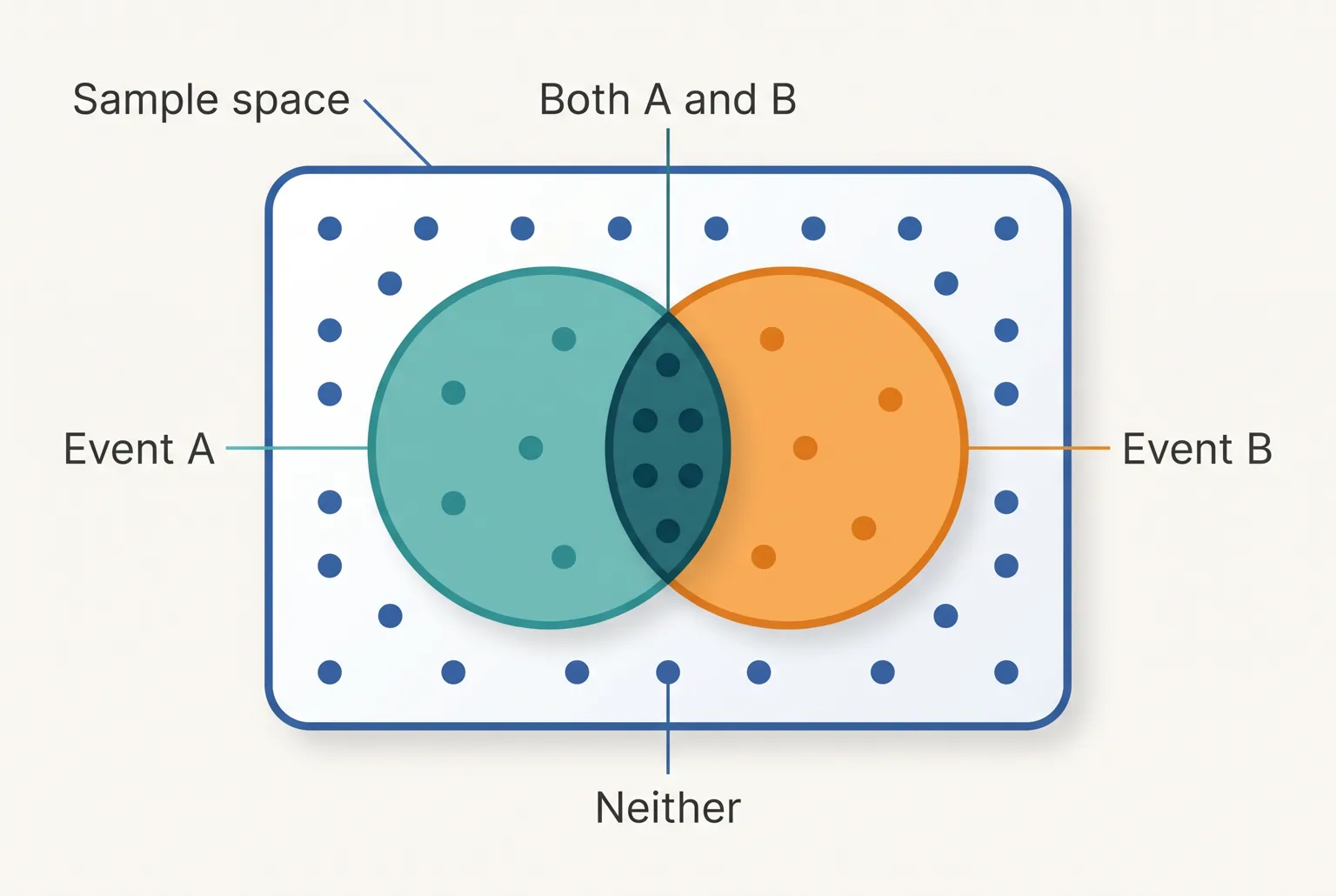
The first assessment uses coin tosses and dice rolls to practise writing a sample space, the set of all possible outcomes for the experiment as modelled. An event is a subset of that space. An elementary event contains one sample point; a compound event contains more than one. A description such as a particular dice total may name a single value while still representing several outcomes if the sample points record the individual dice results.
The operations tell you which outcomes belong in the event. The intersection contains outcomes satisfying both conditions. The union contains outcomes satisfying at least one, including those satisfying both. The difference keeps outcomes in that are not in . The complement contains every outcome in the chosen sample space that is not in . In a written response, make the experiment and its outcomes clear before applying any of these operations.
Common mistake: confusing overlap with coverage
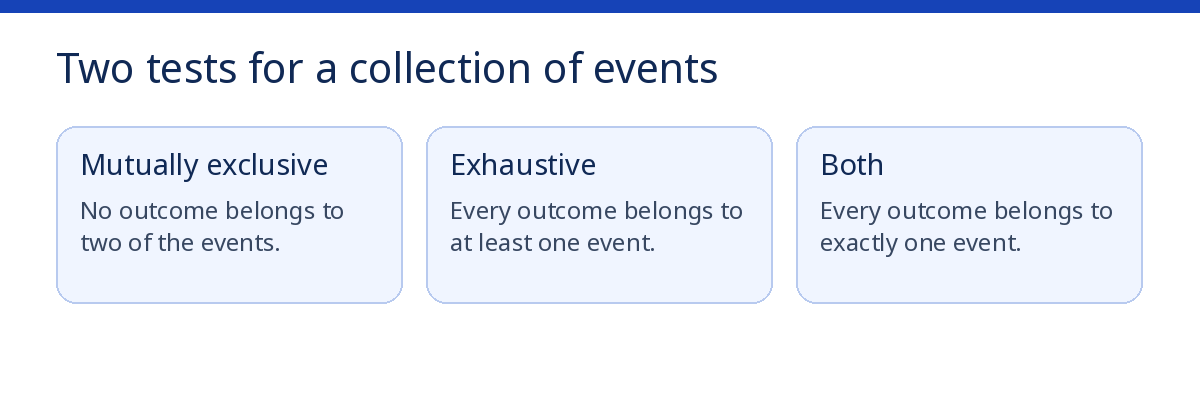
Mutually exclusive events cannot occur together: for two events, their intersection is empty. For a collection of events, check that every pair has an empty intersection. Exhaustive events together cover the whole sample space: check their union instead. These are separate tests. Events may have no overlap and still leave some outcomes uncovered; they may also cover the whole space while overlapping.
The classification questions in the first assessment are a chance to practise both tests explicitly. Ask whether any outcome belongs to two of the listed events, then ask whether any outcome belongs to none of them. When a collection is both mutually exclusive and exhaustive, each outcome belongs to exactly one event, so the event probabilities add to one.
When counting gives a probability
The second assessment asks you to check probability assignments as well as calculate probabilities. For a finite sample space, each elementary outcome must have a non-negative probability, and the probabilities of all elementary outcomes must total one. The probability of an event is the sum of the probabilities of the outcomes it contains. When checking an assignment, inspect the individual entries as well as their total: a total of one does not make a negative entry valid.
The familiar rule applies when the finite sample space has equally likely outcomes. The assessment includes a die with unequal outcome weights precisely where a count alone is not enough. In card draws, selections and arrangements, define what counts as one outcome before forming the ratio. If you count unordered selections for the favourable cases, count unordered selections for the total as well, and check that your model makes those selections equally likely.
Use the addition rule without counting the overlap twice
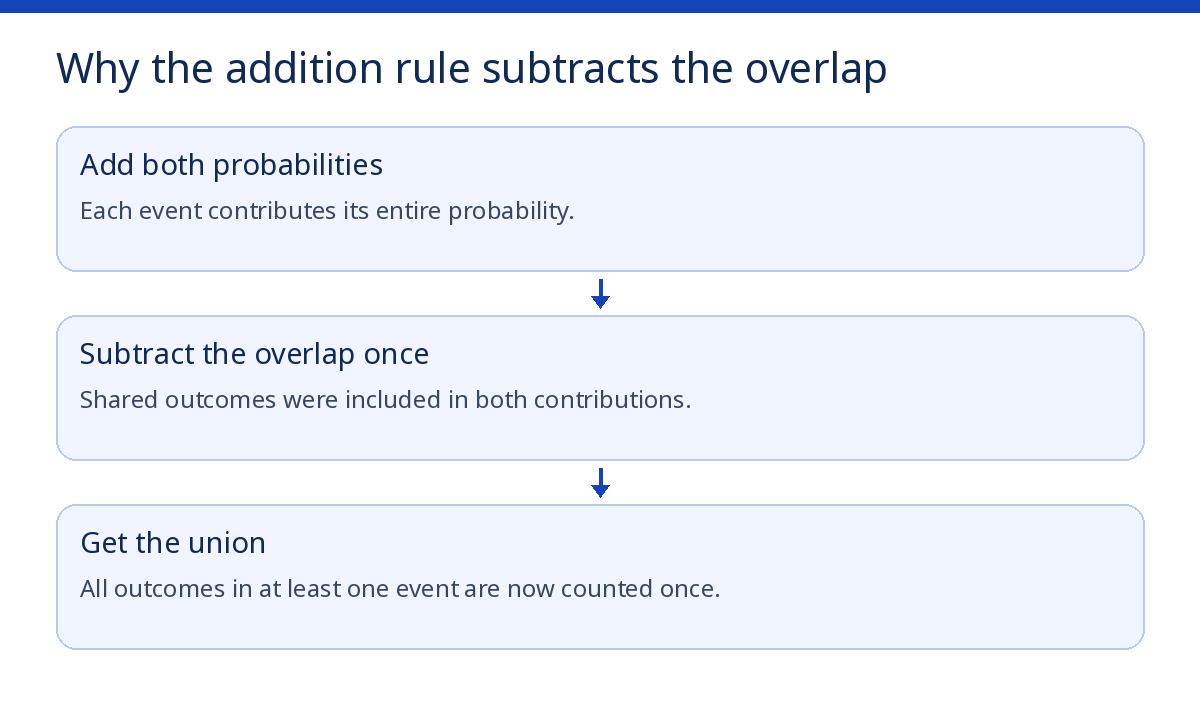
The third assessment develops the cover’s key rule: . Adding the two event probabilities counts the shared region twice, so subtracting its probability once leaves it counted exactly once. If the events are mutually exclusive, the overlap is empty and the rule reduces to the sum of the two probabilities. The general rule does not require equally likely outcomes.
Read the wording before deciding what to calculate. “Both” refers to the intersection; “at least one” refers to the union. “Neither” is the complement of the union, so its probability is . The assessment varies which of these quantities is given. If a question already gives the chance of at least one event and asks about both, the addition rule can be rearranged to find the overlap.
Check your setup with the linked solutions
The file has separate indexes for questions and solutions, and the question pages provide links to the corresponding worked answers. Since numbering restarts in each assessment and in chapter practice, note the section name as well as the question number when you mark an item to revisit.
Before opening a solution, write down the event you are finding and why your rule applies. Then compare your first few lines with the worked method. If the answers differ, check whether you used the same sample space, interpreted the event wording in the same way, or handled the overlap correctly before redoing the arithmetic. In a case-based question, identify which details define the experiment and which describe the event requested in each part.
Source note: This guide omits Assessment 2, Question 25, because its wording leaves the intended event unclear, and Assessment 3, Question 5, because two expressions appear identical in the supplied transcription.
Spotted an error? Report a correction. Practise this in the app: notes, formula sheets and mind maps.
Loading comments…