Permutations and Combinations: Class 11 NCERT Notes
CBSEMathematicsPermutations and Combinations
These CBSE Class 11 Mathematics notes take you from the basic counting rules and factorial notation to arrangements, selections and restrictions. Use the worked examples to practise deciding what counts as a different outcome before choosing a formula.

What Chapter 7 covers and where to start
The notes open with the fundamental principles of multiplication and addition, then introduce factorial notation. The clickable index leads from there to permutations, restricted permutations, combinations and practical problems. It also points to a chapter summary and a subsection on deciding whether a problem calls for a permutation or a combination.
If you can follow the arithmetic but struggle to set up a problem, start with the counting examples rather than the formula list. The opening pages show how to count successive choices, split outcomes into cases and exclude unwanted outcomes. These are the same decisions that make later arrangement and selection problems easier to set up.
Permutations and Combinations Class 11 | Maths Theory| Revision Notes
In the StudentCurio app
Comprehensive revision notes for CBSE Class 11 Mathematics, covering the fundamental principles of counting, factorial notation, and both permutations and combinations with detailed solved examples.
Multiply within a case, add across disjoint cases
Use the multiplication principle when a complete outcome requires several choices. If there are ways to make the first choice and exactly valid ways to make the second for each first choice, there are complete outcomes. The available options need not be identical after every first choice. In the notes’ door example, the entrance determines which exit is ruled out, but the number of possible exits stays the same.
Use the addition principle when you can divide the outcomes into mutually exclusive cases. The flag-signal example illustrates how both rules can apply in one problem: fill the positions for a fixed signal length, then combine the counts for different lengths. A signal belongs to only one length case. If two cases overlap, simply adding their counts counts the common outcomes twice; subtract the overlap when combining those two counts.
Factorials: expand only as far as you need
For a positive integer , the notation means the product of the integers from through . The notes define , so a factorial with argument zero is valid. A negative integer argument is not. Check the arguments in the original expression before keeping a value obtained by algebraic simplification.
The factorial examples show why it is usually unnecessary to calculate large factorials separately. In a quotient such as , expand the numerator only until the denominator appears as a factor, then cancel it. This quotient requires integer values with . In an expression involving subtraction, first factor out the shared factorial from the numerator rather than trying to cancel across a difference.
Common mix-up: reuse is not the same as identical objects
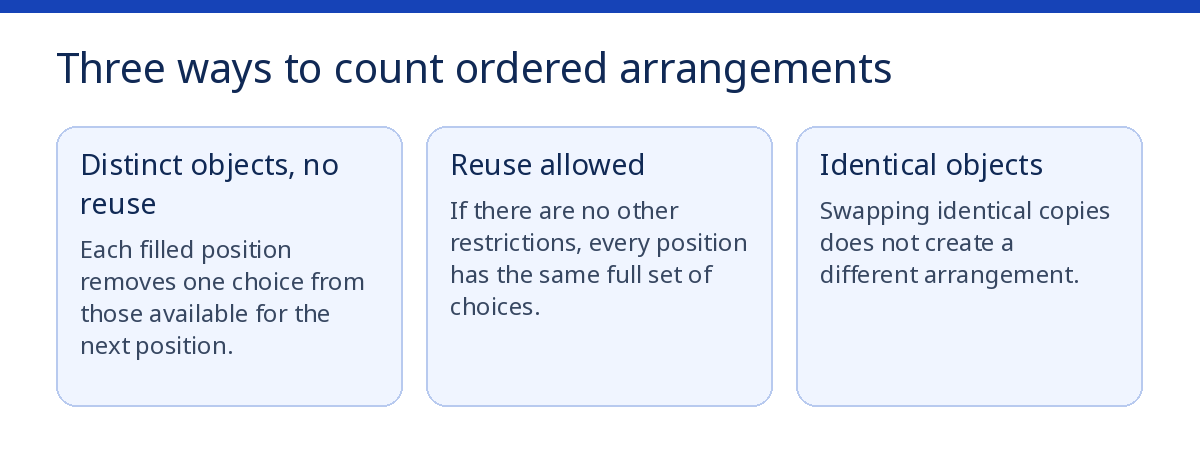
A permutation counts arrangements: changing which object occupies a position changes the outcome. With distinct objects and no reuse, the number of ways to fill ordered positions is for integers . Each filled position removes one option from the next position. If all choices are available at every position, the count is instead for positive integers and . The notes’ digit example compares these two setups directly.
The index separately lists arrangements in which not all objects are distinct. That is a different situation from allowing a choice to be reused. When two objects are identical, swapping them does not produce a new visible arrangement. Treating them as distinct would count the same arrangement more than once.
Let the restriction determine where you start
In a restricted permutation, some otherwise possible arrangements are not allowed. The index includes restrictions both for distinct objects and for objects that are not all distinct. In the earlier digit examples, conditions on a number can determine the first or last position. A leading zero is not allowed when forming a number with a specified number of digits, even though zero may be allowed in another position.
When reviewing a worked example, identify the position with the tightest condition before reading the order in which the notes fill the positions. If fixing that position leaves different numbers of choices in different cases, count the cases separately. Another approach shown in the opening examples is to count all outcomes and subtract the unwanted ones, provided both counts use the same underlying set of possibilities.
A useful connection: select first, then arrange
A combination counts selections, not the order in which the selected objects appear. For distinct objects and an unordered selection of objects without reuse, for integers . The link with permutations explains the extra factorial in the denominator: each selection of distinct objects gives ordered arrangements. If the order does not matter, all those arrangements represent the same selection.
The practical-problems index distinguishes direct formula use from selections with required or excluded objects, selections from different groups, geometry applications and problems involving both permutations and combinations. For a problem that involves both, ask which part determines the membership of the selection and which part assigns positions. That distinction is more reliable than deciding from a single word such as ‘choose’.
Quick self-check before using the chapter summary
Pick a worked example and cover its calculation. State what one complete outcome looks like, then ask whether swapping two different chosen objects produces a new outcome or just another description of the same one. For a problem with cases, check whether every valid outcome belongs to exactly one case before adding the case totals.
Compare your setup with the worked steps before checking the arithmetic. If the setups differ, use the clickable index to return to the relevant distinction. Once you can explain why the method applies, use the chapter summary to review the notation.
Spotted an error? Report a correction. Practise this in the app: notes, formula sheets and mind maps.














Loading comments…