Class 11 Maths Guide to Case-Based Permutations and Combinations
CBSEMathematicsPermutations and Combinations
Master the practical application of counting principles through four detailed case studies involving survey teams, book arrangements, hotel room allocations, and playing cards.
Understanding the Case-Based Assessment Format
The CBSE Class 11 Mathematics curriculum places significant emphasis on moving beyond rote formula memorization toward the practical application of mathematical concepts. This Permutations and Combinations resource from StudentCurio is specifically designed to bridge this gap. By presenting four distinct scenarios—or case studies—the material requires learners to analyze real-world constraints and determine whether a situation calls for a permutation (where order matters) or a combination (where the selection is unordered).
With 16 subparts and step-by-step solutions, the resource covers the essential range of Chapter 6. It starts with simple seating arrangements and progresses to complex multi-stage room allocations and card deck subsets. Each case study serves as a diagnostic tool: if a student can correctly identify the 'unit' or 'block' in a problem, they have grasped the fundamental logic of counting. This guide breaks down the core concepts found in these assessments to help students navigate these higher-order thinking questions effectively.
Permutations and Combinations Class 11 | Maths| CBSE Case Based Assessment
In the StudentCurio app
This resource features case-based assessment questions with detailed solutions for Class 11 Mathematics, focusing on practical applications of permutations and combinations.
Restricted Seating and the Multiplication Principle
The first case study focuses on a survey team consisting of 5 men and 4 women. A primary challenge here involves seating these 9 individuals in a row such that women occupy only the even-numbered positions. To solve this, learners must apply the multiplication principle across two independent tasks. First, the 4 even positions must be filled by the 4 women, which can be done in ways. Second, the remaining 5 odd positions must be filled by the 5 men in ways.
This scenario illustrates a critical rule: when a task is composed of multiple independent parts that must all occur, we multiply the number of ways for each part. The resource calculates the final count as . Learners should also note the distinction in 1(C) regarding choosing a captain and a vice-captain. Since the roles are distinct, a captain-student A and vice-captain-student B is a different outcome from vice-captain-student A and captain-student B. Therefore, permutations () are used rather than combinations.
Selection vs Arrangement in Book Organization
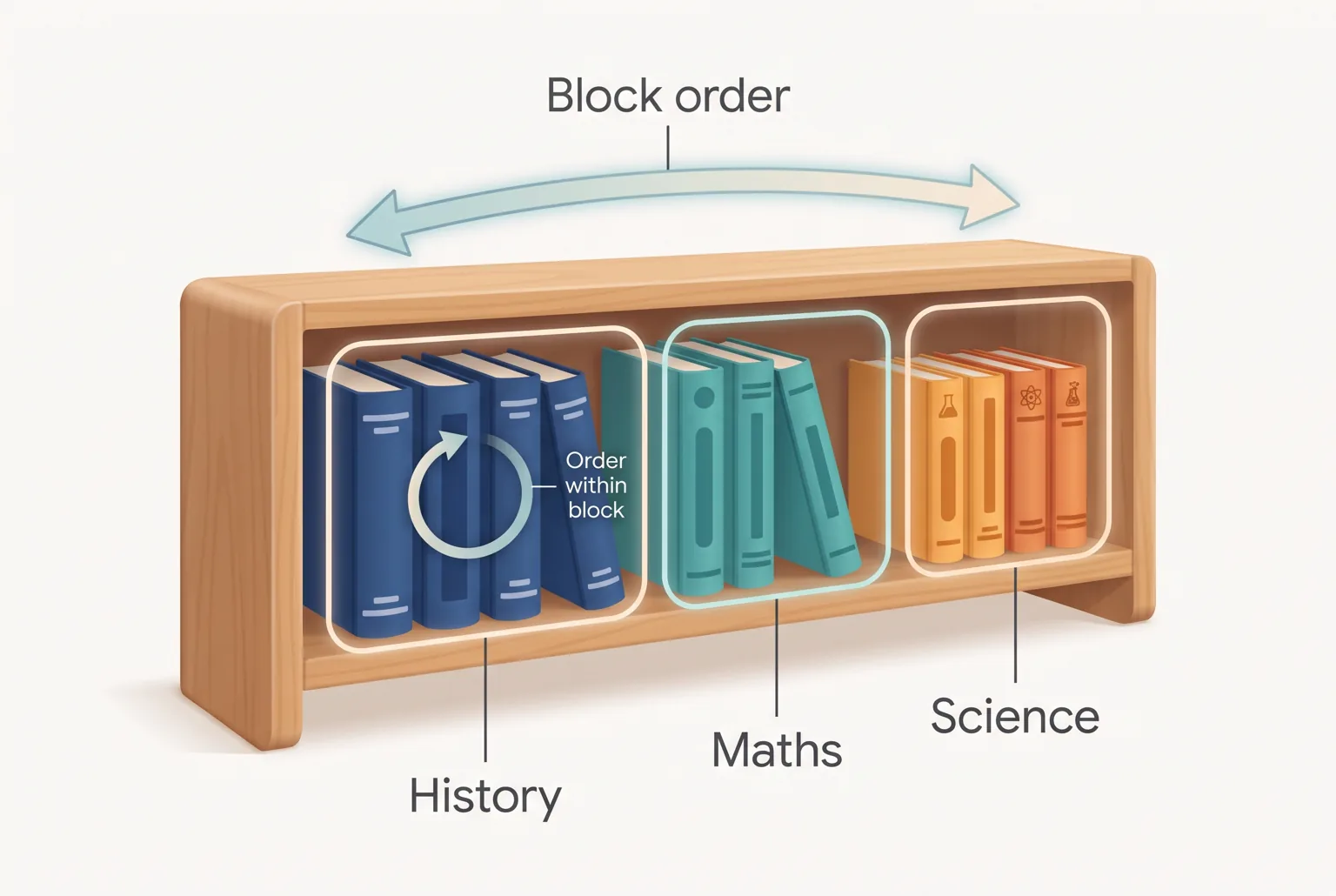
Case Study 2 involves arranging History, Mathematics, and Science books on a shelf. This section highlights a common area of confusion for Class 11 students: the difference between selecting items and arranging them. In subpart 2(A), selecting one History 'or' one Mathematics book uses the addition principle (). However, when multiple subjects are involved, as in 2(B), the 'and' condition triggers the multiplication principle.
A key technique demonstrated here is the 'Block Method' or 'Unit Method.' When the problem specifies that all books of the same subject must stay together, we treat each subject group as a single entity. For three subjects, there are ways to arrange the blocks themselves. Then, internal arrangements must be calculated ( for History, for Maths, etc.). The final answer is the product of the block arrangements and all internal arrangements. This case study demonstrates that internal ordering within a group is just as vital as the external ordering of the groups.
Sequential Logic in Room Allocation
The 'Hotel Rooms' scenario in Case Study 3 introduces the concept of decreasing availability. When Riya and her 5 friends (6 people total) occupy rooms with different capacities, the order of selection matters for the pool of remaining people. For instance, when filling Room A (a double room), we choose 2 people from 6 using .
Once those two people are 'spent,' the pool for the next room shrinks. Room B would then be filled by choosing 2 people from the remaining 4 (). This sequential selection logic—where the denominator or total available 'n' changes at each step—is a frequent feature of CBSE case-based questions. The resource correctly calculates the total ways to fill four rooms (A, B, C, and D) by multiplying the combinations for each subsequent room: . It teaches students to track the 'available pool' after every decision.
Counting Subsets in a Standard Deck of Cards
Case Study 4 applies combinatorics to a standard deck of 52 cards, focusing on suits and face cards. To solve these, a student must first know the composition of the deck: 4 suits of 13 cards each, and 12 face cards in total. When selecting 4 cards of the 'same suit,' there are four mutually exclusive cases (all Hearts, all Diamonds, etc.). Because these are 'either/or' scenarios, we use addition: .
Conversely, selecting one card from 'each' suit is a simultaneous requirement, leading to (or ). The resource also clarifies how to handle specific subsets like face cards. Since there are only 12 face cards, selecting 4 from that specific group is simply . This helps learners practice isolating the relevant 'n' from a larger set (the 52-card deck) based on the restrictions provided in the problem text.
Algebraic Permutations and Repeated Digits
Beyond situational logic, the resource covers the algebraic manipulation of permutation formulas and digit-based counting. In problem 1(B), students are asked to solve a ratio involving and . This requires expanding factorials and simplifying terms. A vital lesson here is the domain of 'n': in the context of permutations, 'n' must be a positive integer. When a quadratic equation yields both and , the negative fractional root must be rejected.
Finally, subpart 3(E) explores the multiplication principle with repetition allowed. When forming a 10-digit number using only the digits 1 and 2, each of the ten positions has exactly 2 choices. This results in total possibilities. This type of problem serves as a bridge to understanding binary systems and powers in combinatorics, moving away from the decreasing 'n' seen in the room allocation problems.
Frequently asked questions
What is the difference between Case Study 2(B) and 2(D)?
2(B) asks for an unordered selection of books using combinations (), whereas 2(D) uses a product of permutations (). Permutations are used when the specific order or 'role' of each book within its subject group matters, while combinations are used for simple, unordered selection.
Why is n = -3/7 rejected in the permutation ratio problem?
In the permutation formula , 'n' represents the total number of distinct items available, which must be a non-negative integer. A negative fraction cannot represent a count of items, so it is mathematically invalid in this context.
How does the 'Block Method' change the calculation for arrangements?
The Block Method treats a group of items that must stay together as one single unit. You first arrange the units among themselves, and then multiply by the internal arrangements of the items within each unit.
Spotted an error? Report a correction. Practise this in the app: notes, formula sheets and mind maps.
Loading comments…