CBSE Class 11 Permutations and Combinations Assessment
CBSEMathematicsPermutations and Combinations
This Class 11 CBSE Mathematics assessment file contains six topic-wise sets, mixed chapter practice and indexed worked solutions. Use it to practise deciding what counts as a distinct outcome before choosing a counting rule or formula.
What the assessment covers
The file is organised around Chapter 7, Permutations and Combinations. The six assessments move from fundamental counting principles and factorial notation to permutations, restricted permutations, combinations and applications of combinations. That sequence lets you separate two skills: working with counting expressions and deciding which expression describes a situation.
The topic-wise sets use objective and written questions, with the latter divided into very short, short and, in some sets, long answers. The chapter practice adds case-based questions. The clickable index has separate pages for questions and solutions, so you can go straight to a topic without seeing the corresponding working. When looking up a solution, use both the assessment name and the question number, since numbering starts again in each assessment.
Permutations and Combinations | Class 11 | CBSE Assessment
In the StudentCurio app
Six topic-wise assessments and chapter practice cover counting principles, factorials, permutations, restricted arrangements, combinations and their applications, with objective, written and case-based questions and worked solutions. Useful for Class 11 students practising a broad range of CBSE permutations and combinations problems.
Count stages and cases before reaching for a formula
The first assessment uses choices such as clothing, travel and digits to test the multiplication principle. Multiply when a complete outcome requires a choice at each stage and the number of available choices at each stage is fixed across the earlier choices. The actual options can change: without repetition, the objects still available depend on what you picked, even though their number may be the same.
Use addition when the outcomes fall into disjoint cases, such as numbers of different lengths. If a prompt permits one condition, another condition, or both, the cases may overlap. Adding their counts directly then counts the shared outcomes twice. A useful first line in a written answer is to name the stages you are combining or the cases you are separating.
Factorials shorten products, not sums
The factorial assessment includes evaluations, equations, product conversions and proofs. A factorial is a product of consecutive positive integers down to one, with . The useful algebraic move is to expand the larger factorial only as far as the smaller one, then cancel the common factor. For example, for integers . This is often more informative than calculating the factorials in full.
Keep the distinction between a factor and a term: matching factorials can be cancelled as common factors in a quotient, but not across addition unless you first factor the entire sum. When an equation contains a factorial with a variable argument, also check that the argument is a non-negative integer before accepting a candidate value.
Quick self-check: Would swapping the choices matter?
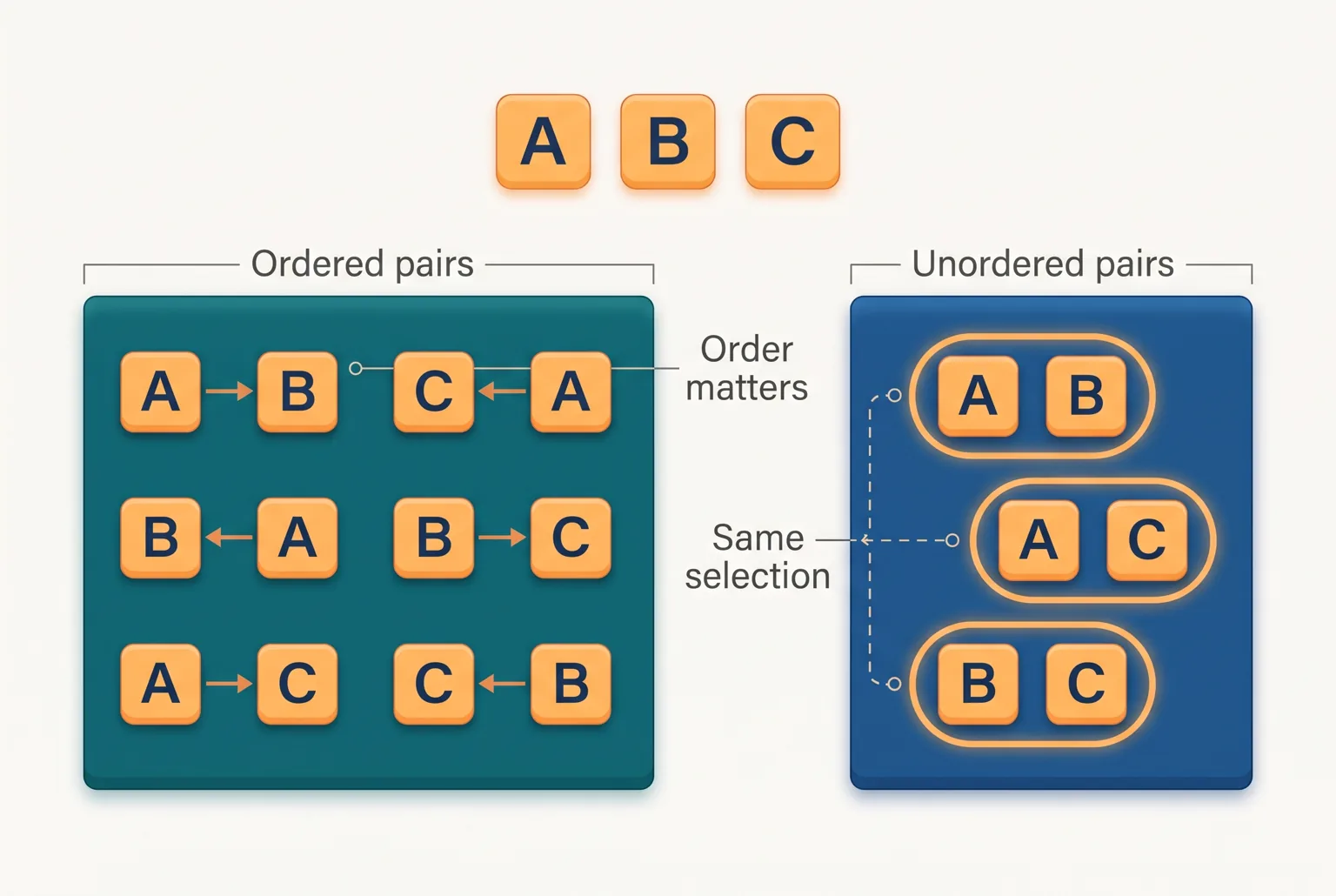
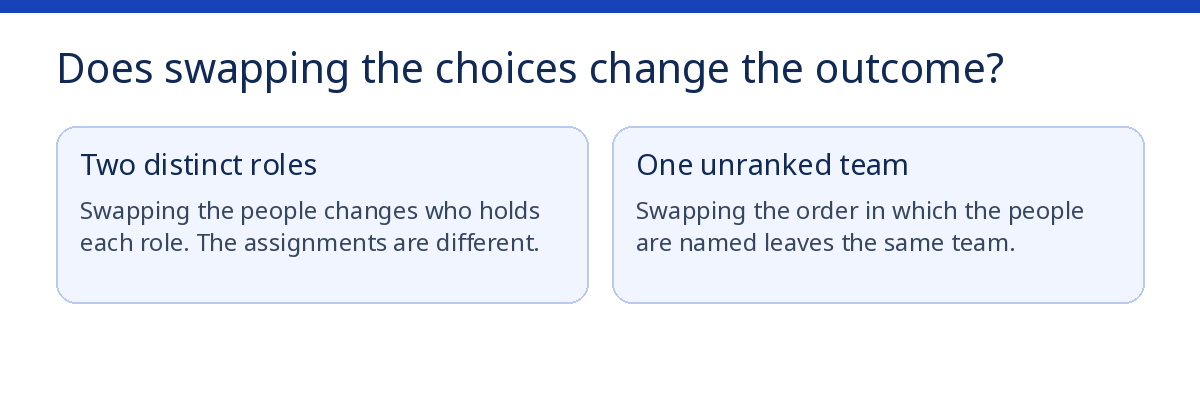
The cover contrasts ordered pairs with unordered pairs drawn from the same letters. Ask the same question in context: if two chosen people exchange roles, does the result change? Distinct offices make the assignments different; membership of an unranked team does not. The word choose alone does not tell you which count to use.
For ordered positions filled from distinct objects without reuse, use , where and are integers with . If reuse is allowed and every position has the same choices with no further restriction, the count is for positive integers and . Before using either formula, check whether the prompt imposes a condition on a particular position.
Restriction checks: Blocks, gaps and repeated objects
The restricted-permutations set includes arrangements with fixed positions, objects that must stay together and objects that must stay apart. When a specified group has to stay together, treat it as one block for the outer arrangement, then account for distinct orders inside it. A separation rule can instead suggest gaps: if no two members of a group may be adjacent, place at most one of them in each eligible gap between or at the ends of the other objects.
Do not confuse allowing reuse with having indistinguishable copies in a fixed collection. Swapping identical copies creates no new arrangement. Also check what the positions represent: a code may explicitly permit zero at the start, whereas a multi-digit number cannot begin with zero.
From combination identities to selections by category
A combination counts a selection of objects from distinct objects without reuse and without regard to order. For integers , the count is . The division by removes the distinct orders of each selected group. Another way to interpret the notation is through symmetry: choosing the members to include also determines exactly which members to leave out, so .
The applications assessment opens with a selection from two colour categories. For fixed quotas from disjoint groups, count the selections within each group and multiply when every selection from one group can be paired with every selection from the other. Each factor counts a group selection, not an ordering of its members.
Use the worked solutions to find your first wrong step
Use a topic-wise set to isolate a skill, then switch to chapter practice to see whether you recognise the same idea without a narrow topic heading. On an objective question, write the counting setup before comparing options. On a longer or case-based question, identify the outcome and the restrictions for each part before doing the arithmetic.
When checking the worked solution, compare the setup before comparing the final result. If your work diverges, look for the first point where you counted a different outcome, allowed a forbidden choice or counted the same arrangement twice. Then return to the question and rewrite that step without the solution open.
Spotted an error? Report a correction. Practise this in the app: notes, formula sheets and mind maps.
Loading comments…