Linear Inequalities: CBSE Class 11 NCERT Notes Guide
CBSEMathematicsComplex Numbers and Quadratic Equations
The supplied CBSE Class 11 Mathematics notes cover Linear Inequalities, not Complex Numbers and Quadratic Equations. Use this guide to connect the algebraic rules with number-line diagrams, solution sets and constraints in word problems.
What this Chapter 6 file covers
The notes begin with inequality symbols and first-degree expressions, then develop methods for solving inequalities in one variable. They move from single inequalities to systems and list applications before the chapter summary. The clickable index lets you go directly to an interval definition, a worked example or the section on systems, depending on where you need help.
The opening pages distinguish one-variable and two-variable linear inequalities. In both, the variables occur only to the first degree, with no products of variables. The distinction matters when you interpret a solution: in one variable it is a number, whereas in two variables it is an ordered pair. The number-line method developed in the supplied pages is for one variable; the introduction of two-variable expressions is not a lesson on graphing regions in the coordinate plane.
Linear Inequalities Class 11 | Maths Theory| Revision Notes
In the StudentCurio app
Comprehensive notes covering linear inequalities in one and two variables, including modulus functions, intervals on number lines, and real-world application problems.
Common mistake: Reversing the sign at the wrong step
The notes' algebraic method is to collect variable terms on one side and constants on the other, then isolate the variable. Adding or subtracting the same quantity on both sides preserves the direction of the inequality. Multiplying or dividing both sides by the same positive number also preserves it. Multiplying or dividing by the same negative number reverses it. Division by zero is never allowed.
A negative term appearing in a line of working is not itself a reason to reverse the sign. What matters is the operation you perform on both sides. This distinction is useful when reading the worked examples with constant denominators: multiplying through by a positive common multiple keeps the direction unchanged, even if some numerators contain negative terms. Later, dividing by a negative coefficient to isolate the variable does reverse the direction.
Read each endpoint before shading the number line
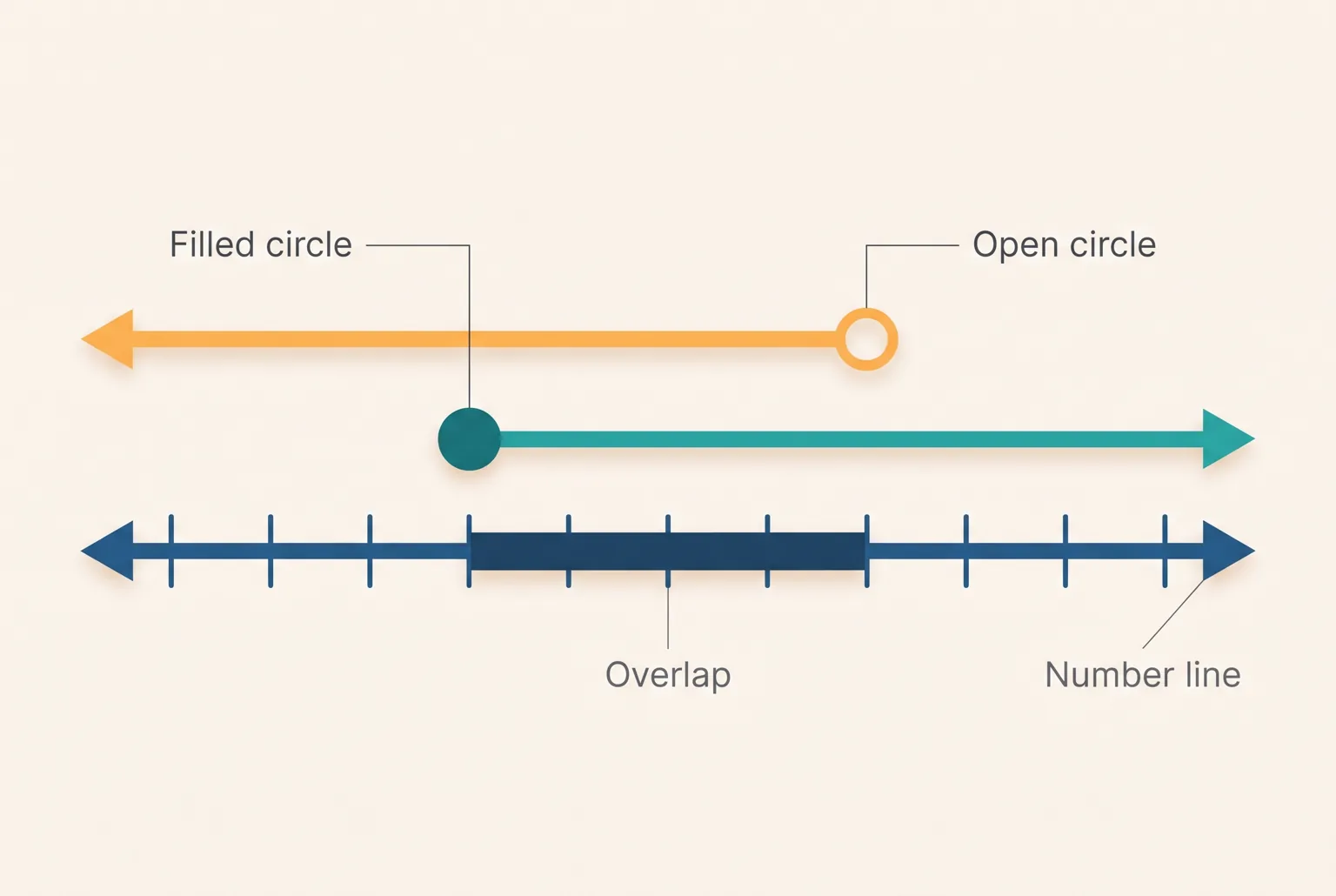
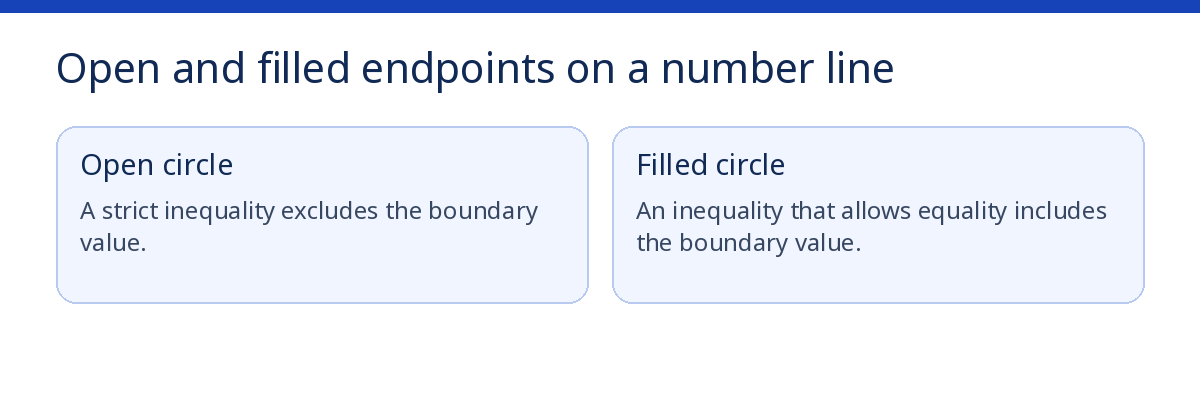
A strict inequality uses or , so the boundary value does not satisfy it. Draw an open circle at the boundary. With or , equality is allowed, so draw a filled circle. Once the variable is isolated on the left, shade left for values less than the boundary and right for values greater than it. The direction of shading tells you which values to take; the circle tells you whether to take the boundary itself.
The interval section expresses the same information with brackets and parentheses. For real endpoints , the closed interval includes both endpoints, the open interval includes neither, and a semi-open interval includes just one. An unbounded interval uses a parenthesis at infinity because infinity is not a real endpoint that can be included.
Quick self-check: Which values are allowed?
A solution is a value that makes the original inequality true. The solution set contains all such values in the stated domain. The notes compare natural-number, whole-number, integer and real-number domains. The simplified inequality can stay the same across those cases, but the set you report changes. An interval describes all real values between its bounds; if the problem specifies integers, only the integer points in that range belong to the solution set.
Before comparing your work with a worked example, ask two separate questions: Does the boundary satisfy the inequality, and is it even a member of the stated domain? Keeping those checks separate helps you see whether an unexpected result came from the algebra, the endpoint notation or the domain restriction.
Combine bounds by taking their intersection
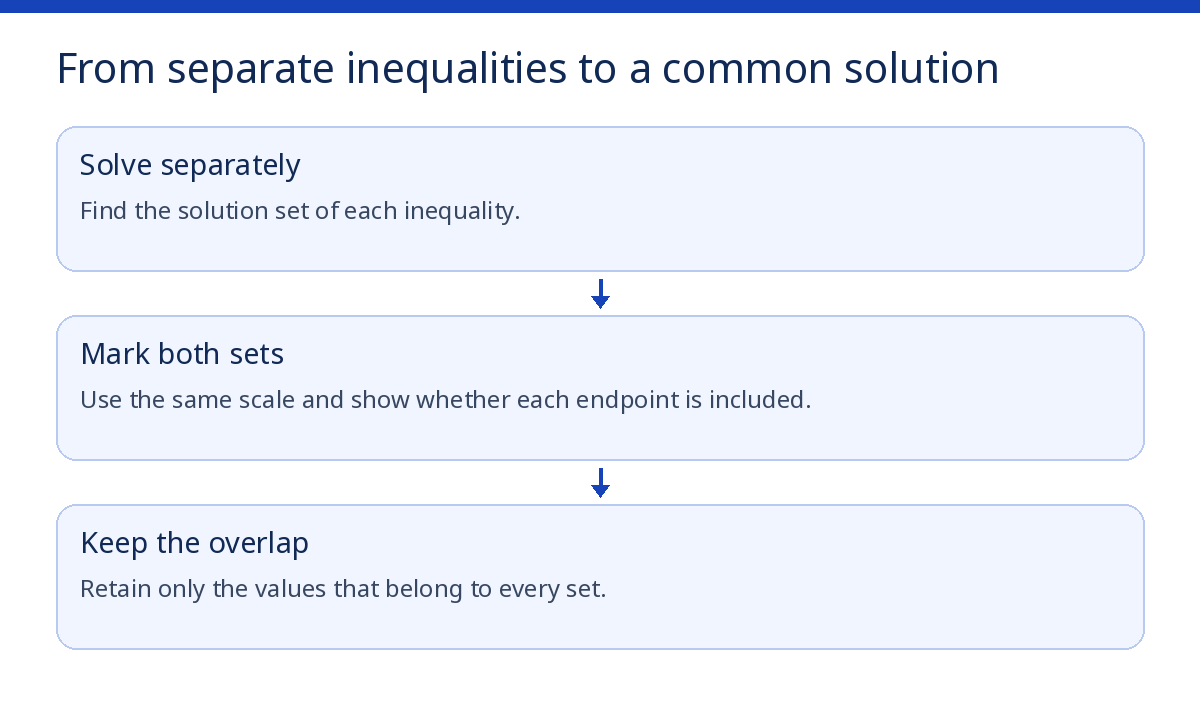
A system asks which values satisfy every inequality. The notes solve separate inequalities first and then compare their solution sets on a number line. Retain only the overlap, not every point shaded at least once. An endpoint belongs to the overlap only if every condition allows it. Two sets can share exactly one endpoint, and if they share no points at all, the system has an empty solution set.
A chained inequality puts two conditions on the same middle expression. You can read the conditions separately and intersect their solution sets, or apply the same operation to all three parts of the chain. If you multiply or divide all three parts by a negative number, reverse both inequality signs. When rewriting the chain with the smaller bound first, keep track of which bound is strict and which, if either, allows equality.
When a denominator or modulus needs its own check
The index also lists inequalities with variable denominators and with modulus expressions. These forms need checks beyond the routine for a single linear inequality. A variable denominator must not be zero, and its sign may vary with the value of the variable. Unlike a positive constant denominator, it cannot be cleared using one fixed inequality direction unless its sign is known on the part of the domain you are considering.
For modulus, the listed comparison with a positive constant has a useful distance interpretation. An absolute value less than that constant means the expression inside lies between the negative and positive bounds. An absolute value greater than the constant means the expression lies outside those bounds. Whether the boundary values belong depends on whether the comparison allows equality.
Translate the wording before solving an application
The applications index lists marks, number problems, profit and cost, temperature, geometry and dilution. Start by naming the unknown and translating each condition: at least permits equality and sets a lower bound; at most permits equality and sets an upper bound. A requirement to be strictly above or below a threshold excludes that threshold.
After solving, return to the meaning of the variable. If it counts objects, a real interval describes the algebraic bounds, but only permitted whole-number counts can answer the question. When revising from a worked example, compare your translation with the notes before comparing your algebra. That way, you can distinguish a misread condition from a calculation error.
Spotted an error? Report a correction. Practise this in the app: notes, formula sheets and mind maps.
Loading comments…