CBSE Class 11 Linear Inequalities: Assessment Guide
CBSEMathematicsLinear Inequalities
This CBSE Class 11 Mathematics assessment covers one-variable linear inequalities, systems and applications. Use the topic-wise questions to practise specific skills, then use the chapter practice and linked worked solutions to check your reasoning.
What the assessment contains
The file contains 82 questions with worked solutions. Three topic-wise assessments move from solving inequalities in one variable to combining conditions and modelling situations. A separate chapter practice brings these skills together. The topic-wise sets include objective and written questions, with formats ranging from very short answers to longer responses. The chapter practice combines objective questions with two groups of short-answer questions.
Separate clickable indexes take you to the question and solution sections. Individual questions point to their solution pages, and the solutions link back. Keep the assessment name as well as the question number when noting an error: the numbering starts again in each set.
Linear Inequalities | Class 11 | CBSE Assessment
In the StudentCurio app
Chapter assessments with worked solutions cover linear inequalities, their representations, systems and applied modelling problems, including measurement bounds and mixture concentrations. Helps Class 11 students practise objective and written questions and check their solving methods.
Solve for a set, not just a boundary
The first assessment distinguishes numerical inequalities, which compare numbers, from inequalities involving a variable. In a variable inequality, the aim is to find every permitted value that makes the comparison true. Isolating the variable may give a boundary, but you still have to decide which side of it satisfies the inequality and whether the boundary itself is allowed.
Adding or subtracting the same expression on both sides preserves the comparison wherever the expressions are defined. Multiplication or division by a positive number also preserves the direction; multiplication or division by a negative number reverses it. This is why clearing constant denominators with a positive common multiple is different from dividing by a negative coefficient. Check the requested domain before writing the final set. A whole interval may describe the real solutions, but an integer or natural-number question keeps only the permitted values from that interval. There may be none.
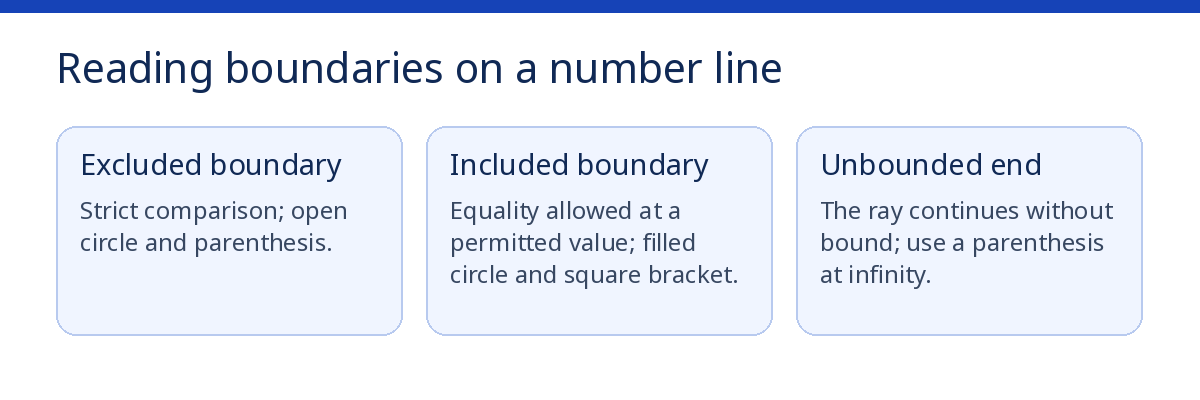
Good to remember: match the endpoint to the sign
A strict comparison, or , excludes equality. On a real number line, mark the boundary with an open circle; in interval notation, use a parenthesis there. A non-strict comparison, or , allows equality, so use a filled circle and a square bracket if the boundary belongs to the domain. In interval notation, infinity always takes a parenthesis: it signals that the set is unbounded, not that it contains an extra endpoint.
When a question asks for a number-line graph, compare it with your algebra before checking the solution. The endpoint mark shows whether equality is allowed, while the shaded segment or ray shows which values satisfy the comparison. These are two separate decisions.
Combine conditions in one variable
The second assessment covers simultaneous inequalities, chained comparisons and absolute-value conditions. For a system joined by and, solve each condition, then take the intersection. A value that works in only one condition cannot belong to the final set. A chained comparison also imposes two conditions at once, and the two endpoints need not follow the same inclusion rule.
Absolute value measures distance from zero. For a positive bound , is equivalent to : the distance condition keeps values between two limits. By contrast, keeps values on either side outside those limits. Those two alternatives are combined by a union. This distinction helps you decide whether to look for overlap or keep separate parts of the number line.
Common mistake: clearing a variable denominator
The systems assessment and chapter practice also include rational inequalities. These are not the same as linear inequalities with constant fractional coefficients. A denominator containing the variable may be positive for some values and negative for others, so multiplying through without checking its sign can give the wrong direction.
First exclude values that make the denominator zero. A useful approach is to bring the terms to one side and examine the sign of the resulting expression on intervals where that sign can be determined. A zero of the resulting numerator can belong to the solution of a non-strict inequality only if the original expression is defined there. A denominator zero remains excluded, even when the inequality allows equality.
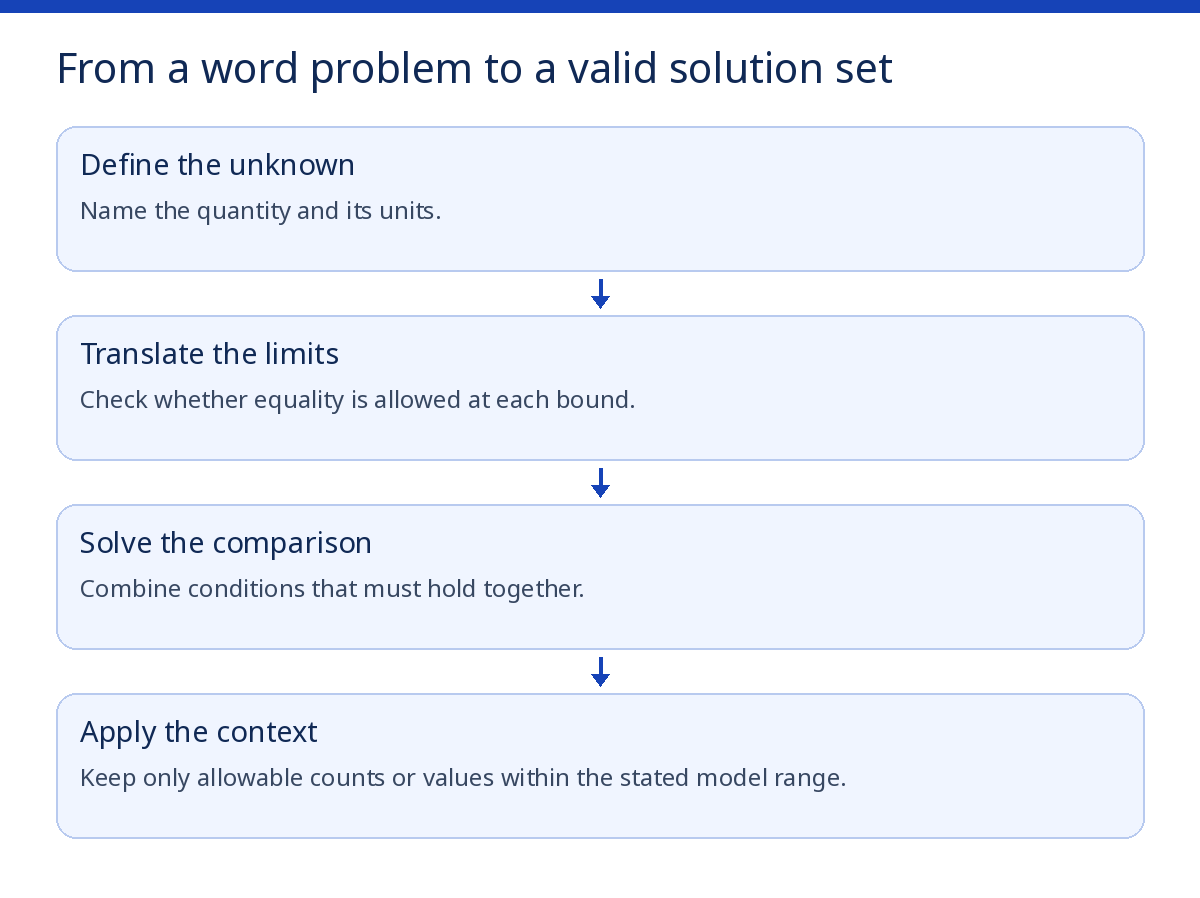
Turn words into bounds before doing algebra
The applications assessment uses budgets, marks and averages, consecutive integers, profit, temperature ranges and mixture concentrations. Begin by defining the unknown and its units. Phrases such as at least and at most include the stated value; more than, less than and strictly between exclude the relevant limits. In a profit question, revenue has to exceed cost: equality describes break-even, not profit.
The context still matters after the algebra. A packet count is a non-negative integer, while a depth must stay within the range where the given model applies. In temperature conversion, compare temperatures on the same scale. In a mixture question, distinguish the amount of acid from the total volume: concentration describes the acid as a proportion of the mixture, so adding solution changes the total volume as well as the amount of acid.
Use worked solutions to find the first wrong step
Attempt a topic-wise set before opening its solutions. For objective questions, write down the comparison or domain check that justifies your choice. For written questions, include what the task asks for: an interval, a number-line representation or a conclusion in context. Then use the chapter practice to see whether you can choose a method without the topic heading telling you which one to use.
When your result differs from a worked solution, compare the steps in order. Identify whether the first difference is in translating the words, manipulating the inequality or reporting the solution set. The file flags a printed-key discrepancy in Assessment 1; this guide leaves out the disputed answer and does not reproduce individual answer options.
Spotted an error? Report a correction. Practise this in the app: notes, formula sheets and mind maps.

Loading comments…