Class 11 Linear Inequalities: Case-Based Assessment
CBSEMathematicsLinear Inequalities
This CBSE Class 11 Mathematics assessment pairs inequality rules and interval notation with a shopping-budget case. Its worked explanations help you distinguish between algebraic rules, restrictions imposed by an expression, and limits set by a real-world situation.
What the two case studies cover
The file covers Chapter 5, Linear Inequalities, through two case studies with eight subparts. The first has five multiple-choice items on solving inequalities, dividing by a negative number, interpreting absolute-value conditions and handling a quotient. The second has three short-answer items: modelling a shopping budget, finding a maximum packet count and solving a separate inequality over the real numbers.
A clickable index lists the questions and solutions. Individual links let you move from a question to its worked explanation and then back again. There is no separate chapter-practice section, so the file is best used as a focused check on the reasoning tested in these two cases, rather than as a bank of additional exercises.
Linear Inequalities | Class 11 | Case-based Assessment
In the StudentCurio app
Case studies cover modelling shopping and budget constraints, finding a maximum number of packets, and solving inequalities involving negative divisors, absolute values, quotients and domain restrictions. Includes worked solutions and interval notation to help Class 11 students practise applying linear inequalities.
What changes when you divide by a negative?
The first case tests the same rule in two forms: a numerical inequality and a comparison involving a divisor whose sign is given. Adding or subtracting the same expression on both sides preserves the order wherever the expressions are defined. Multiplying or dividing both sides by a positive number also preserves the order. With a negative multiplier or divisor, the direction reverses. Division by zero is not allowed.
Direction and strictness are different. Reversing an inequality does not turn a strict comparison into a non-strict one. A weaker comparison can be true without expressing the precise relation that follows from the original statement. That distinction matters in this file: the worked explanation for the negative-divisor item flags both an error in the supplied key and overlap among the choices. Use the reasoning to judge the comparison rather than relying on the option label.
Reading absolute-value conditions as intervals
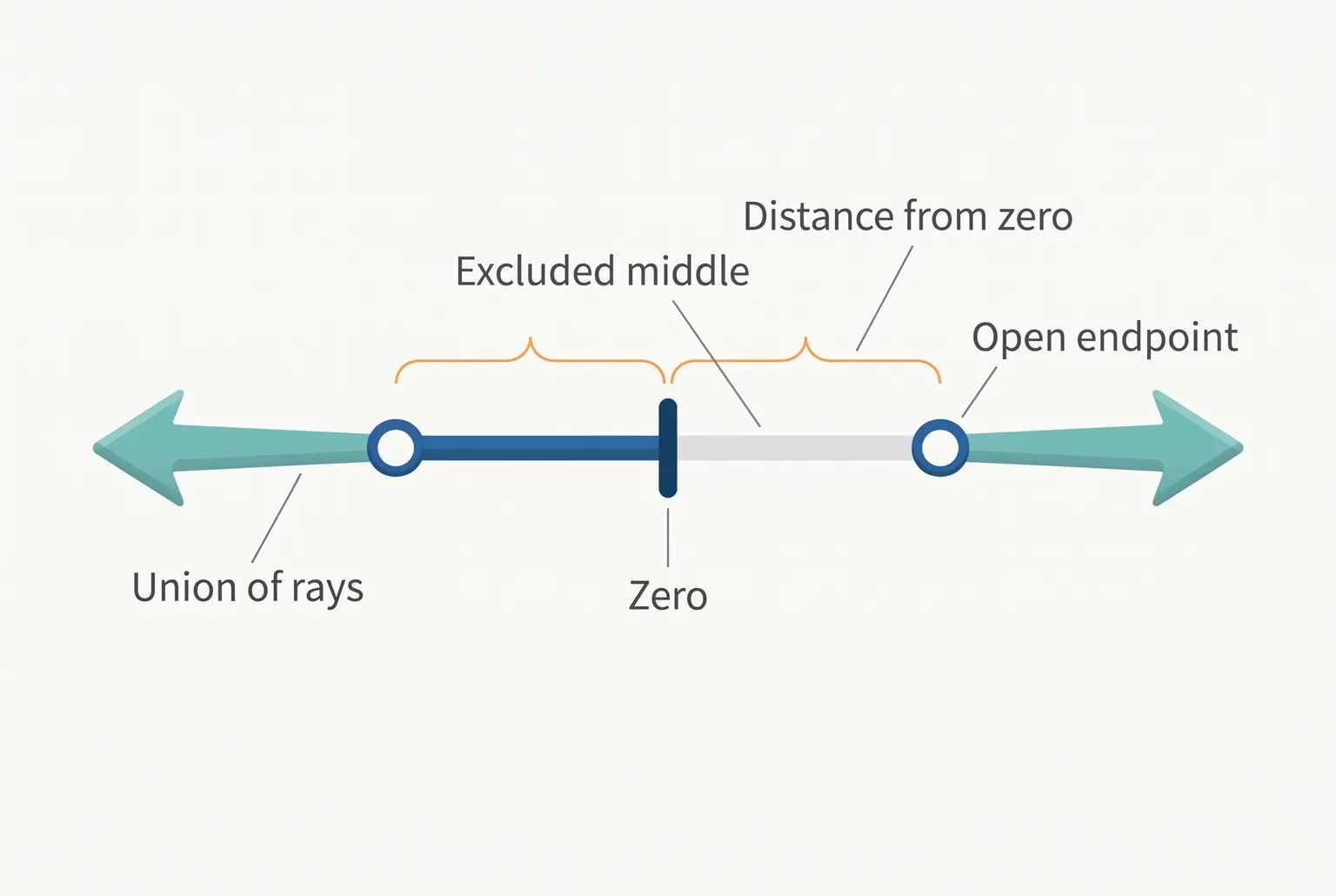
Absolute value measures distance from zero. For a positive threshold, asking for a distance greater than that threshold gives two possibilities: the expression is below the negative threshold or above the positive threshold. These possibilities form a union. Joining them with and would instead require the same value to be on both sides at once.
For these exterior intervals, a strict comparison excludes the finite boundary points, while an “at least” comparison includes them. Parentheses mark excluded endpoints and square brackets mark included endpoints. Infinity always takes a parenthesis because it is not a real endpoint that can belong to the solution set.
The two absolute-value prompts have damaged notation. The file preserves the printed text and explains the intended conditions in the solutions. Use those stated readings for interval practice, but do not treat the printed choices as reliable evidence of a unique answer label.
Before you compare a quotient with zero
For a quotient inequality, identify the domain before deciding where the quotient has the required sign. Any input that makes the denominator zero is excluded, even if the numerator is also zero. A non-strict inequality can admit values where a quotient equals zero, but only if the quotient is defined at those values.
The quotient item places the absolute value of an expression in the numerator and the expression itself in the denominator. That structure makes sign cases useful: the absolute value agrees with the expression when it is positive and is its negative when it is negative. Do not clear a variable denominator as though it were positive everywhere. Its sign determines whether multiplication preserves or reverses the comparison, and the zero-denominator case must stay outside the domain.
From a spending limit to whole packet counts
In the shopping case, the two variables count different products. Each unit price is measured in rupees per packet, so multiplying it by the corresponding count gives an amount in rupees. Adding those amounts gives total spending. Staying within a budget allows spending less than the available amount as well as spending exactly that amount. The later prompt explicitly fixes the rice count and says that the entire amount is spent, so it adds conditions that the general budget model does not impose.
Packet counts must be nonnegative integers. An algebraic bound can describe a range, but a proposed purchase still has to satisfy both the spending constraint and the whole-packet restriction. The final short-answer item explicitly asks for real values instead. Although it appears under the same case heading, its variable is not subject to the packet-count restriction.
Quick self-check before opening a solution
For a legible prompt, write the allowed values first: are you considering all real numbers, real numbers with an exclusion, or whole packet counts? Then identify what could change the direction of the comparison and whether a boundary value is both defined and permitted. For a damaged absolute-value prompt, consult the solution note for the intended condition before attempting the mathematics.
When you open the worked explanation, compare the step that controls the result, not just the final line. In the algebra case, look for the reason a comparison reverses or an endpoint is excluded. In the budget case, check that each term represents spending and that the final interpretation respects the kind of quantity being counted.
Spotted an error? Report a correction. Practise this in the app: notes, formula sheets and mind maps.


Loading comments…