CBSE Class 11 Limits and Derivatives Assessment Guide
CBSEMathematicsLimits and Derivatives
This Class 11 CBSE Mathematics assessment pairs topic-wise questions with worked solutions and a chapter practice set. Use it to practise choosing a limit method, finding a derivative from first principles and checking the reasoning behind each step.
Find the right practice set in the PDF
The assessment covers Chapter 13, Limits and Derivatives, in seven topic-wise sets. The first four move from the fundamentals of limits to rational, trigonometric, and exponential and logarithmic limits. The next three cover derivatives from first principles, rules for differentiation and trigonometric derivatives. A separate chapter practice set brings the topics together.
The clickable index has separate pages for questions and solutions. Use the questions index to select a topic and an answer format, from objective questions to longer written responses where listed. When checking your work, match both the assessment and the question number: numbering restarts in each topic-wise set. The question pages also give solution-page references.
Limits and Derivatives | Class 11 | CBSE Assessment
In the StudentCurio app
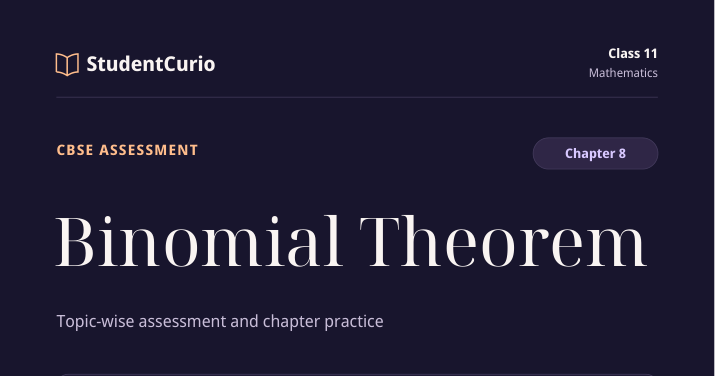
Assessment questions with worked solutions cover one-sided and standard limits, derivative definitions, and differentiation of algebraic and trigonometric functions. Helps Class 11 CBSE students practise and check their methods.
One-sided limits: look near the point, not just at it
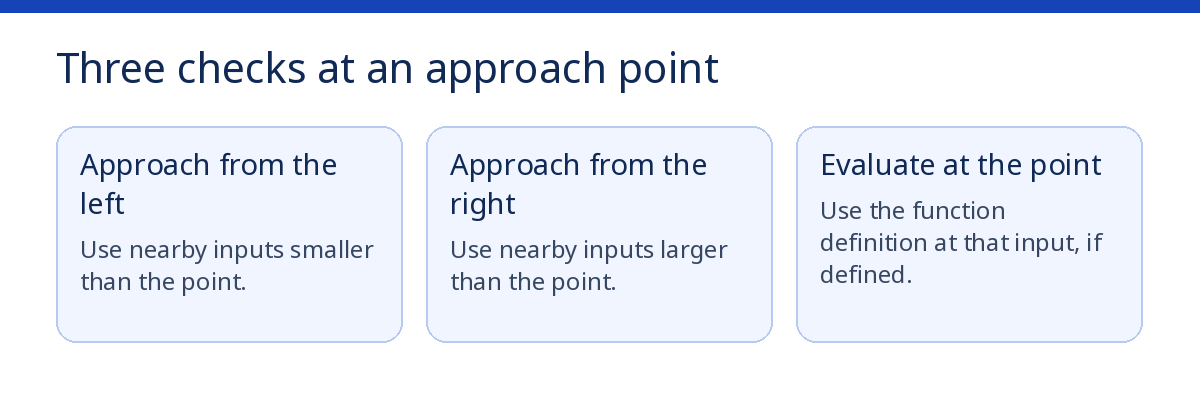
A limit describes what happens to as approaches a point, not necessarily what the function equals at that point. The fundamentals set makes this distinction concrete with piecewise functions, absolute values and the greatest integer function. In a piecewise question, identify which branch applies just to the left of the approach point and which applies just to the right. The branch that includes the point itself tells you the function value there, but it does not determine the behaviour on both sides.
For a finite two-sided limit at a point approached from both sides, the left-hand and right-hand limits must exist and agree. If a question also requires the limit to equal the function value, that is a separate condition. Keep those two checks distinct when writing your reasoning.
When substitution works for a rational limit
For a ratio of polynomials, direct substitution gives the limit when the denominator is nonzero at the approach point. If substitution gives , it has not evaluated the limit. Look for a common factor in the numerator and denominator. The assessment also groups expressions involving square roots with this practice; there, multiplying by a conjugate may reveal a factor that was hidden in the original expression.
The important step is to say where the simplified expression agrees with the original. You can cancel a common factor only where it is nonzero, and any square roots must remain defined. A simplification can be valid for nearby inputs even when the original expression is undefined at the point itself. That is why it can help evaluate a limit without assigning the original function a value there.
Trigonometric limits: match the angle and its unit
The trigonometric set includes expressions involving scaled angles, differences involving cosine and limits at points other than zero. Before using a standard limit, identify which argument is tending to zero. For an approach point other than zero, a change of variable can make that argument easier to see. An identity may also put a cosine difference into a form involving sine.
Check before applying the standard sine limit: In , the angle is in radians and the denominator matches the sine argument. If the original denominator differs from that argument by a constant factor, that factor must be accounted for. The PDF uses radians unless degrees are explicitly marked, so check the unit before using the radian formula.
Exponential and logarithmic limits: check the input
The exponential and logarithmic set includes differences of powers, logarithms with arguments close to one, and expressions that combine these functions with trigonometric ones. In the solutions, means the natural logarithm. A standard logarithmic limit uses the form as tends to zero. Recognising it means identifying the change from one in the logarithm’s argument, not just noticing that the denominator goes to zero.
For real logarithms, the argument must stay positive on the part of the domain used in the limit. For real exponentials with a variable exponent, the constant base must be positive. In a mixed expression, check these restrictions as well as the behaviour of each inner argument before deciding which standard limit applies.
A useful connection: a derivative is a limit of slopes
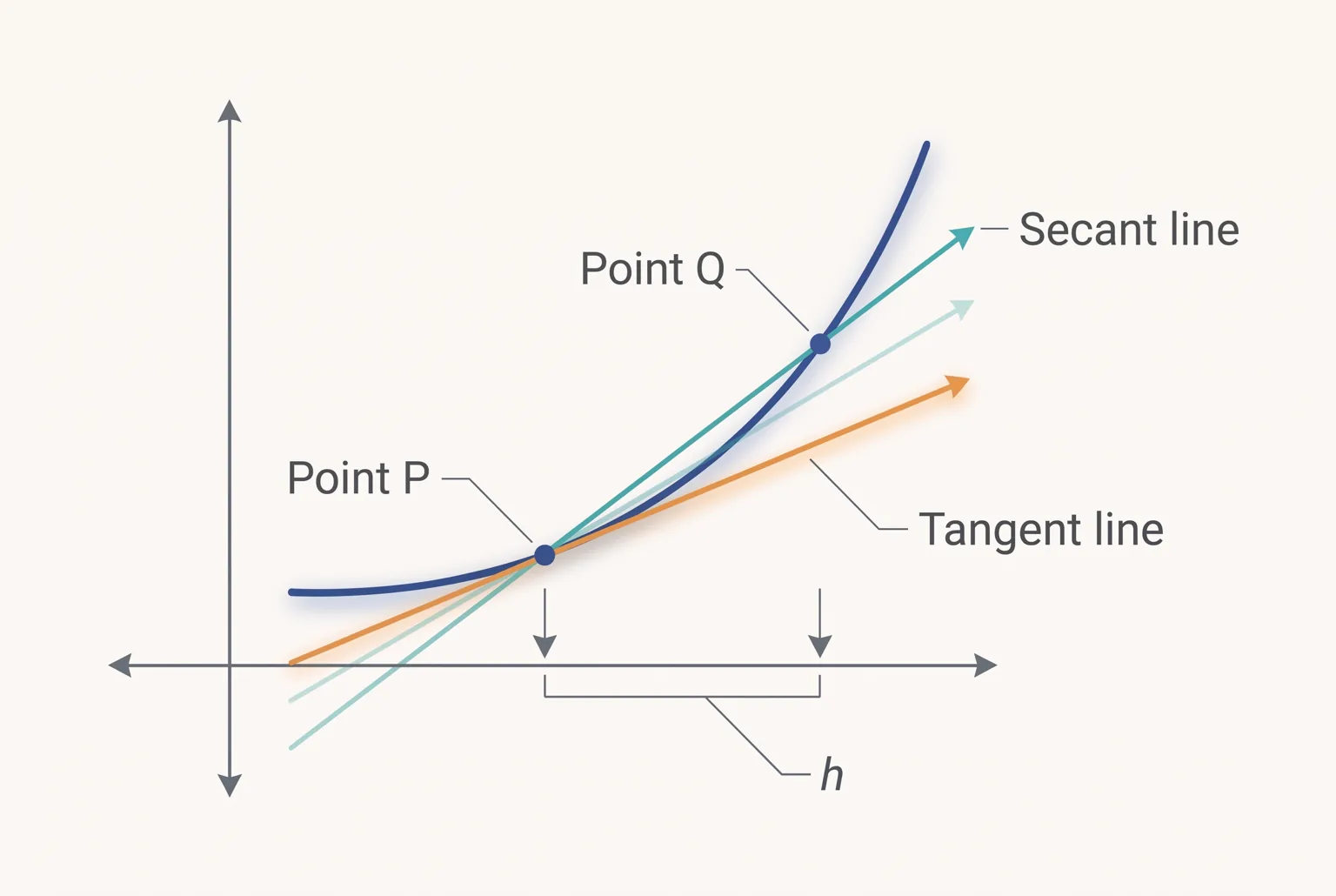
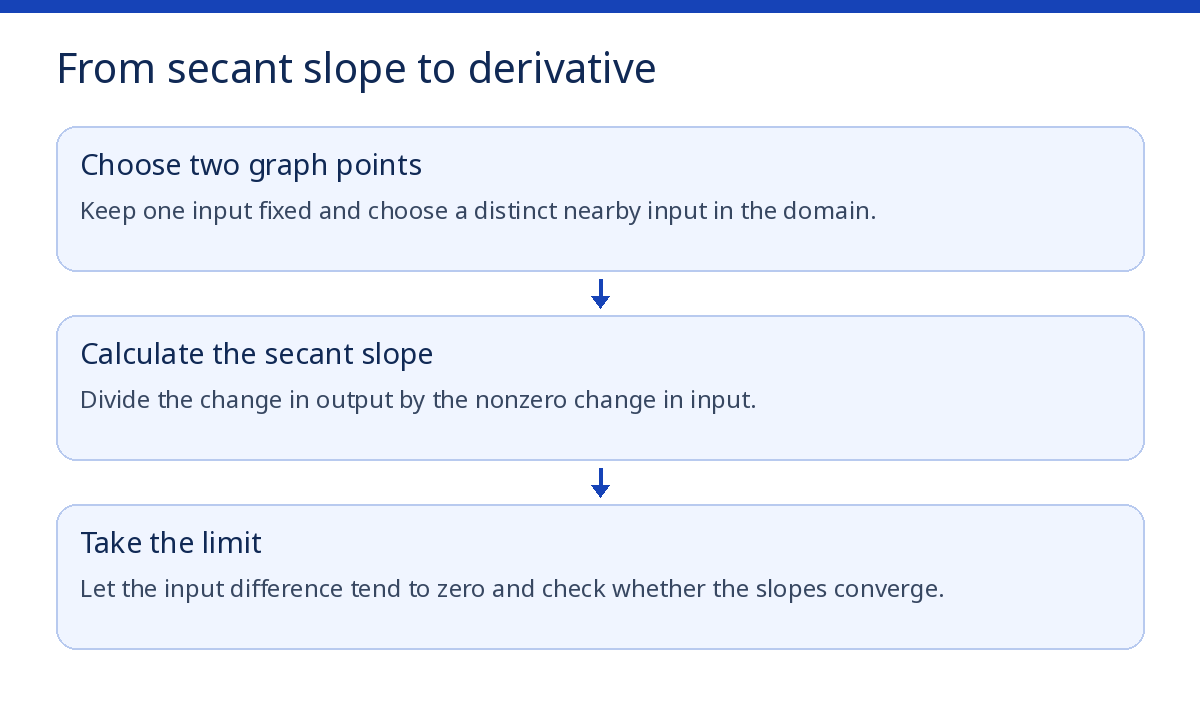
The cover connects the derivative at a point with the slope of the tangent. Before taking the limit, is the slope of the secant line through the graph at inputs and , with and both function values defined. As tends to zero, the quotient gives if its finite two-sided limit exists. This is why setting equal to zero at the start does not find the derivative.
The first-principles set includes algebraic and trigonometric functions as well as exponential and logarithmic expressions. Distinguish a derivative at a specified input from a derivative formula valid wherever the function is differentiable. If a question asks for first principles, show how you form and evaluate the difference quotient rather than replacing it with a differentiation rule.
Use the worked solutions to find your first wrong step
Attempt each selected question before opening its solution. For an objective item, note the reason for your choice; for a written item, show where you use a branch, a domain condition or a standard limit. Then compare the steps, not just the final result. If your work diverges, identify the first line where the method stops being valid. That tells you what to revisit more precisely than marking the entire attempt wrong.
Use the dedicated differentiation sets to practise rule selection after first principles. Then try the chapter practice set without a topic heading to cue your method. When reviewing it, ask whether you misread the approach direction, chose an inapplicable formula or made an algebraic error after choosing a sound method.
Spotted an error? Report a correction. Practise this in the app: notes, formula sheets and mind maps.
Loading comments…