Limits and Derivatives: CBSE Class 11 Case-Based Assessment
CBSEMathematicsLimits and Derivatives
This CBSE Class 11 Mathematics assessment pairs case-based questions with linked worked solutions. Use it to practise choosing a limit method, setting up a derivative from first principles, and deciding when to differentiate before substituting.
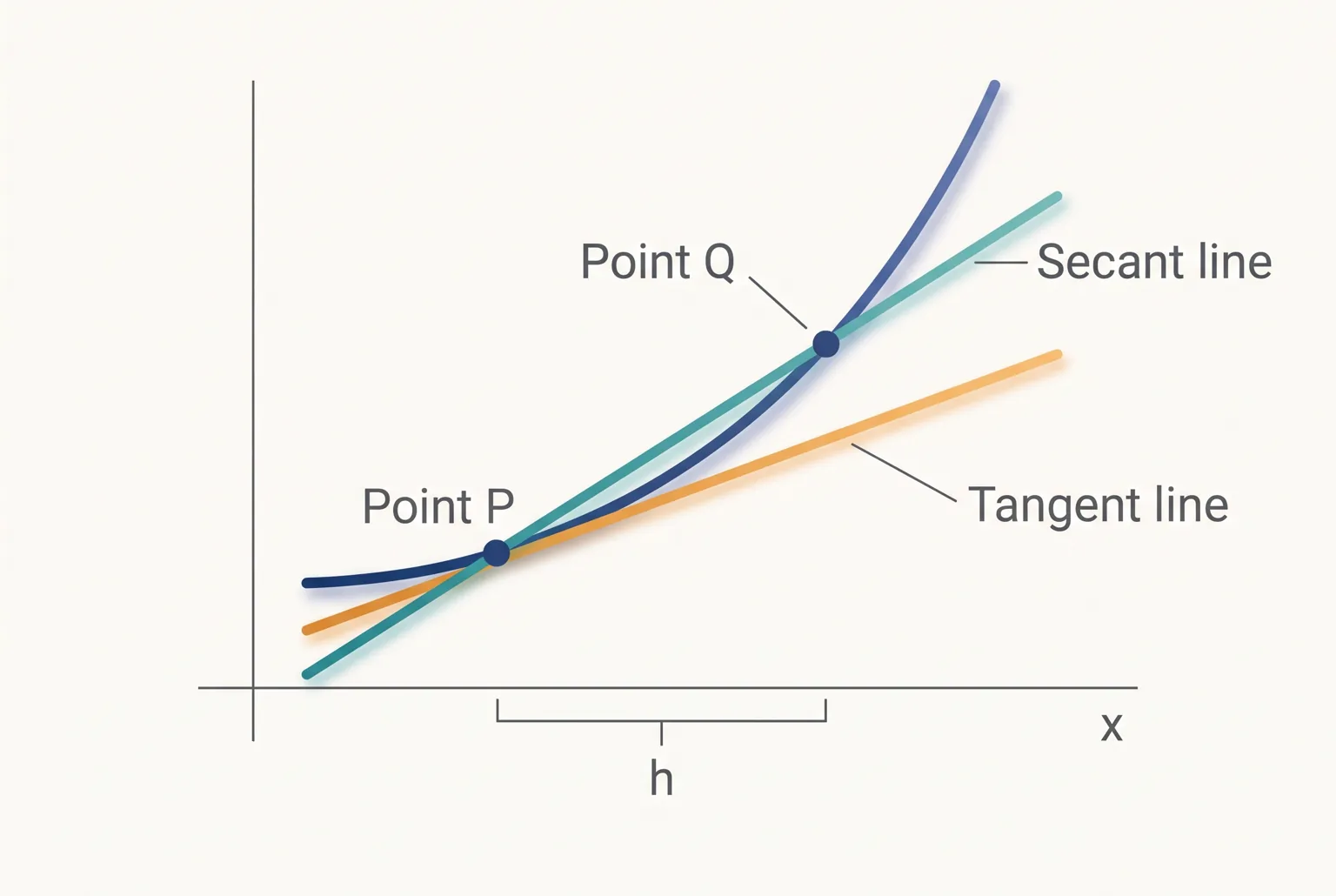
What the four case studies cover
This file contains four case studies with 16 subparts in total. The first two focus on limits: the rational-functions case uses short answers and includes a standard power limit, while the polynomial case uses multiple-choice questions. The third case returns to short answers for differentiation from first principles. The fourth uses multiple-choice questions on trigonometric differentiation, evaluation at specified angles and the product rule. There is no separate chapter-practice section in the file.
The cases test different decisions. In the polynomial case, the main task is to recognise when substitution is enough. In the first-principles case, the task is to explain how a quotient can have a limit even though its denominator tends to zero.
Limits and Derivatives | Class 11 | Case-based Assessment
In the StudentCurio app
Case-study questions with worked solutions on polynomial and trigonometric limits, differentiation from first principles, trigonometric derivatives, and the product rule. Helps Class 11 students practise limit and differentiation methods and check common errors.
Polynomials: recognise when substitution is enough
For a polynomial , the limit as approaches a real number is . Each term has a limit at that point, and the limit of the finite sum is the sum of those term limits. A polynomial written as a product is still continuous, so you can substitute into its factored form without expanding it first. The zero function is one polynomial, not the definition of a polynomial.
The multiple-choice format makes it useful to separate the method from the arithmetic. Write the substituted expression before checking the options. At a negative approach value, put that value in brackets before raising it to a power. Even and odd powers behave differently, so a correct choice of method can still produce the wrong result if a sign is lost.
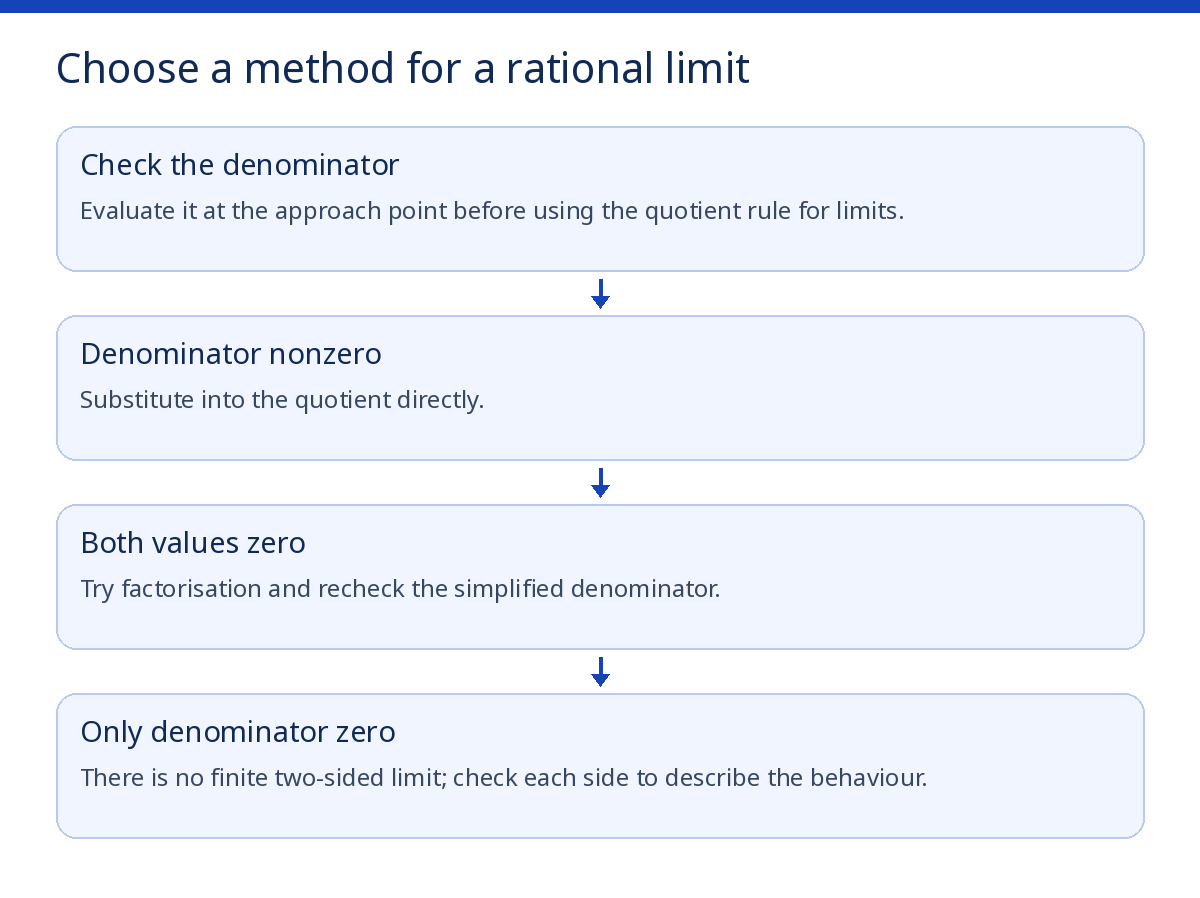
Rational limits: check the denominator first
A rational function is a quotient of polynomials. At an approach point , direct substitution gives provided the denominator value is nonzero. If only the numerator is zero, the quotient is zero. If the denominator is zero and the numerator is not, there is no finite two-sided limit; one-sided behaviour can help explain what happens near the point.
If both values are zero, is an indeterminate form, not a result. Factorisation may expose a common factor that can be cancelled at nearby points where it is nonzero. The simplified expression then represents the same values there without redefining the original function at the approach point. Check the denominator again after simplifying. If it still vanishes, cancellation alone has not settled the limit, and comparing the two sides may be necessary.
A useful connection: power limits and first principles
The standard power limit applies for positive integer exponents , with the case giving a limit of one directly. Its numerator measures the change in the power function and its denominator measures the change in the input. Writing the approaching input as turns this into the same kind of difference quotient used to define a derivative.
In the first-principles case, keep the base input fixed and let the increment tend to zero. The derivative is when this limit exists. Form the difference first, then divide and simplify for nonzero before taking the limit. The cubic task calls for algebraic expansion; the tangent tasks use a trigonometric identity to simplify the difference. If a prompt specifies first principles, quoting a derivative rule alone does not show the requested method.
Trigonometric derivatives: keep track of radians
The tangent argument uses the standard limit , with the increment measured in radians. Tangent is defined only where , so the first-principles calculation starts at a point in that domain. The same radian convention underlies the standard sine and cosine derivative formulas used in the final case.
A degree-labelled evaluation point identifies an angle; it does not change the variable convention used to differentiate. Differentiate the function first using the radian-based rules, then evaluate the derivative at the equivalent radian angle. Substituting the angle into the original function before differentiating would give the function's value, not its rate of change there.
Quick self-check: a sum or a product?
The last case moves from a sum of trigonometric terms to a product of a polynomial and a trigonometric factor. A sum can be differentiated term by term. For a product of two differentiable functions, use . Each term keeps one factor unchanged and differentiates the other; multiplying the two derivatives together is not the product rule.
Before comparing your work with the linked solution, ask: can I point to the unchanged factor in each term, and have I carried through the sign from differentiating the trigonometric factor? Those checks test the structure of the derivative before any numerical evaluation.
How to use the linked solutions
Open a case from the clickable index and attempt a subpart before following its solution link. Look for the first step where your method differs from the worked method, then use the return link to revisit the prompt. For a limit, compare the approach value, including its sign, before comparing any algebra. The rational-limit notes explicitly distinguish the printed approach values from those used in earlier working, so treat calculations at different points as separate problems.
This guide omits disputed workings and a multiple-choice item flagged for an option mismatch. Use the remaining questions to check whether you can justify the method, rather than treating a matching answer choice as proof that every step is valid.
Spotted an error? Report a correction. Practise this in the app: notes, formula sheets and mind maps.




Loading comments…