Conic Sections: CBSE Class 11 Maths NCERT Notes
CBSEMathematicsCoordinate Geometry
These CBSE Class 11 Mathematics notes cover circles, parabolas, ellipses and hyperbolas. Use the diagrams, worked examples and chapter summary to practise moving between a curve’s geometric definition, its equation and the features you can read from that equation.
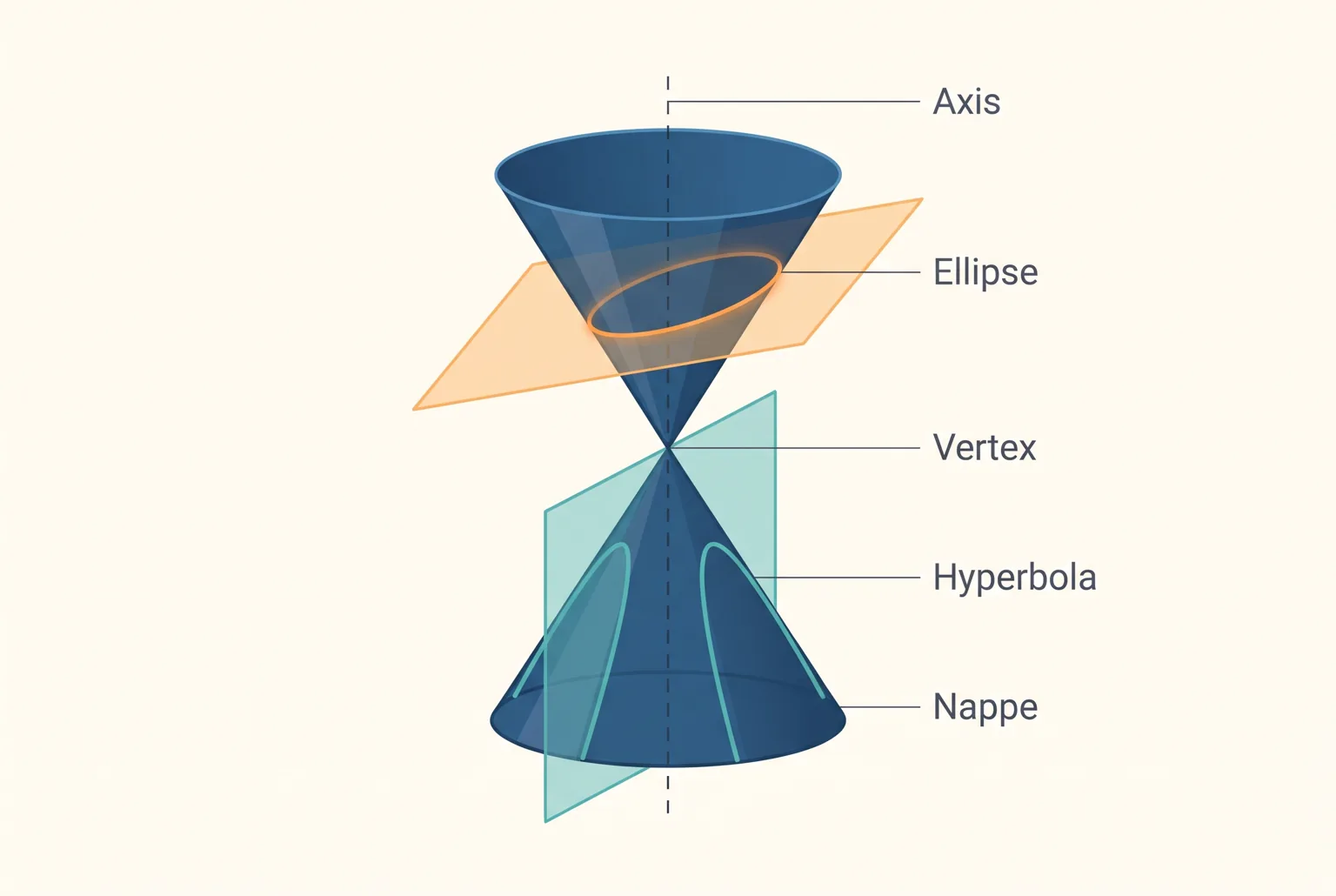
How a plane slices a double cone
The notes begin with a right circular cone. Its two parts, called nappes, meet at the vertex. In the diagrams, is the angle between a generator and the cone’s axis, while is the angle between the cutting plane and that axis. Keeping those two angles distinct makes the diagrams easier to read.
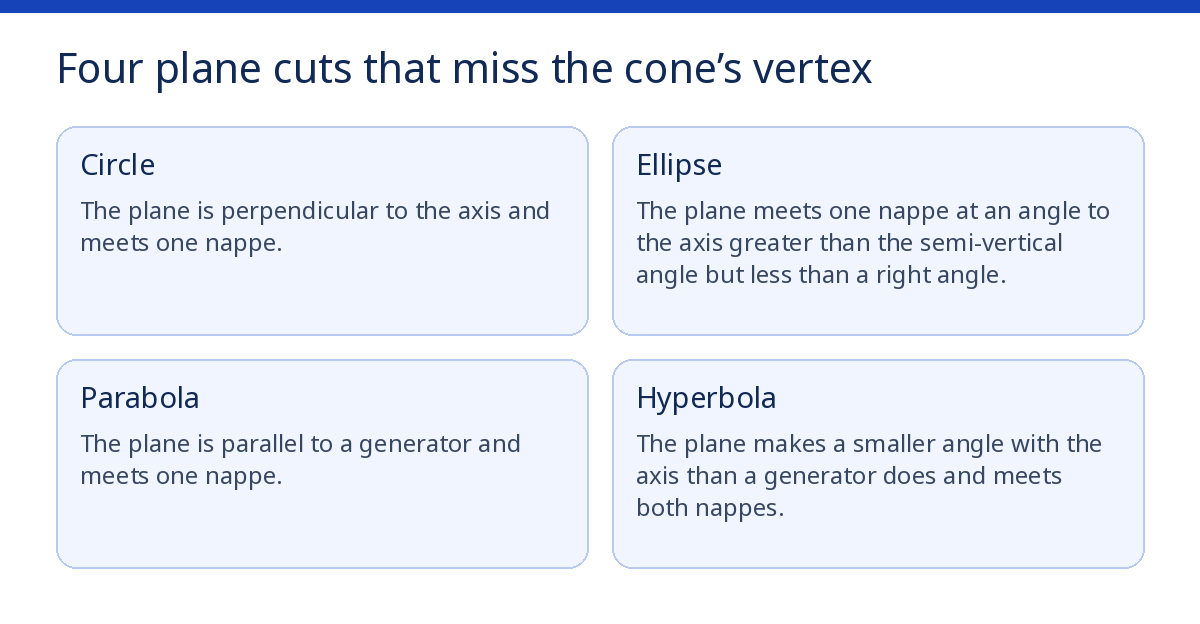
First check whether the plane passes through the vertex. If it does, the intersection can be a point, one line or a pair of lines. If it misses the vertex, a perpendicular cut gives a circle; a cut with gives an ellipse; and a cut with gives a parabola. When , the plane meets both nappes and gives a hyperbola, even though it misses the vertex.
Conic Sections Class 11 Maths | NCERT Theory | Revision Notes
In the StudentCurio app
Comprehensive revision notes for Conic Sections covering circles, parabolas, ellipses, and hyperbolas with standard equations, properties, and various solved problem types.
A useful connection: eccentricity and distance
The notes move from slicing a cone to describing a curve as a locus: the set of points satisfying a geometric condition. In the focus–directrix definition, the focus is a fixed point and the directrix is a fixed line. The distance to the line is measured perpendicularly. Eccentricity is the distance to the focus divided by the distance to the directrix, not the other way round.
With a fixed finite directrix, describes an ellipse, a parabola and a hyperbola. A circle has eccentricity zero as a limiting conic, but substituting zero into this finite-directrix ratio does not produce a circle. For the circle, use the fixed-distance-from-the-centre definition instead.
Circles: read the centre before expanding
For a circle with centre and radius , the standard equation is the distance formula written in squared form. This form shows the centre and radius directly. If the equation is expanded, complete the squares to recover that information. For the normalised general form , the centre is and the squared radius is . That quantity must be positive for a non-degenerate real circle; zero gives a single point and a negative value gives no real points.
Common mistake: confusing a centre on an axis with a circle touching it. A centre on the x-axis has . A circle tangent to the x-axis instead has , because the radius is the perpendicular distance to the axis. For tangency to the y-axis, use . If the circle touches both axes, the signs of the two centre coordinates are independent.
Parabolas: separate the axis from the opening
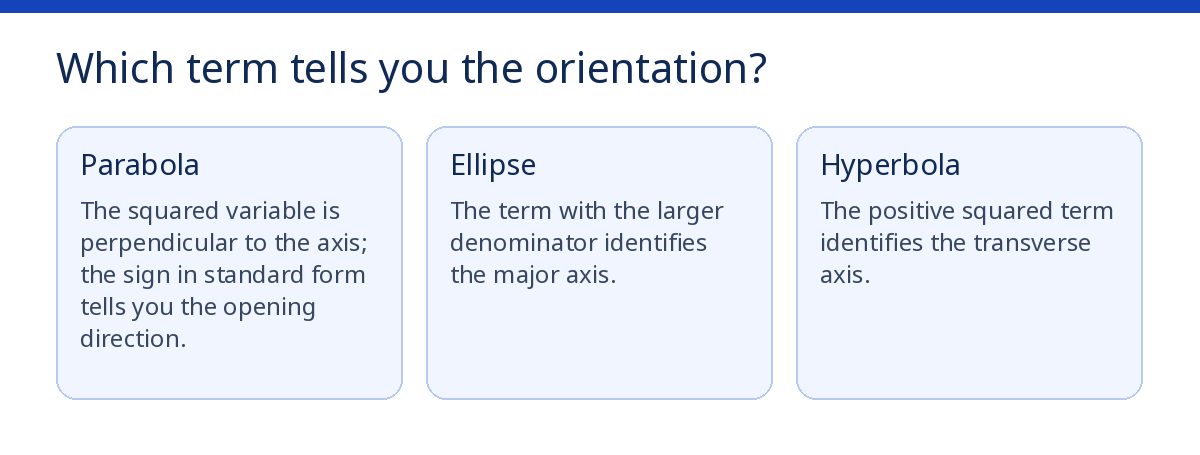
The parabola section compares four standard forms with the vertex at the origin. In these forms, a squared gives a horizontal axis and a squared gives a vertical axis. With , the positive sign in opens the curve to the right, whereas opens it to the left. The same sign distinction in the vertical forms gives an upward or downward opening. Check the squared variable before using the sign to decide which way to sketch.
The index separates questions that ask you to read features from an equation from those that ask you to build an equation from geometric information. When using the worked examples for the second task, sketch the given focus, vertex or directrix first. The equal-distance definition explains why the focus lies on the opening side of the vertex and the directrix lies on the opposite side.
Ellipses: read the major axis from the denominators
The ellipse section links the lengths of the semi-major and semi-minor axes to the distance from the centre to a focus. In a standard ellipse centred at the origin with coordinate-aligned axes, first write the equation with the sum of the two squared terms equal to one. The larger denominator then identifies the major axis: it is horizontal if that denominator is under , and vertical if it is under .
If are the semi-major and semi-minor lengths and is the centre-to-focus distance, then and . In the notes’ comparison of the two standard orientations, track what changes and what stays fixed: switching the major axis changes which coordinates are used for the foci, not the relationship between the lengths.
Hyperbolas: follow the positive term
The hyperbola section compares the two standard orientations and groups worked problems by the information given, such as foci and vertices or vertices and eccentricity. For an origin-centred standard hyperbola written with the difference of the two squared terms equal to one, the positive term identifies the transverse axis, which passes through the vertices. Do not carry over the ellipse rule about the larger denominator.
Here the centre-to-focus distance satisfies , where and are the transverse and conjugate semi-axis lengths. Thus , in contrast with the ellipse, where . That comparison explains why the ratio is above one for a hyperbola and below one for an ellipse.
Quick self-check before using the chapter summary
Use the clickable index to pair one example that starts with an equation with another that starts with geometric data. Before reading the working, ask what tells you the orientation, which length you can read directly and which length you still have to find. Then use the chapter summary to check the conditions on each rule, especially the step of putting an equation into standard form.
This guide leaves out the parameter-dependent circle examples whose stated radii need restrictions, as well as the incomplete worked example at the end of the supplied excerpt.
Spotted an error? Report a correction. Practise this in the app: notes, formula sheets and mind maps.
Loading comments…