CBSE Class 11 Conic Sections Assessment: How to Use It
CBSEMathematicsConic Sections
This CBSE Class 11 Mathematics assessment pairs four topic-wise sets with mixed chapter practice and worked solutions. Use it to practise reading geometric features from equations and building equations from geometric conditions.
What the assessment covers
The file begins with sections of a cone and circles, then gives separate assessments on the parabola, ellipse and hyperbola. The opening topic connects the curves to plane sections of a double-napped right circular cone. The later questions shift to coordinate geometry: given an equation, what does the curve look like, and given its defining features, how can you write its equation?
Each topic-wise set has objective, very short answer, Short Answer Type I and Short Answer Type II questions. The mixed chapter practice also includes a long-answer section. The PDF has separate clickable indexes for questions and solutions, and individual questions show a solution page reference. Since numbering restarts in each assessment, use the topic name as well as the question number when looking up a solution.
Conic Sections | Class 11 | CBSE Assessment
In the StudentCurio app
A Class 11 chapter-wise assessment on conic sections, including circles, parabolas, ellipses and hyperbolas, with objective, short-answer and long-answer questions and worked solutions. It helps students practise equations and properties such as foci, eccentricity, directrices and latus rectums.
Circle: Move between coordinates and distances
A circle consists of points at a fixed positive distance from a centre . Its equation, , expresses that distance without a square root. The circle set asks you to work in both directions: write equations from a centre and radius, or recover those features from an equation. For an expanded equation with a common nonzero coefficient on the squared terms, divide through by that coefficient before completing the squares. The resulting squared radius must be positive for a nondegenerate circle.
The questions also show how different geometric clues provide the same information. The midpoint of a diameter gives the centre; half the diameter gives the radius. If a line is tangent, the perpendicular distance from the centre to the line gives the radius. Neither clue requires guessing a point on the circumference.
Parabola: The squared variable tells you the axis
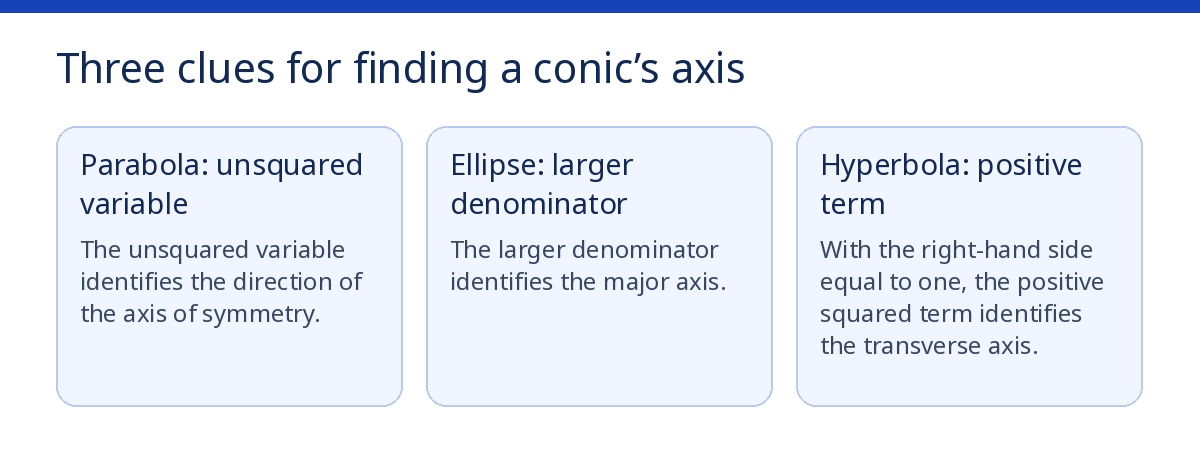
A parabola consists of points whose distance from a fixed focus equals their perpendicular distance from a fixed line, the directrix. The assessment asks for equations from geometric data and also asks you to read the vertex, focus, directrix and latus rectum from equations. For an origin-centred coordinate setup with the vertex at the origin, has a horizontal axis, while has a vertical axis. With signed , the sign determines the opening direction along that axis, and the latus rectum length is .
The set also includes translated parabolas and problems with an oblique axis. Completing the square can expose the vertex in a translated, axis-aligned equation. When the axis is oblique, start from the focus–directrix distance condition rather than forcing the equation into a horizontal or vertical form.
Ellipse: Use the longer axis to place the foci
For an ellipse with two distinct foci, the sum of the distances from any point on the curve to the foci is constant. That sum equals the full major-axis length, , not the distance between the foci, . In an origin-centred, axis-aligned standard equation, the larger denominator identifies the major axis. With , where and are the semi-major and semi-minor lengths, and the eccentricity is , with .
The ellipse set connects these relationships through questions involving sketches, vertices, directrices and latus rectum lengths. It also includes a semi-elliptical arch problem. In that setting, distinguish the full span from the horizontal semi-axis, and measure horizontal position from the centre if you choose an origin-centred equation.
Hyperbola: Follow the positive squared term
A hyperbola has two branches. The absolute difference of the distances from a point on either branch to the two foci is constant. For an origin-centred, axis-aligned hyperbola, first put the equation in standard form with a right-hand side of . The variable in the positive squared term identifies the transverse axis, which contains the vertices and foci. The larger denominator does not determine the orientation.
Here is half the transverse-axis length and is half the conjugate-axis length. If is the centre-to-focus distance, then , so . The hyperbola questions let you practise both extracting features from an equation and using clues such as vertices, focal separation or a directrix to reconstruct the equation.
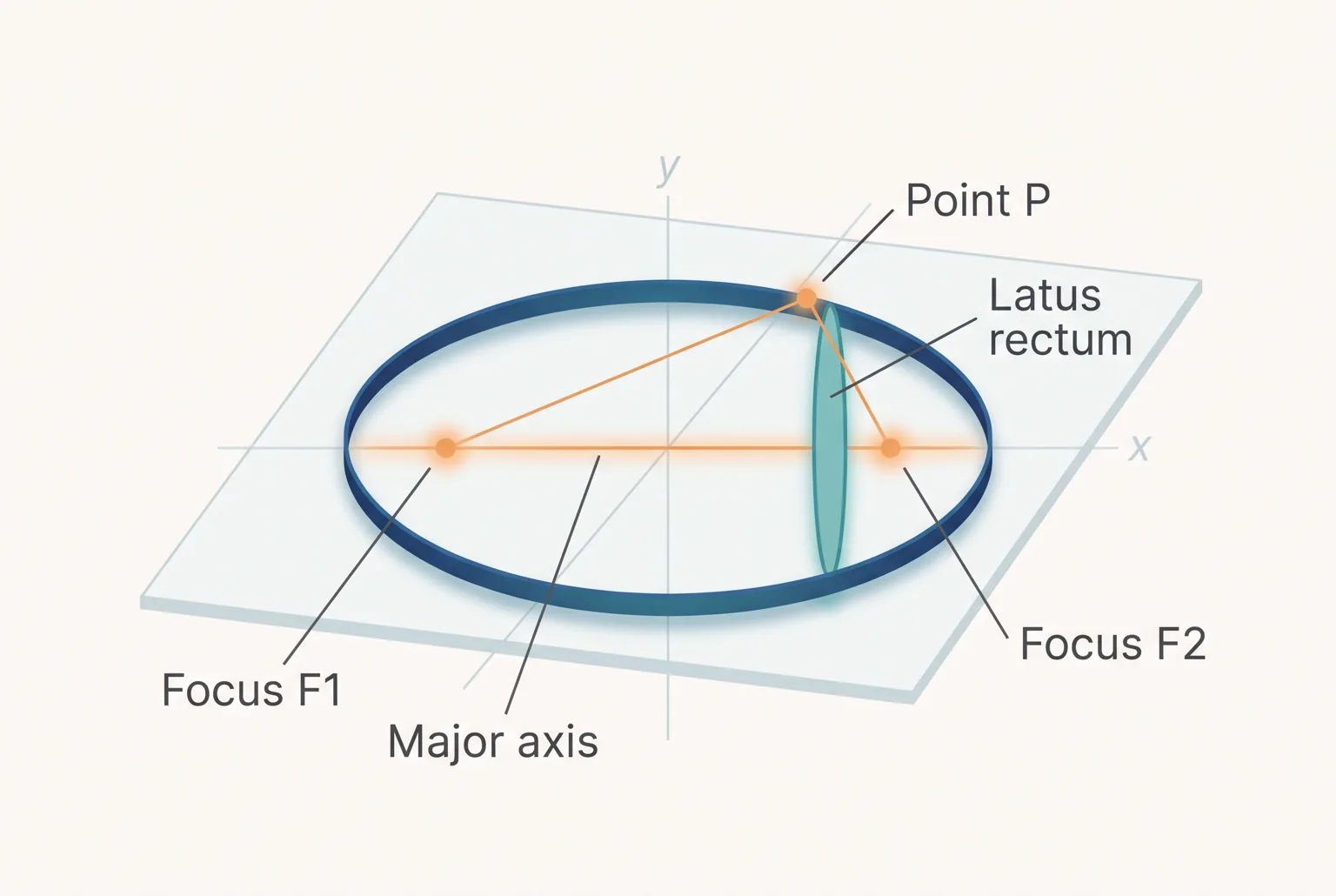
A useful connection: What makes a latus rectum?
For the parabolas, ellipses and hyperbolas in this assessment, a latus rectum is a chord through a focus and perpendicular to the axis that contains that focus. The focus tells you where to place the chord; the axis tells you its direction. On a sketch, mark both before drawing the chord. This helps separate its full length from other distances in the diagram, such as the distance from the centre to a focus. It also explains why a chord through a vertex, or one drawn along the focal axis, is not a latus rectum.
Quick self-check before opening the solutions
Use a topic-wise set first to practise translating between equations and diagrams. Then try the mixed chapter practice without relying on the topic heading to tell you which method to use. Before opening a worked solution, ask: What fixed distance or distance relationship defines this curve? If you started from an equation, can you justify its orientation from the algebra and show it on a sketch?
When you compare your work with the solution, look for the first step where the approaches differ. Distinguish a wrong geometric choice, such as putting the foci on the wrong axis, from an algebraic slip made after choosing the right form. That distinction tells you what to revisit.
Spotted an error? Report a correction. Practise this in the app: notes, formula sheets and mind maps.
Loading comments…