Complex Numbers: CBSE Class 11 NCERT Notes Guide
CBSEMathematicsComplex Numbers and Quadratic Equations
These CBSE Class 11 Mathematics notes develop the complex-number part of the NCERT chapter Complex Numbers and Quadratic Equations. Use them to revise powers of the imaginary unit, practise arithmetic in standard form, and connect conjugate and modulus to the Argand plane.
What this notes file covers
The file is labelled Chapter 5, Complex Number. Its index starts with definitions, equality and integer powers of the imaginary unit, then moves to arithmetic and algebraic identities. The final indexed topics are conjugate, modulus and the Argand plane, followed by a chapter summary. The supplied material does not establish a separate treatment of methods for solving quadratic equations, so use this file as a guide to the complex-number portion of the broader chapter.
The worked examples let you follow how definitions become calculation rules. For targeted revision, the index separates division from the method for writing a quotient in standard form, and lists the geometric representations of conjugate and modulus separately.

Complex Numbers Class 11 Maths | NCERT Theory | Revision Notes
In the StudentCurio app
Comprehensive revision notes covering the algebra of complex numbers, properties of modulus and conjugate, and their representation on the Argand plane. It includes detailed worked examples and property summaries for Class 11 students.
Read standard form before comparing two numbers
In standard form, a complex number is written as , with real coefficients and and with . The real part is and the imaginary part is , not . The same number can be represented by the ordered pair . A real number has imaginary part zero; a purely imaginary expression has real part zero. The complex number is zero exactly when both parts are zero.
Two complex numbers are equal precisely when their real parts match and their imaginary parts match. The equality examples show why collecting terms first matters: once both sides are in standard form, a single complex equality gives two real equations. An unwritten component is zero, so a side with only an imaginary term still supplies a real-part equation.
When power and square-root rules apply
The powers of the imaginary unit repeat every four exponents because . For an integer exponent , write with integer and remainder between zero and three. Then . A zero remainder gives , not . For a negative exponent, the notes also demonstrate the reciprocal method: evaluate the corresponding positive power and take its reciprocal. This is valid because the imaginary unit is nonzero. An exponent containing a variable can be reduced by this cycle only when the required integer condition holds.
The notes also distinguish a valid square-root conversion from an invalid product rule. For positive real , the principal square root of is . But multiplying the principal square roots of two negative real numbers does not give the principal square root of their product: the two factors of the imaginary unit introduce a minus sign.
Common mistake: treating multiplication like addition
Addition and subtraction work component by component. To subtract a complex number, reverse both of its component signs before adding. This follows from the additive inverse: adding to must give zero.
Multiplication is different. Expand the brackets using the distributive law, then replace by before collecting terms. For factors and , the real part of the product is , while the imaginary part is . In particular, the product of the two imaginary terms contributes to the real part. The notes use the same algebra to develop familiar identities for complex numbers, including the square of a sum and the difference of two squares.
A useful connection: conjugate, modulus and division
The conjugate of is : it reverses the imaginary part but leaves the real part unchanged. This distinguishes it from the additive inverse, which reverses both parts. Multiplying a number by its conjugate gives . That product is the square of the modulus, , so it is real and is positive when the number is nonzero.
This explains the division method listed in the index. Multiply both numerator and denominator by the conjugate of the denominator to turn the denominator into a positive real number. You can then divide each component of the numerator by that real number to obtain standard form. The original denominator must be nonzero; the method does not make division by zero possible.
See conjugate and modulus on the Argand plane
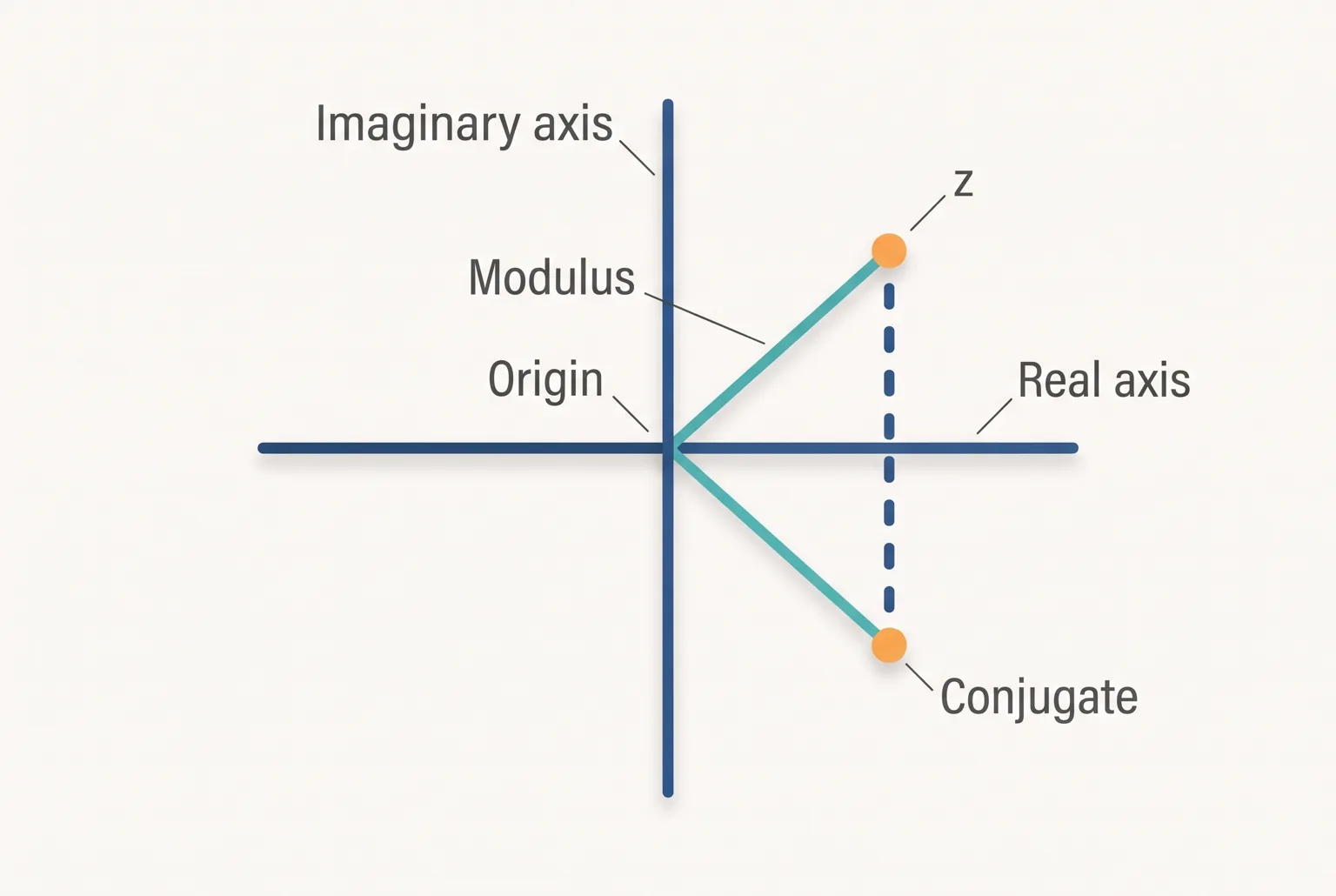
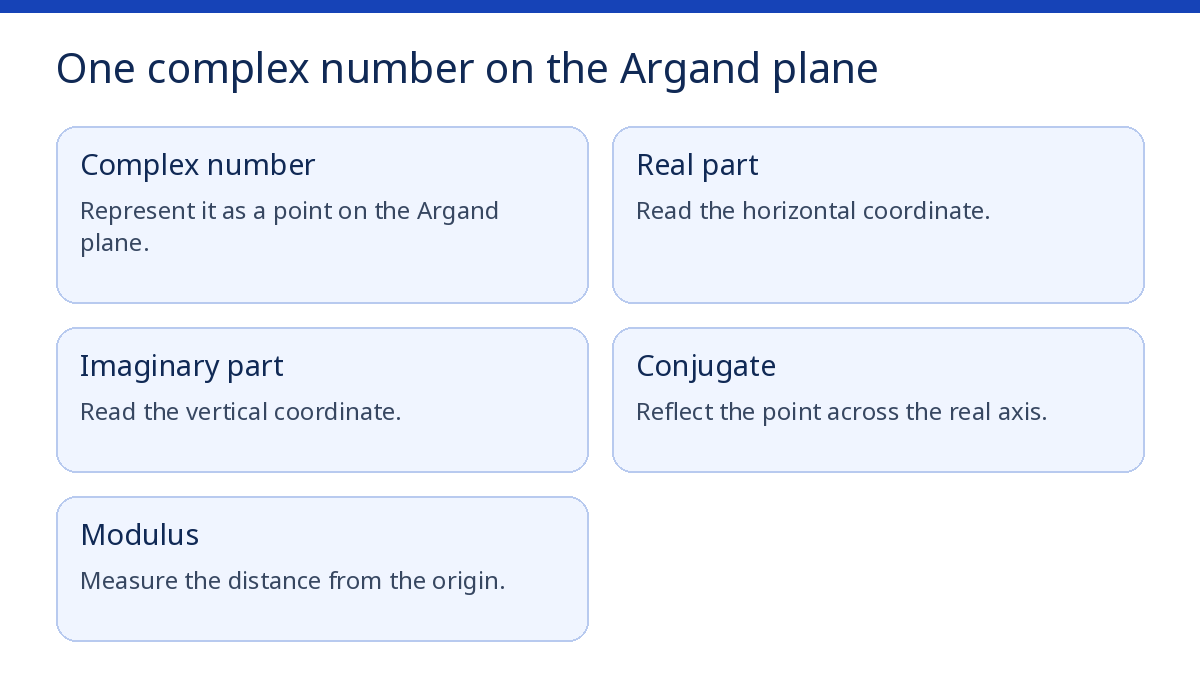
The Argand plane turns the ordered-pair representation into a picture. The horizontal coordinate is the real part, and the vertical coordinate is the imaginary part. A number with zero imaginary part lies on the horizontal axis, a number with zero real part lies on the vertical axis, and the zero complex number lies at the origin.
Taking the conjugate changes only the vertical coordinate, so the point is reflected across the real axis. The modulus measures the distance from the origin to the point, not its distance from either axis. Reflection leaves that distance unchanged, which explains geometrically why a number and its conjugate have the same modulus.
Use the worked examples to check your method
Choose a worked example from the index and pause before reading its calculation. For equality, identify the two component equations you would write. For a product, mark the term that will become real after simplifying the square of the imaginary unit. Then compare your reasoning with the corresponding step in the notes, rather than checking only the final line. Use the chapter summary afterwards to recall which operations required a sign change or a nonzero condition.
The historical aside and worked expressions with unclear formatting or missing continuation in the supplied preview are not reproduced in this guide.
Spotted an error? Report a correction. Practise this in the app: notes, formula sheets and mind maps.























Loading comments…