Class 11 CBSE Assessment: Complex Numbers and Quadratics
CBSEMathematicsComplex Numbers and Quadratic Equations
This Class 11 CBSE Mathematics assessment pairs topic-wise questions with linked worked solutions. Use it to practise complex-number algebra, connect conjugates and modulus to the Argand plane, and see how a quadratic relation can simplify higher powers.
What the assessment covers and where to start
The PDF is organised into three topic-wise assessments: Introduction to Complex Numbers, Algebra of Complex Numbers, and Conjugate, Modulus and Argand Plane. A separate chapter practice set brings the topics together. The question index lists the starting page for each assessment and question type; a parallel index does the same for the solutions. Individual questions link to their worked answers, and the solutions link back to the questions.
If you can identify real and imaginary parts but struggle to simplify a quotient, start with the algebra assessment rather than repeating the introduction. If your calculations work but your plots do not, start with conjugates and the Argand plane. The file includes objective and written questions, with longer tasks in the second and third assessments and case-based practice at the end.
Complex Numbers and Quadratic Equations | Class 11 | CBSE Assessment
In the StudentCurio app
Topic-wise assessment questions with worked solutions cover complex-number operations, powers of i, conjugates, reciprocals, rationalisation, modulus, real and purely imaginary values, and Argand-plane representation. Useful for Class 11 students practising objective, written and case-based questions and checking their methods.
Read the coefficients before comparing complex numbers
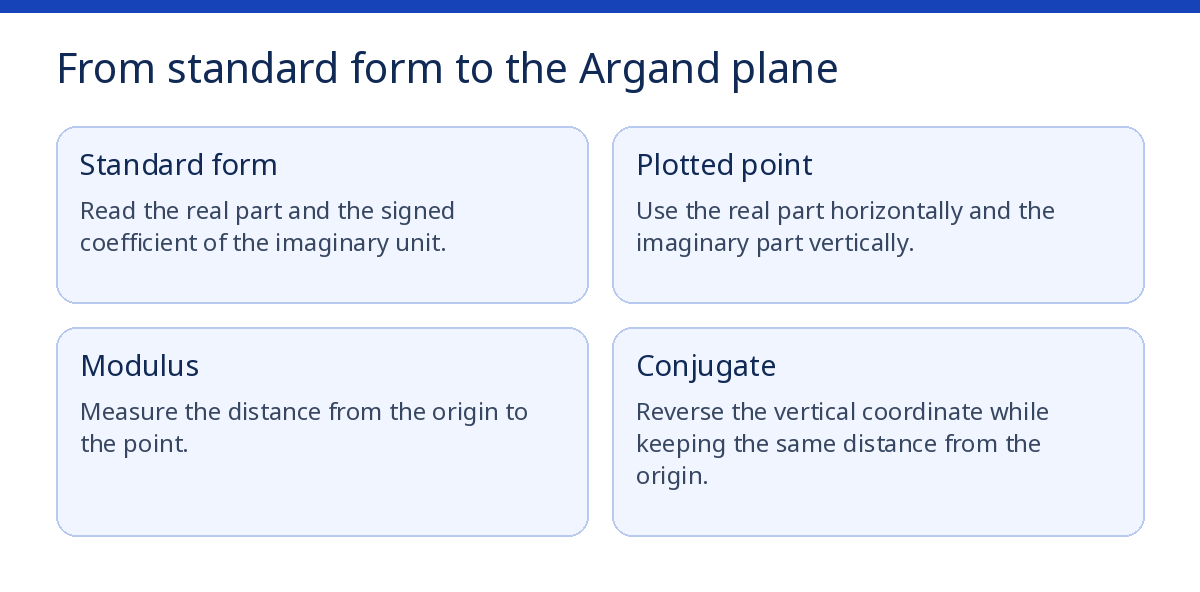
In standard form, , both and are real. The imaginary part is the signed coefficient , not the term . Writing an expression in standard form makes it possible to compare two complex numbers by matching their real parts and imaginary parts separately. In a written response, showing that pair of equations makes it clear how a single complex equality becomes two real conditions.
A number is real when its imaginary coefficient vanishes. A nonzero purely imaginary number has zero real part and a nonzero imaginary coefficient. So being non-real is not enough to be purely imaginary: a number can have both components nonzero. Keep zero separate when a question explicitly asks for a nonzero value. This distinction is useful in chapter practice, where an expression may need simplifying before either component can be read off.
Common mistakes with powers and square roots
The introduction asks you to simplify both positive and negative integer powers of . Starting from , the powers repeat every four because . For an integer exponent, use its remainder modulo four. With a negative exponent, take care not to drop the sign: either find the corresponding remainder or rewrite the power as a reciprocal first. The cycle applies to the base ; if the base is a multiple of , the real factor must also be raised to the stated power.
For a positive real , the principal square root of is written . Do not assume that multiplying two square roots of negative real numbers is equivalent to taking the principal square root of their product. The introduction includes a fallacy question that tests this distinction.
When rationalising a denominator works
For sums and differences, collect like components. For products, expand first, replace with , and then collect the resulting real and imaginary terms. When subtracting a bracket, the minus sign applies to both components. These operations often come before a question asks for a particular coefficient or imposes a condition on the result.
For division by a nonzero number , multiply both numerator and denominator by its conjugate . The denominator becomes , which is positive because the real coefficients and are not both zero. This is also the method behind the reciprocal formula for . Do not confuse the reciprocal with the conjugate: conjugation changes the sign of the imaginary coefficient, while the reciprocal also divides the conjugate by the squared modulus.
A useful connection: conjugates, modulus and the Argand plane
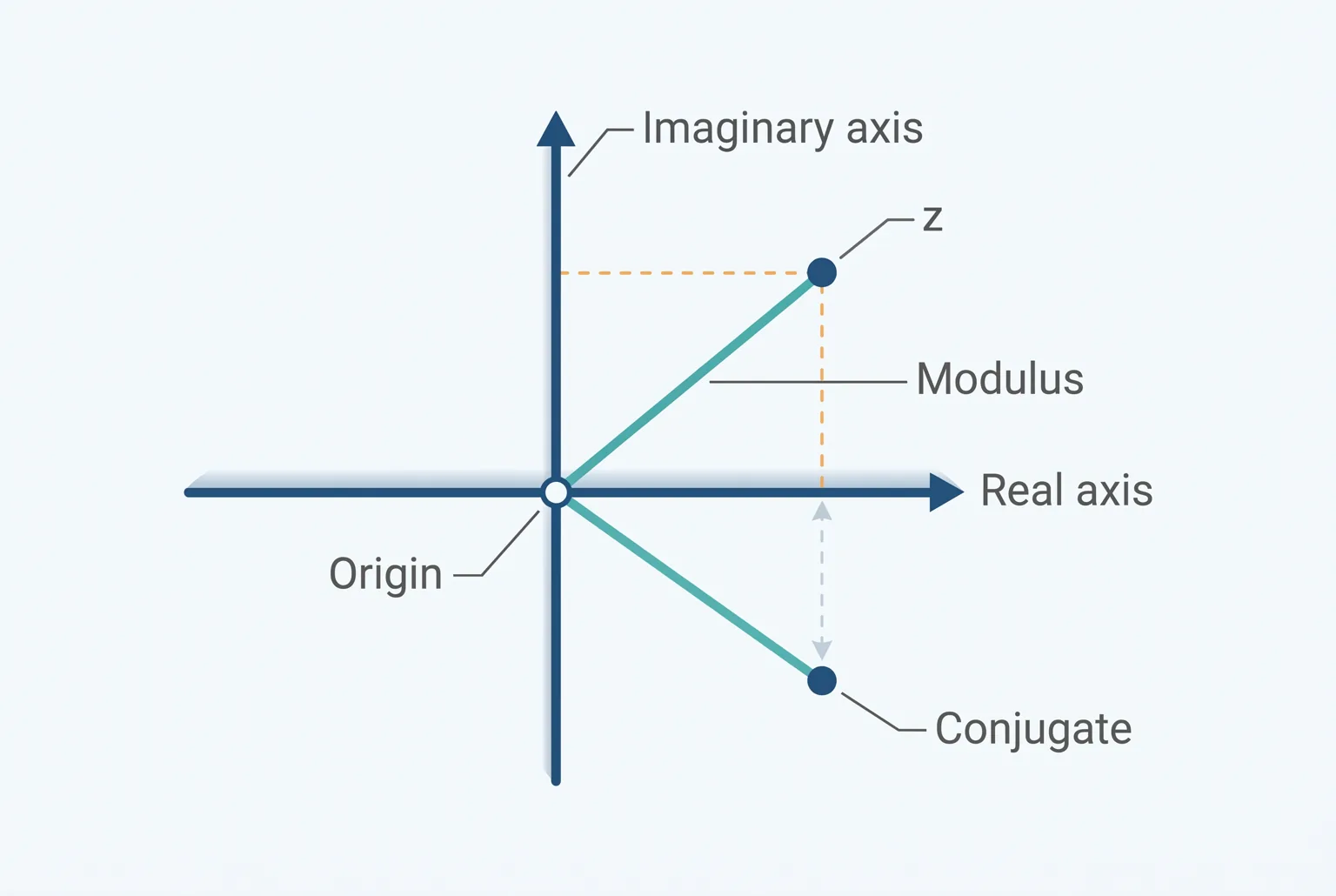
On the Argand plane, is plotted at , with the real component horizontal and the imaginary component vertical. The modulus is the distance from the origin, not a coordinate or a signed quantity. The cover diagram shows this connection between the plotted point and its distance from the origin.
Conjugation keeps the horizontal coordinate and reverses the vertical coordinate, so it reflects the point in the real axis without changing its modulus. When a question asks for the quadrant of a quotient or its conjugate, first determine the signs of the final components. If either coordinate is zero, the point lies on an axis, not inside a quadrant. Modulus alone cannot tell you which quadrant a point occupies.
Where quadratic equations enter the practice
The file’s three topic-wise assessments focus on complex numbers rather than offering a separate sequence on solving quadratic equations. The connection appears in chapter practice: a written question asks you to verify a quadratic relation for a given complex value and then use that relation in a higher-degree expression.
The word hence matters. If a quadratic relation expresses the square of a number in terms of the number itself and a constant, that relation can be used to reduce higher powers. When reviewing this type of question, look for the step where the quadratic relation replaces a power; that step shows why the question asks you to establish the relation first.
Use the linked solutions to find the first wrong step
Try the question before opening its solution link. For an objective item, keep a line of reasoning as well as your choice. For a written item, compare your steps in order: a wrong sign after expansion calls for a different correction from a misplaced coordinate after successful simplification. Use the return link to retry the question without looking at the worked answer.
In the case-based practice, separate the property given in the setup from the algebra each part still requires. The PDF flags printed-key discrepancies in the introductory questions on reading coefficients and simplifying a radical fraction. The affected worked examples are omitted here.
Spotted an error? Report a correction. Practise this in the app: notes, formula sheets and mind maps.








Loading comments…