Binomial Theorem: Class 11 CBSE Maths Revision Notes
CBSEMathematicsBinomial Theorem
These Class 11 CBSE Mathematics notes cover the NCERT Binomial Theorem for positive integer powers. Use them to connect Pascal’s triangle with the general expansion, then apply the same structure to numerical powers, approximations and remainders.
Start with the structure of an expansion
A binomial is an expression with two terms joined by addition or subtraction. The notes begin with familiar low powers to show what changes from one term to the next, then state the general theorem. For real and and a positive integer , the expansion is .
Read this as an ordered list of terms, starting with and ending with . At each step, the exponent of the first quantity falls by one and that of the second rises by one, so their sum stays equal to the outer exponent. The formula gives positions before any simplification. That is not a promise that every position will give a distinct nonzero term after you substitute particular expressions and collect like terms.
Binomial Theorem Class 11 Maths | NCERT Theory | Revision Notes
In the StudentCurio app
Detailed revision notes covering the Binomial Theorem for positive integral indices, Pascal's triangle, expansion properties, and applications in divisibility and numerical approximations.
Two ways to find the coefficients
Pascal’s triangle gives a whole row of coefficients. Each row starts and ends with one, and each interior entry is the sum of the two entries directly above it. The top row corresponds to exponent zero, so the row number, counted from zero, matches the exponent of the binomial.
If you need only one coefficient, the combination formula avoids building the earlier rows: , where and are integers with . The notes also give the symmetry rule . This lets you check one coefficient against its partner at the opposite end. The coefficients match, but the associated powers usually do not. The two methods are useful for different tasks: build a row when you want to see the pattern across the expansion, and use combinations when you want to go straight to a specified position.
Common mistakes: term positions, brackets and signs
The index starts at zero, so it labels the term in position , not position . This matters when the notes refer to terms in odd or even places. The first term is in an odd place even though its index, and the exponent on the second quantity, is zero.
Keep each quantity in brackets until you have applied its power. If the second quantity is , the power applies to the two as well as to the variable. For subtraction, treat the entire second quantity as negative: write as . The factor changes the sign for odd indices and leaves it unchanged for even indices. This is also the sign rule behind the notes’ special case .
What survives when two expansions are combined?
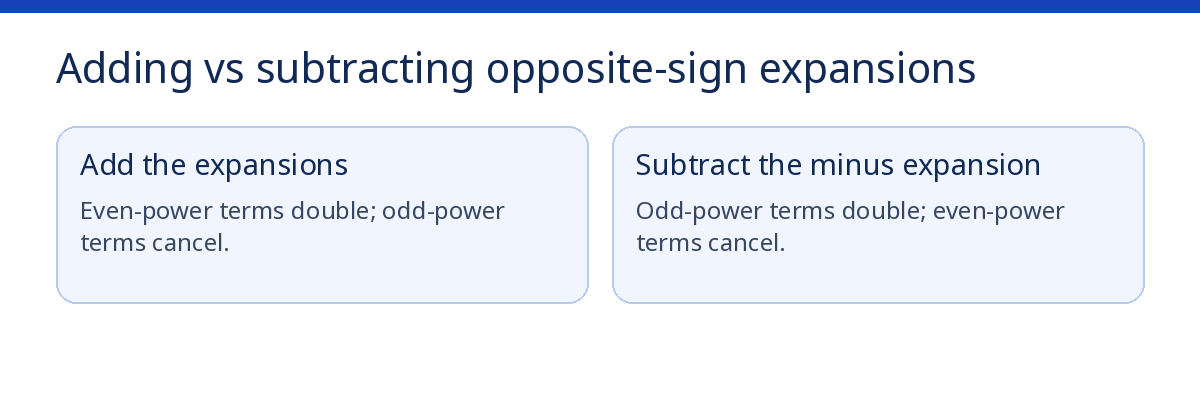
The notes compare and . Matching terms have the same coefficient magnitude and powers; the difference is the sign attached to odd powers of . When you add the expansions, the odd powers of cancel and the even-power terms double. When you subtract the second expansion from the first, the even powers cancel and the odd-power terms double.
This gives you a way to count or identify surviving terms without writing out both expansions. Look at the parity of the exponent on the quantity whose sign changes, not the parity of the exponent on the unchanged quantity. The same idea explains why adding two expansions with opposite signs can simplify examples involving square roots: if the square root is the sign-changing quantity, only its even powers survive.
Exact powers, approximations and comparisons
In the applications section, the notes rewrite integer bases near a convenient number as a sum or difference. A base near one hundred, for instance, can be expressed using one hundred and a small offset. Keeping every term gives an exact value; the benefit is that powers of the convenient part are easier to calculate than repeated multiplication of the original base.
For a decimal close to one, the notes instead write the base as one plus or minus a small quantity. Their approximation example uses only the first three terms. The full expansion is still exact, but the shortened sum must be marked as an approximation. A separate comparison illustrates a different reason to stop early: when the omitted terms are positive, a partial sum gives a lower bound. If that lower bound already exceeds the number being compared, an exact evaluation is unnecessary.
When the expansion reveals a remainder
For a remainder problem with a positive integer divisor, look for a way to write the integer base, or a convenient power of it, as a multiple of the divisor plus a small integer. After expansion, every term containing that multiple is divisible by the divisor. Only the term without the multiple needs to be reduced to a remainder between zero and one less than the divisor. If you rewrote only part of the original power, account for the remaining factor too.
Use this method with the positive integer exponents stated in the theorem. The applications introduction’s reference to a rational index and the division note’s ambiguous wording about a factor are not used as rules here. The printed intermediate algebra in the remainder example continued on page 16 is also omitted.
Quick self-check before using the chapter summary
Use the clickable index to move between the theory and worked examples, then revisit the chapter summary once you can explain the main decisions. Can you identify a term’s powers and coefficient without expanding every position? For a numerical example, can you tell from the setup whether the aim is an exact value, an approximation or a remainder, and explain why it is legitimate to stop where the method does?
Spotted an error? Report a correction. Practise this in the app: notes, formula sheets and mind maps.





















Loading comments…