Class 11 Binomial Theorem Case-Based Assessment Guide
CBSEMathematicsBinomial Theorem
This guide examines a specialized CBSE Class 11 Mathematics assessment featuring case studies on Pascal’s triangle, binomial coefficients, and divisibility proofs.
Overview of the Binomial Theorem Resource
The StudentCurio Case-Based Assessment for Class 11 Mathematics focuses exclusively on Chapter 7: The Binomial Theorem. This resource is designed to help students navigate the shift in CBSE examination patterns toward competency-based questions. It contains two distinct case studies comprised of eight subparts, including multiple-choice questions, assertion-reasoning tasks, and short-answer problems. The material is structured to move from theoretical foundations, such as Pascal's triangle, to practical applications like numerical evaluation and divisibility proofs.
Learners can expect a high-fidelity digital format featuring sharply typeset equations and a clickable index. A key value of this specific document is its detailed solution manual. Unlike standard worksheets, this resource identifies and resolves internal printing ambiguities, teaching students how to logically deduce intended meanings when faced with malformed indices or exponents. By providing step-by-step derivations for every sub-question, the resource serves as both a testing tool and a remedial learning aid for Class 11 learners.
Binomial Theorem Class 11 | Maths| CBSE Case Based Assessment
In the StudentCurio app
A set of case-based questions for Class 11 Mathematics covering binomial expansions, Pascal's triangle, and divisibility proofs with detailed step-by-step solutions.
Analyzing Coefficients in Complex Series
Case Study 1 introduces the binomial theorem formula through the lens of Pascal’s triangle. One of the more challenging applications included is finding the coefficient of within a geometric sum of expansions, specifically . The resource demonstrates that such a series should be treated as a geometric progression with a common ratio of .
By simplifying the sum into the form , the learner is shown how to apply the binomial expansion to the numerator. The guide explains that the term in in the final result actually originates from the term of the numerator before it is divided by the denominator . This specific exercise reinforces the connection between algebraic series and binomial properties, a concept crucial for mastering the Class 11 curriculum.
Determining Term Counts and Even-Power Sums
The assessment covers the behavior of paired expansions, such as . The resource explains how to determine the number of surviving terms after expansion. When the power is odd, the expansion of results in the cancellation of all odd-indexed terms. This leaves exactly terms. This analytical approach prevents students from manually expanding high-power binomials to find a simple count.
Another significant concept explored is the sum of coefficients for even powers of . In an expansion like , the general term is expressed as . Because the exponent is always even for any integer , every term in the expansion is an even power. The resource demonstrates that the sum of these coefficients can be found by substituting into the original expression, which leads to . This highlights the power of functional substitution over term-by-term summation.
Numerical Evaluation and Assertion-Reasoning
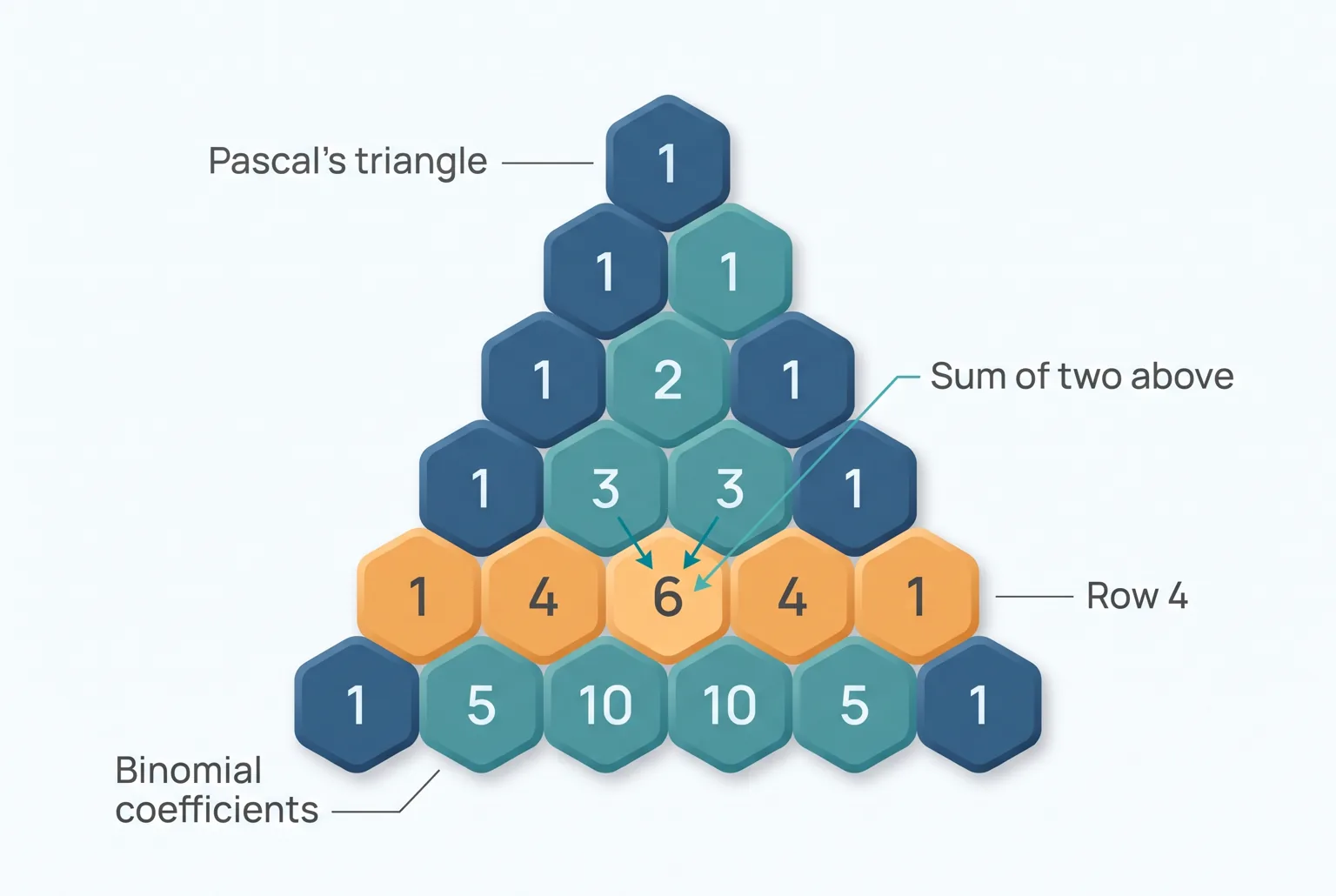
A dedicated section focuses on the numerical evaluation of large powers using the binomial theorem, such as calculating . The resource breaks this down into the sum , allowing for the application of coefficients from the fourth row of Pascal’s triangle (). This method is used to validate an Assertion-Reason question, where the assertion is the numerical result and the reason is the general binomial formula.
This portion of the material teaches students to assess not just the truth of a mathematical statement, but also the logical validity of the explanation provided. It requires learners to confirm if the binomial identity is the direct cause of the numerical result. The step-by-step solution clarifies that the reason must be a true statement and a sufficient explanation for the specific calculation in the assertion to select the correct MCQ option.
Expanding Trinomials and Higher-Order Polynomials
Case Study 2 moves into short-answer questions that require complete polynomial expansions. A notable problem involves expanding a trinomial to the fourth power: . The resource provides a methodology for this by grouping the first two terms as a single entity, , and treating as the second term. This transforms the trinomial into a standard binomial .
The solution demonstrates a nested expansion process. First, the outer binomial is expanded using the powers of and . Then, each resulting power of , such as and , is expanded individually. Finally, like terms are collected to produce the final polynomial. This rigorous exercise tests a student's ability to maintain sign accuracy and manage multiple algebraic steps without losing terms, which is a common source of error in Class 11 exams.
Applying the Theorem to Divisibility Proofs
The final subpart of the assessment uses binomial expansions to prove divisibility, a core requirement of the CBSE Mathematics syllabus. To show that is divisible by 10, the resource instructs the student to rewrite the bases as and . By expanding these using the binomial theorem, the constant terms ( and ) are shown to cancel out.
Every other term in both expansions contains at least one factor of 10 (e.g., ). This allows the student to factor out 10 from the entire expression, representing the sum as , where is an integer. This proof-based approach moves beyond simple arithmetic and teaches students how to use algebraic identities to uncover the properties of integers. It serves as a practical conclusion to the chapter, showing how theoretical expansions have direct implications in number theory.
Frequently asked questions
How does the material handle typos in questions?
The resource includes 'Accuracy notes' in the solution section that identify typos, such as missing exponents or malformed signs. It then provides the logical derivation for the intended question, ensuring students understand the underlying mathematics even when a problem is printed incorrectly.
What is the correct way to find the number of terms in $(x+y)^n + (x-y)^n$?
Based on the Case Study 1(C) solution, when is an odd integer, the number of terms is . This is because the terms with odd powers of the second variable cancel each other out.
Can the binomial theorem be used for trinomials like $(1 - x + x^2)^4$?
Yes. The resource demonstrates that by grouping two terms together, such as , you can apply the standard binomial formula and then perform secondary expansions on the internal terms.
Spotted an error? Report a correction. Practise this in the app: notes, formula sheets and mind maps.
Loading comments…