Class 11 CBSE Binomial Theorem Assessment Guide
CBSEMathematicsBinomial Theorem
This Class 11 CBSE Mathematics PDF pairs two topic-wise assessments with a mixed chapter practice set. Use it to practise expansions and coefficient questions, then apply the same ideas to numerical comparisons, divisibility and remainders.
What the assessment covers
The PDF covers Chapter 8, Binomial Theorem, and lists 39 questions with worked solutions. The first assessment focuses on the theorem for a positive integral index. It includes direct expansions, term counting and expressions that become easier once you recognise a perfect power or group parts of the expression. The second assessment moves to applications, including powers of integers and decimals, comparisons, divisibility and remainders.
The final Chapter Practice set mixes these ideas with coefficient questions and longer proofs. The distinction matters: the topic-wise assessments let you check a particular skill, while the mixed set asks you to decide which skill to use. The clickable index separates questions from solutions and divides each set by question type, including objective and short-answer questions, with long-answer questions in Chapter Practice.
Binomial Theorem | Class 11 | CBSE Assessment
In the StudentCurio app
Chapter-wise assessment questions and worked solutions cover binomial expansions, terms and coefficients, numerical evaluation, divisibility, remainders, comparisons and other applications. Useful for Class 11 students practising objective, short-answer and long-answer questions.
Check the index before choosing a term
For a positive integer , the general term in the expansion of is , where runs from to . In the standard order, the power of the first quantity falls while the power of the second rises. The two exponents add to in terms of the binomial quantities themselves; after substituting expressions for those quantities, the powers of the underlying variables need not follow that same pattern.
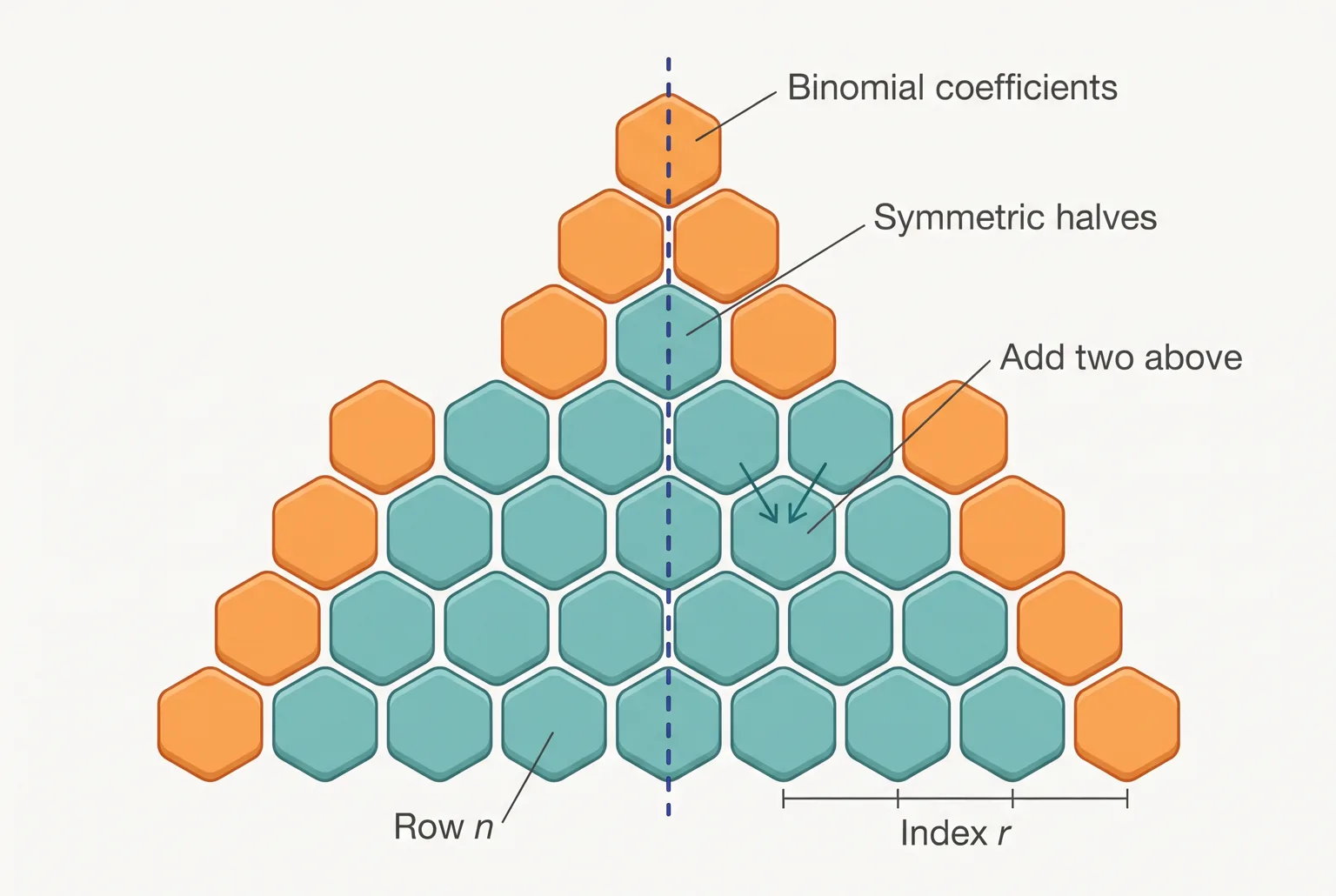
A common indexing mistake is to use the term number as . The first term corresponds to , so to find a term by position, subtract one from its position before substituting. The cover’s Pascal’s triangle shows the binomial coefficients in order. Those entries are multipliers, not necessarily the final numerical coefficients: any constants inside the binomial must also be raised to their respective powers.
Count what remains after simplification
The theorem generates terms before simplification. To count distinct terms in a final expression, first check whether the powers are distinct and whether any terms combine or cancel. Some questions are shorter if you recognise a perfect square or cube before expanding. When a three-term expression is not a convenient perfect power, grouping can let you use the theorem in stages; collect like terms at the end rather than counting each group in isolation.
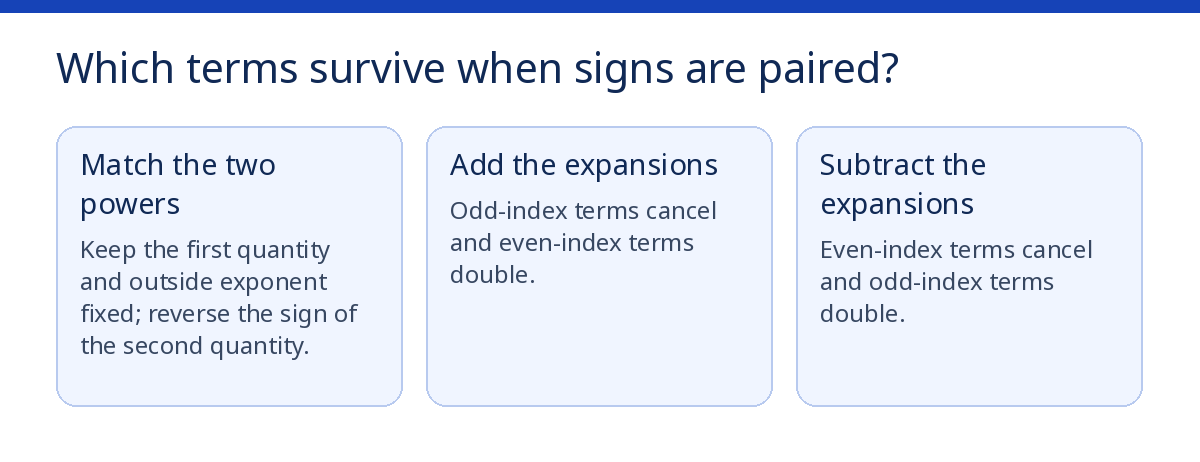
For a matched pair and , changing the sign of the second quantity multiplies the term indexed by by . Adding the expansions keeps the even values of ; subtracting keeps the odd values. Here even and odd refer to the index, not the printed term position. Apply this shortcut only after checking that the exponent and the first quantity match and that only the second quantity changes sign.
Find coefficients without expanding everything
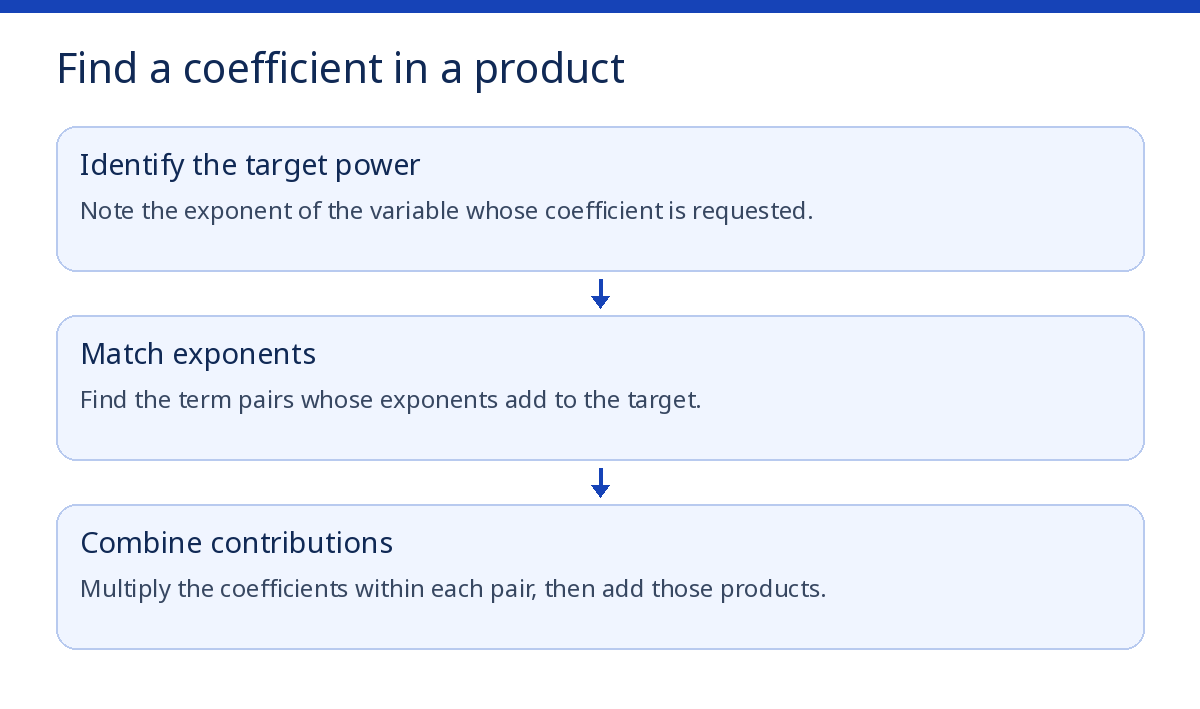
A question that asks for one coefficient does not necessarily require a full expansion. Write the general term, simplify the power of the target variable, and find which index produces the requested power. Then check that the index is an integer within the allowed range. For a product of expansions, a given power can come from several pairs of terms: identify the pairs whose exponents add to the target, then add their coefficient contributions.
Keep the original domain restrictions when simplifying. A variable in a denominator must be nonzero, even if a later expression no longer shows that denominator. With real square roots, the quantities under the roots must be nonnegative. The theorem applies to the two quantities being raised to the positive integral power; it does not remove restrictions on where those quantities are defined.
Choose a useful form for numerical applications
In the applications assessment, the same number can be written in different ways depending on the goal. For exact evaluation, expressing a base as a convenient round number plus or minus a small adjustment can simplify the arithmetic. For a large-power comparison, a full expansion may be unnecessary. If the omitted terms are all nonnegative, a partial sum gives a lower bound. Once that bound exceeds the comparison value, the comparison is settled. Do not assume this when the omitted terms can have different signs.
For divisibility and remainders, choose a form that exposes a multiple of the divisor. Terms that are multiples of the divisor do not affect the remainder, but terms without that property still need to be accounted for. In a short-answer explanation or proof, show why a group of terms can be dropped rather than simply leaving it out.
Use the linked solutions to check your reasoning
Start from the question side of the clickable index and attempt a set before opening its solutions. Keep the assessment name and original question number together, since numbering restarts across sets. Then use the solution page reference to find the matching method. For an objective question, write down the step that determined your choice. For a longer response, compare how you justified the key step, not just whether your last line matches.
Use Chapter Practice to see whether you can recognise a shortcut without the topic heading pointing you toward it. When a result differs, locate the first point of disagreement: the index, the sign, the collection of like terms or the justification for omitting terms. This guide omits the specific answers flagged in the PDF’s clarification notes for Assessment 1, Question 7 parts (iii) and (vii) and Question 9 part (xii), as well as the unclear remainder expression in Assessment 2, Question 4.
Spotted an error? Report a correction. Practise this in the app: notes, formula sheets and mind maps.

















Loading comments…