Class 11 3D Geometry: Case-Based Study of Distance and Locus
CBSEMathematicsThree-Dimensional Geometry
Master spatial coordinates, distance formulas, and geometric loci through real-world applications in this guide to CBSE Class 11 Three-Dimensional Geometry.
Transitioning to Case-Based Mathematical Reasoning
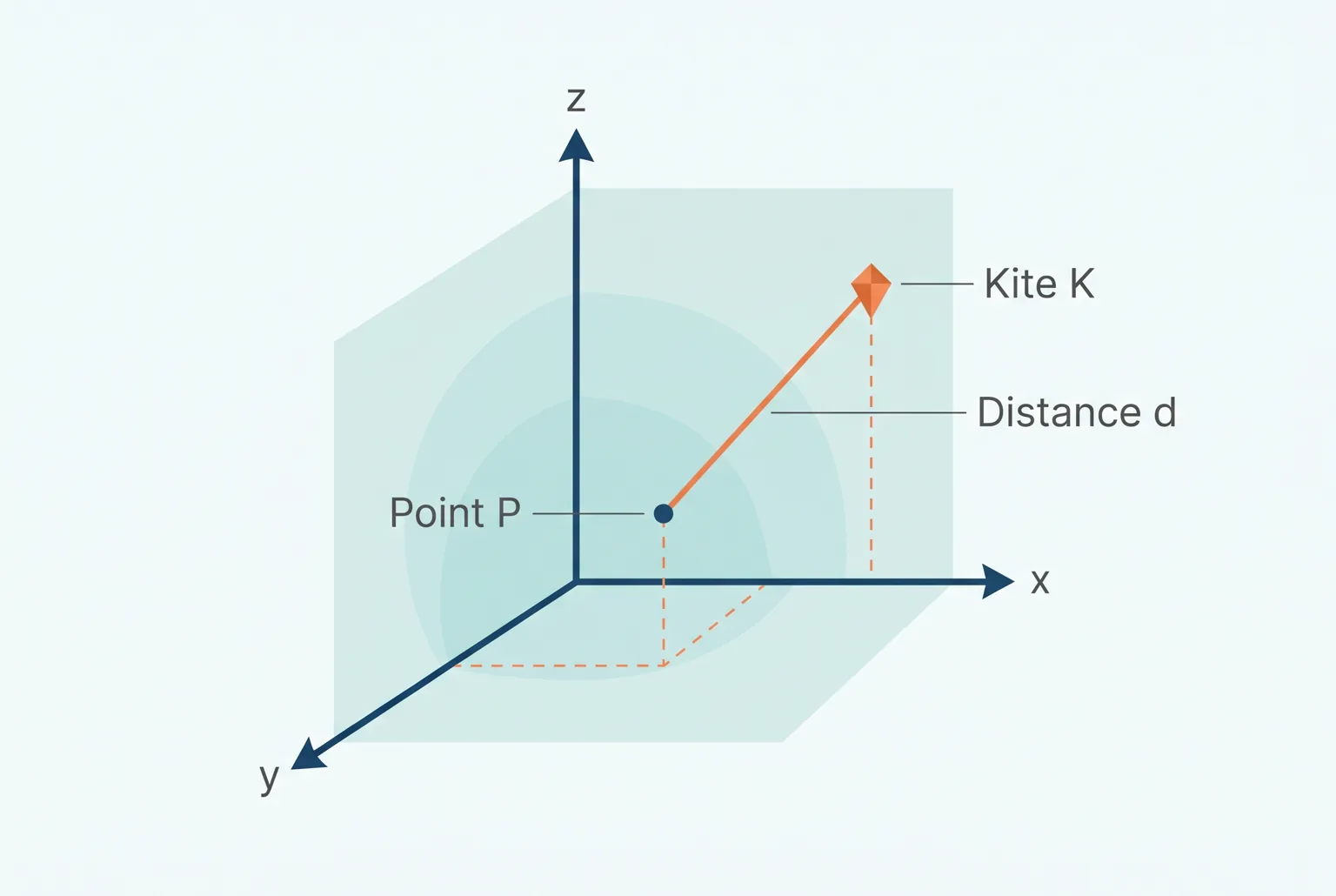
The introduction of Three-Dimensional (3D) Geometry in Class 11 marks a significant shift from the two-dimensional coordinate systems studied in earlier grades. This particular resource, a StudentCurio Case-based Assessment, is designed to align with the current CBSE curriculum's focus on competency-based learning. Instead of presenting abstract coordinates in isolation, the material utilizes real-world scenarios—such as tracking a kite in flight or measuring the dimensions of a camping tent—to test a student's ability to apply geometric principles to physical space.
The curriculum for Chapter 11 focuses on the fundamental infrastructure of 3D space: identifying octants, calculating distances between points, and determining the position of centroids and midpoints. By engaging with these case studies, learners transition from simple formula substitution to spatial modeling. This guide analyzes how the resource structures these challenges, providing a bridge between theoretical definitions and practical problem-solving in a three-axis environment.
3D Geometry Class 11 | Maths| CBSE Case Based Assessment
In the StudentCurio app
Case-based assessment questions with step-by-step solutions for Class 11 Mathematics, covering 3D coordinates, distance formula, and centroids through real-world scenarios.
Navigating the Three-Dimensional Grid
The first essential concept covered in this assessment is the orientation of points within the coordinate planes and octants. In 2D geometry, space is divided into four quadrants by the and axes. In 3D geometry, the addition of the -axis creates eight distinct regions known as octants. The resource presents a scenario where a character named Pankaj is located at . Since all three coordinates—, , and —are positive, learners must recognize that the point resides in the first octant.
Furthermore, the material emphasizes the properties of coordinate planes. For instance, in the -plane, the height or depth represented by the -coordinate must be zero. Consequently, any point in the -plane follows the general form . Understanding these constraints is vital for solving problems involving objects resting on a surface or moving within a specific boundary. The assessment requires students to identify these forms, reinforcing the conceptual link between physical surfaces and algebraic restrictions.
Proximity and the 3D Distance Formula
A primary focus of Case Study 1 is the application of the distance formula in space. The scenario involves calculating the length of string or the direct distance between individuals and a kite. The distance between two points and is defined by the formula .
The resource provides specific coordinates for a kite and Pankaj . By substituting these into the formula, the calculation becomes , which simplifies to . The assessment emphasizes precision in squaring these differences and summing them to find the radicand. A key takeaway for the learner is the importance of computational accuracy, as the resource highlights potential pitfalls in rounding and truncation during the final evaluation of square roots like and .
Spatial Midpoints and Triangle Centroids
Beyond simple distances, the material explores the internal properties of geometric shapes in space. When the kite and the two observers are treated as vertices of a triangle, the assessment asks for the coordinates of the centroid. The centroid formula in 3D is a direct extension of the 2D version, requiring the average of all three coordinates: . This measures the geometric center of the triangle formed by the flight path and the observers' positions.
Similarly, Case Study 2 introduces a camping tent where a midpoint must be found between two vertices and . Using the midpoint formula——the assessment demonstrates how these calculations often result in points lying directly on an axis or a coordinate plane. In this instance, the midpoint evaluates to , which places the 'bags' inside the tent on the -axis. This highlights how symmetry in coordinate values can simplify the spatial visualization of a problem.
Algebraic Modeling of Loci and Planes
The final section of the resource tackles the more advanced topic of the 'locus' of a point. A locus is a set of points that satisfies a specific geometric condition. In Case Study 2, learners are asked to find the equation for a set of points that maintain a fixed distance from a vertex . This fixed distance is units, representing the length of a rope. Squaring both sides of the distance formula leads to the equation of a sphere: .
The resource also includes a challenge to find the set of points equidistant from two fixed points. By setting the distances and equal and squaring them, learners must expand binomials such as and . The assessment shows that the quadratic terms () cancel out on both sides, leaving a linear equation of the form . In this specific exercise, the result is the plane . This demonstrates that the collection of points equidistant from two given points always forms a perpendicular bisecting plane.
Common Mistakes to Avoid
- Terminology Confusion: Do not use the term 'quadrant' when referring to 3D space. While the source material options occasionally use this word, the correct spatial term is 'octant'.
- Rounding vs. Truncation: When evaluating square roots like , distinguish between rounding to the nearest hundredth (31.53) and truncating the decimal (31.52). Exam options may sometimes use truncation, so check the calculations carefully.
- Square Root Simplification: Ensure that constants are calculated correctly before taking the square root. For example, in the distance between and , the radicand is 4. The square root is 2, not 4. Always double-check the final root extraction.
- Sign Errors in Locus Equations: When expanding terms like , it becomes . Mismanaging signs during expansion is a frequent source of error in deriving the final equation of a plane or sphere.
Quick Self-Check
- Can you identify which coordinate must be zero for a point to lie on the -plane?
- If you are given three vertices of a triangle, do you know the specific formula to find its geometric center in 3D space?
- When finding a locus equidistant from two points, why do the , , and terms always disappear?
- What is the geometric shape represented by an equation where the distance from a fixed point is constant?
Frequently asked questions
How many octants are there in a three-dimensional coordinate system?
There are eight octants in a 3D system, determined by the positive and negative directions of the , , and axes.
What is the general form of a point located in the XY-plane?
Any point in the -plane has a -coordinate of zero, so it takes the form .
What does the equation of a locus equidistant from two points represent?
It represents a plane that acts as the perpendicular bisector of the line segment joining the two points.
How do you calculate the centroid of a triangle in 3D space?
The centroid is calculated by taking the average of the , , and coordinates of the three vertices: .
Spotted an error? Report a correction. Practise this in the app: notes, formula sheets and mind maps.
Loading comments…