Redox Reactions: CBSE Class 11 Case-Based Assessment
CBSEChemistryRedox Reactions
This CBSE Class 11 Chemistry assessment uses four cases to connect oxidation numbers and electron transfer with galvanic cells and metal displacement. Use the worked solutions to check your reasoning, and read the editorial notes where the printed questions are ambiguous.
What the four cases ask you to practise
The assessment pairs two short-answer experiment cases with two multiple-choice cases. The first experiment case introduces redox couples and a galvanic cell; the last looks at what happens when a metal strip is placed directly in a solution containing another metal’s ions. Between them, the multiple-choice cases cover oxidation-number rules, Stock notation, the meaning of oxidation and the conditions under which a substance can act as either an oxidant or a reductant.
The questions come before the worked solutions. The clickable index takes you to each case, and the individual links let you check one subquestion and return to it without reading ahead. For multiple-choice items, write down the rule that supports your choice before opening the solution. For experiment items, distinguish what the passage reports from what your explanation must infer.
Redox Reactions | Class 11 | Case-based Assessment
In the StudentCurio app
Case-based questions with worked solutions on oxidation and reduction, redox couples, oxidation numbers, oxidising and reducing agents, and the zinc–copper displacement reaction. Helps Class 11 students practise applying redox concepts in experimental and electrochemical contexts.
Redox couples and the two paths through a cell
A redox couple contains the oxidised and reduced forms of the same chemical species, conventionally written with the oxidised form first. Think of the two forms as the endpoints of a half-reaction. The slash separates them; it is not an arrow showing which way the half-reaction proceeds. That direction depends on what is happening in the cell.
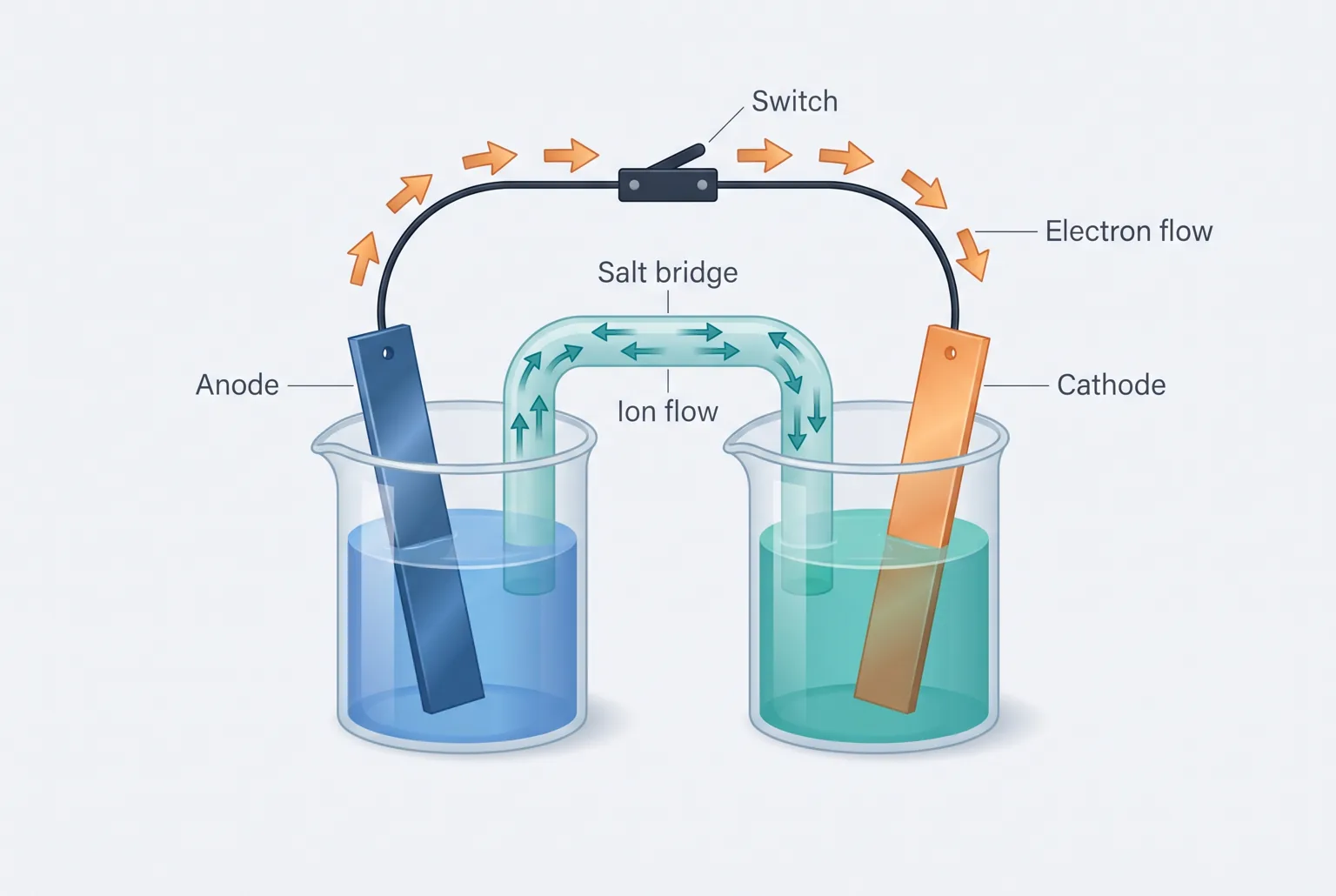
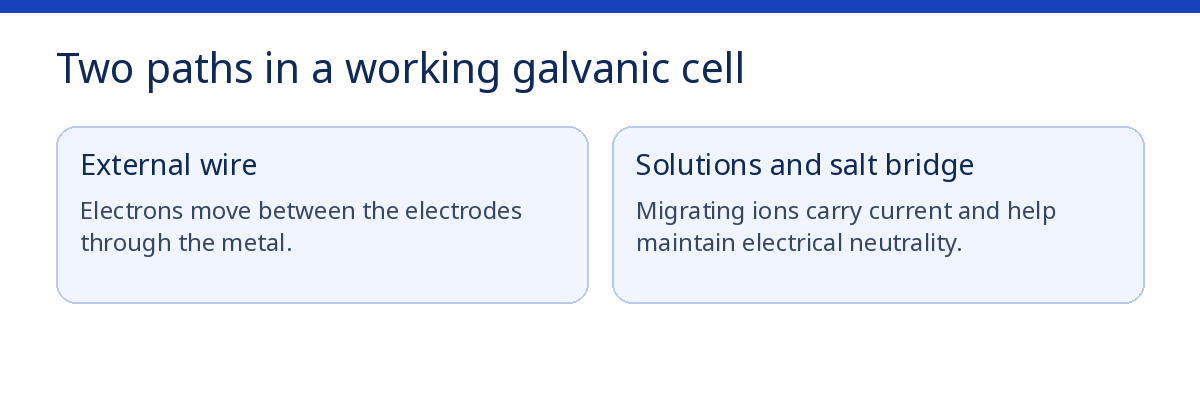
When reading the two-beaker diagram, trace the metallic path and the ionic path separately. Electrons travel through the external wire, whereas migrating ions carry current through the solutions and the salt bridge. The bridge provides the ionic connection and helps maintain electrical neutrality; it is not a route for free electrons between the beakers. An open switch prevents sustained current through the wire, even though a potential difference can still exist between the electrodes.
When the oxidation-number sum rule applies
An oxidation number is a formal bookkeeping value, not necessarily the actual charge on an atom in a compound. The sum of the oxidation numbers, counting every atom, equals zero for a neutral formula and equals the overall charge for an ion. In a formula with a subscript outside brackets, that subscript multiplies the contribution of the entire group. In a hydrated formula, each water molecule contributes zero to the total, even though its hydrogen and oxygen atoms have nonzero oxidation numbers.
Treat familiar assignments as rules with conditions. Oxygen is commonly , but that value does not apply to oxygen in a peroxide. Likewise, the familiar halide value of is not a blanket assignment for a halogen in an oxyacid. If you are comparing two formulas, set up the charge balance for each rather than inferring an oxidation number from a subscript alone.
Stock notation names a state, not an atom count
In Stock notation, a Roman numeral in parentheses follows the element name and specifies its oxidation state. It does not count atoms, and it is not inserted into the ordinary chemical formula. Keep naming and calculation separate: first use the formula and overall charge to determine the oxidation state; then check how that value should appear in the name.
This distinction matters because the assessment retains the malformed choices in its Stock-notation item. The accompanying note identifies a problem with the printed choices and key. This guide leaves those choices and the disputed key out. Use the item to practise checking whether a proposed name and formula agree, rather than assuming that one of the printed options must be valid.
Common mix-up: an agent versus what happens to it
Oxidation is loss of electrons and corresponds to an increase in oxidation number; reduction is gain of electrons and corresponds to a decrease. The older description of oxidation as addition of oxygen works for suitable reactions, but oxygen need not be present for oxidation to occur. In a full redox reaction, look for both changes, even if the wording draws your attention to only one.
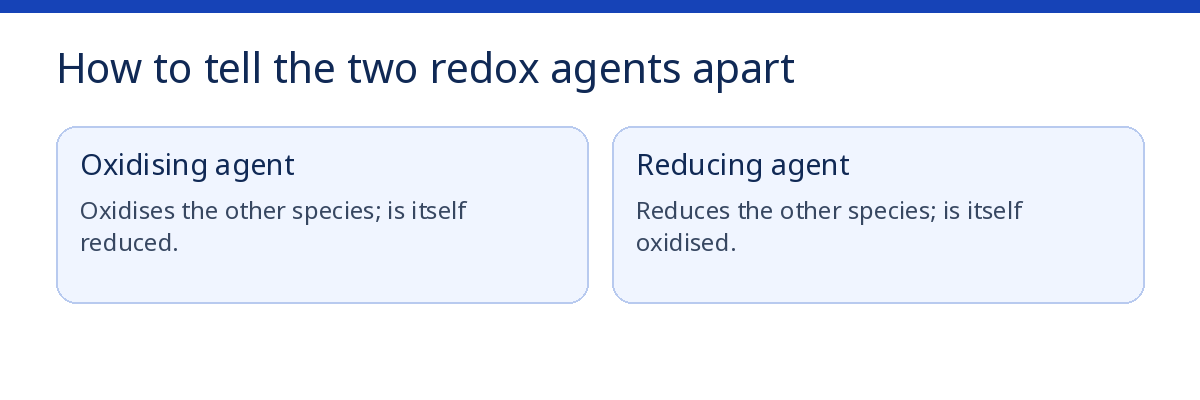
An oxidising agent causes another species to be oxidised and is itself reduced. A reducing agent causes another species to be reduced and is itself oxidised. An intermediate oxidation state can leave room for a change in either direction, but that does not mean the substance plays both roles in every reaction. Its role depends on the reaction partner and conditions.
Quick self-check: observation or inference?
The displacement case puts a metal strip directly into an ionic solution, rather than separating the two half-reactions into beakers connected by a wire and a salt bridge. As you read, sort the reported changes to the strip and solution from the claims about which particles react. A fading colour can indicate depletion of the species responsible for it; it does not by itself identify a new dissolved ion. Complete colour loss also depends on how far the reaction proceeds.
Before opening the solution, ask: Which statements could I make just by looking, and which require a chemical model? Then check your half-reactions for both atom and charge balance. When combined, they must cancel the electrons. Use the distinction between a net ionic equation and a molecular equation to explain why spectator ions appear in one representation but not the other.
Which passages need extra care
The opening cell passage mixes two apparatus descriptions and does not specify which switch position it means. This guide leaves out the mixed apparatus details and uses the labelled two-beaker diagram and its open- and closed-circuit explanations. The oxidation-example item also admits more than one interpretation of the printed options, so this guide does not reproduce them or select a preferred answer. The misprinted atmospheric oxygen figure is omitted as well. These local issues do not prevent you from using the other items to test the underlying concepts.
Spotted an error? Report a correction. Practise this in the app: notes, formula sheets and mind maps.


Loading comments…