Structure of Atom: CBSE Class 11 Case-Based Assessment
CBSEChemistryStructure of Atom
This CBSE Class 11 Chemistry assessment uses four cases to connect hydrogen spectra, the photoelectric effect, matter waves and quantum numbers. Use the linked solutions to check not just your calculations, but also the assumptions behind them.
How to use the four cases and their linked solutions
The assessment mixes short answers, multiple-choice items and calculations. The first case starts with a hydrogen emission diagram. The second moves from photons and photoemission to energy in a Bohr orbit. The third pairs matter waves with the uncertainty principle, and the fourth asks you to interpret quantum numbers and subshells.
Attempt each case before opening its solution. Use the direct links to compare the step where your reasoning diverged, then return to the question. Pay particular attention to the correction notes: a mismatch can come from an imprecise option rather than a calculation error. This guide leaves out disputed choices in the photoelectric and uncertainty items and does not interpret the orbital-angle prompt, whose solution is not in the available excerpt.

Structure of Atom | Class 11 | Case-based Assessment
In the StudentCurio app
Case-based questions and worked solutions cover photoelectric effect, hydrogen spectral transitions, Bohr energy levels, de Broglie matter waves, the uncertainty principle and quantum numbers. Useful for Class 11 Chemistry students practising atomic-structure concepts and checking their reasoning.
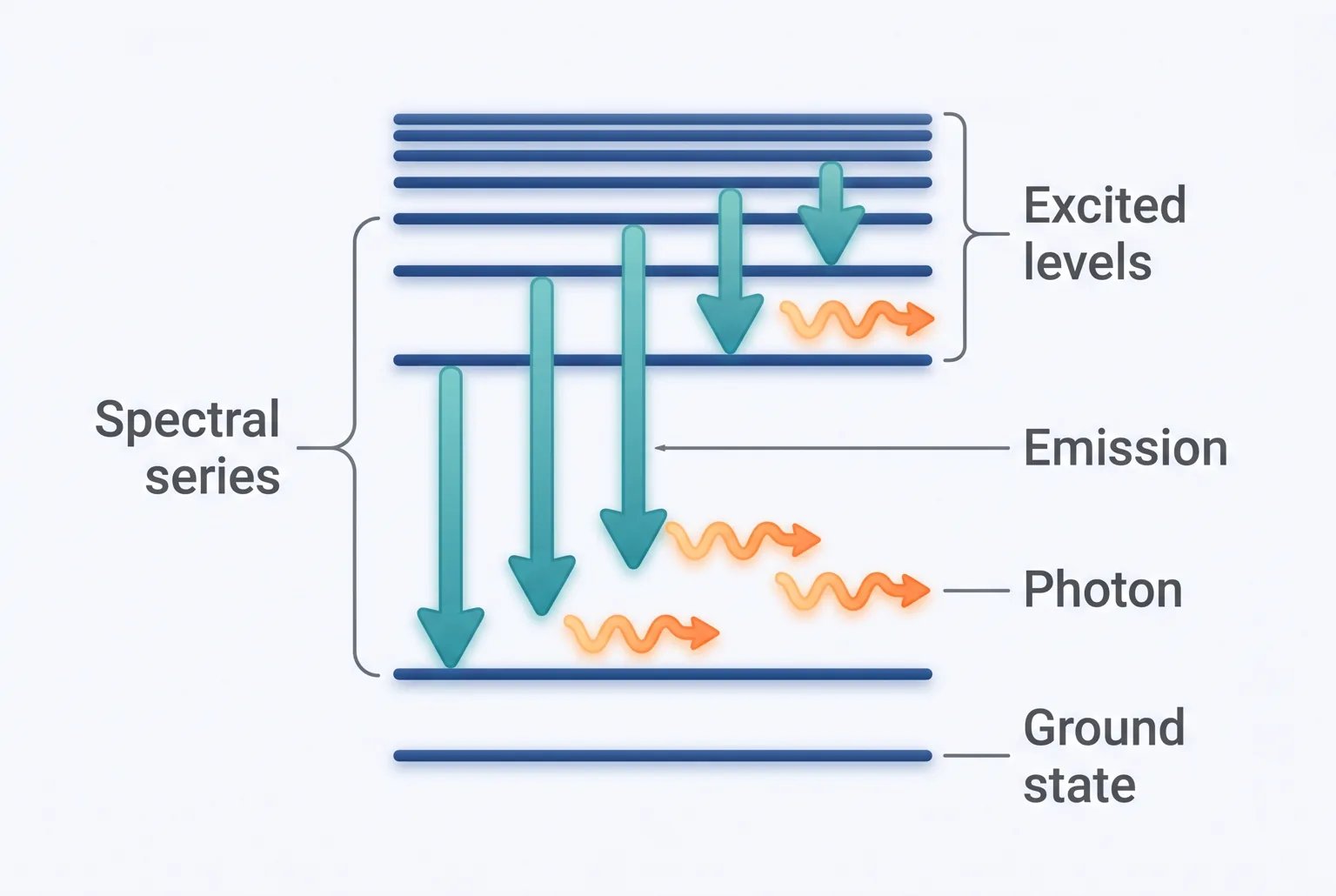
Read hydrogen spectra by following the final level
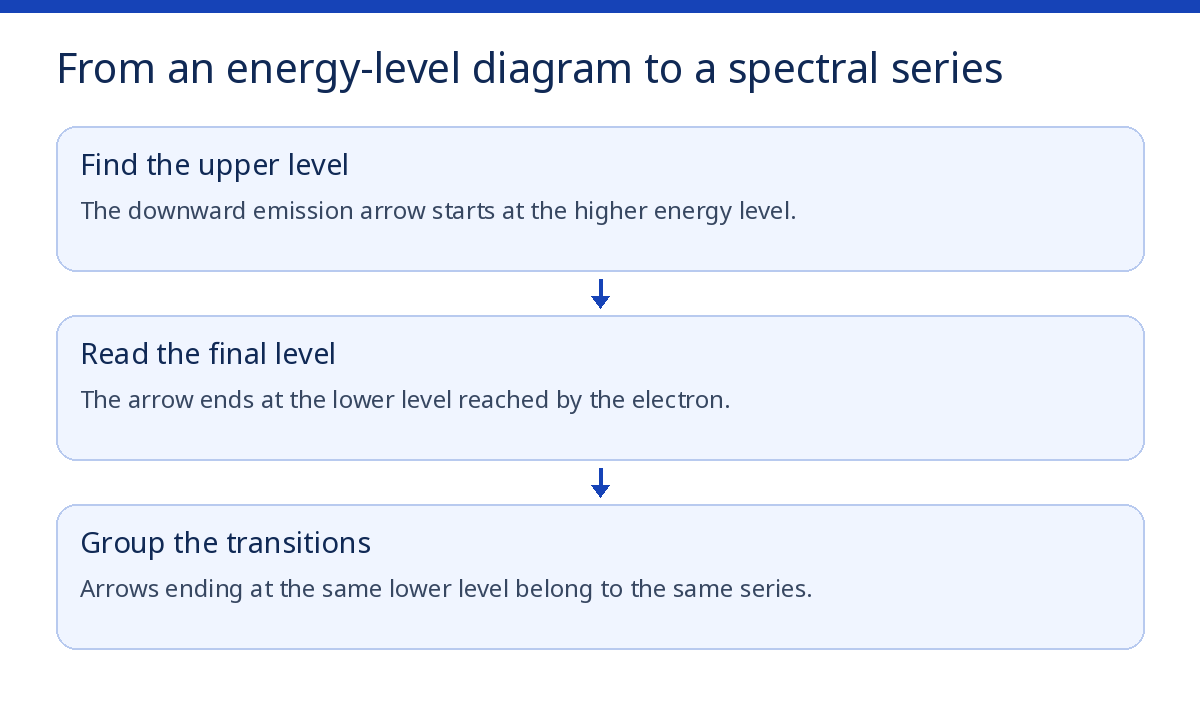
In the first case’s diagram, each downward arrow represents emission: an electron moves to a lower allowed energy level, and the photon carries away the energy difference. A spectral series groups transitions by the level where they end, even when they start at different levels. Use the level labels to identify that grouping and the printed wavelengths to compare the lines. The diagram’s spacing is schematic, so the drawn length of an arrow is not a scale for photon energy.
For a wavelength comparison, convert nanometres, micrometres and ångströms to the same unit before ranking anything. From , a shorter wavelength means a higher photon energy, while equal wavelengths mean equal photon energies. The case also compares hydrogen with singly ionised helium, which has one electron. That comparison uses the hydrogen-like model with a common Rydberg constant, while accounting for the different nuclear charges.
Photoemission: separate frequency from intensity
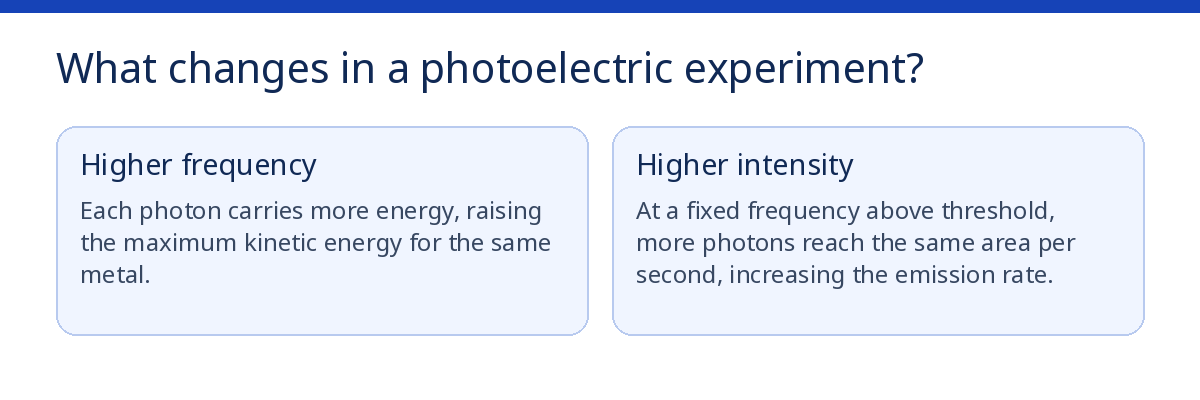
The second case asks you to distinguish the energy delivered by one photon from the number of photons arriving at the metal. A photon’s energy is . The work function is the minimum energy needed to remove an electron from the surface, so the threshold frequency is . At or above threshold, the maximum photoelectron kinetic energy is . This is the energy of the fastest electrons, not a claim that all emitted electrons have that energy.
For a fixed metal, maximum kinetic energy increases linearly with frequency above threshold. It is directly proportional to the frequency above threshold, not to the total frequency. By contrast, increasing intensity at a fixed frequency above threshold delivers more photons per second to the same area. With the illuminated area and observation time held fixed, more electrons can be emitted. Increasing intensity below threshold does not make an individual photon energetic enough to eject an electron.
Sign check: kinetic and potential energy in a Bohr orbit
The orbital-energy item in the same case concerns a bound electron, not a photoelectron leaving a metal. In the circular Coulomb orbit of the Bohr model, the kinetic energy is positive. The electrostatic potential energy is negative when its zero is set at infinite separation. The signed relation is , or equivalently .
When checking the linked working, notice the difference between a signed quantity and its magnitude. The minus sign does not mean that the kinetic energy is negative; it compensates for the negative potential energy. Do not carry this result over to an arbitrary potential simply because an electron is described as bound.
Matter waves: know when to use mass times speed
The third case connects the de Broglie wavelength to momentum through . For a material particle moving at a non-relativistic speed, you can substitute . The calculation has a useful unit check: dividing Planck’s constant in joule-seconds by momentum in kilogram metres per second leaves metres.
The case puts electron diffraction alongside a calculation for an everyday moving object. Diffraction shows the wave behaviour of electrons, while the larger momentum of an ordinary moving object can make its associated wavelength too small for wave behaviour to be readily observed. Keep the photon argument separate from the matter-wave calculation: the photon relation motivates the wavelength–momentum connection, but it is not an energy formula for a massive particle.
Uncertainty check: a lower bound is not a measurement
The position–momentum relation is an inequality: . Here the position and momentum uncertainties refer to the same direction. For a specified position uncertainty, the equation sets a minimum momentum uncertainty; the actual value can be greater.
That distinction matters when the case gives information about two different particles. Equal position uncertainties imply equal lower bounds on their momentum uncertainties, not equal actual momentum uncertainties. Before consulting the solution note, ask whether the question gives a measured uncertainty or asks for the smallest one the inequality allows.
Quantum numbers label states, not trajectories
The final case shifts from the Bohr picture of an orbit to the quantum description of an orbital. The principal quantum number labels the shell; the orbital angular momentum quantum number identifies the subshell and is related to orbital shape. The magnetic quantum number labels the projection of orbital angular momentum and does not distinguish energies within a subshell in zero external field. The spin quantum number labels the spin projection.
Use the Pauli exclusion principle to connect these labels to occupancy: no two electrons in an atom can have the same set of four quantum numbers. Two electrons occupying the same orbital share the three orbital labels, so their spin projections must differ. This is a statement about allowed quantum states, not about electrons following different paths around the nucleus.
Spotted an error? Report a correction. Practise this in the app: notes, formula sheets and mind maps.








Loading comments…