Some Basic Concepts of Chemistry: Class 11 Case Studies
CBSEChemistrySome Basic Concepts of Chemistry
This CBSE Class 11 Chemistry assessment uses four case studies to practise classifying matter, counting particles, comparing concentration measures and applying balanced equations. The worked solutions and their correction notes help you check not just your result, but also the units, definitions and assumptions behind it.
What the four cases ask you to do
The file contains four case studies with 16 subquestions. Classification of matter uses short answers, while particle counting and concentration use multiple-choice questions. The final case combines numerical and short-answer questions on stoichiometry. That mix lets you test whether you can explain a distinction in words as well as select or calculate a quantity.
The questions come before the worked solutions. The clickable index takes you to each case or its solution section, and each subquestion has a direct solution link. When using the file for revision, finish a case before opening its solutions. Then check whether you chose the right principle, even if your final result matches an option.
Some Basic Concepts of Chemistry | Class 11 | Case-based Assessment
In the StudentCurio app
Case-based questions with worked solutions practise mole and particle calculations, concentration terms, mass percentage, limiting reagents and stoichiometry. Suitable for Class 11 students applying and revising fundamental chemistry concepts.
Classify matter by composition, not appearance
The first case asks you to distinguish elements, compounds and mixtures. Elements and compounds are both pure substances. An element contains one kind of atom, whereas a compound contains two or more elements chemically combined in a fixed proportion. The components of a mixture are not chemically combined into a single substance, and their proportions can vary.
Deciding whether something is a mixture comes before deciding whether it is homogeneous or heterogeneous. A homogeneous mixture is uniform throughout; a heterogeneous mixture is not. A sample can therefore look uniform without being a pure substance. The case also compares gas and vapour. In that discussion, what matters is the substance’s usual physical state at room temperature and ordinary atmospheric pressure. Vapour is not restricted to substances that are usually liquids; it can also arise from a solid.
Good to remember: Name the entity before counting
The second case links sample mass, amount in moles and the number of specified entities. When mass is given, divide it by the molar mass, using compatible units, to find the amount in moles. Multiplying that amount by the Avogadro constant counts the entities associated with that molar mass. If the question asks for atoms within molecules or valence electrons within ions, you then need the number of those smaller entities per molecule or ion. Total electrons and valence electrons are not interchangeable counts.
Keep molecular mass and molar mass distinct even when their numerical values match: molecular mass can be expressed in unified atomic mass units (u), while molar mass is expressed here in grams per mole. For a stated amount of gas, changing temperature and pressure does not change its particle count, but it can change its volume. The assessment uses the textbook molar-volume approximation of at and , not as a universal conversion.
Common mix-up: Which quantity goes in the denominator?
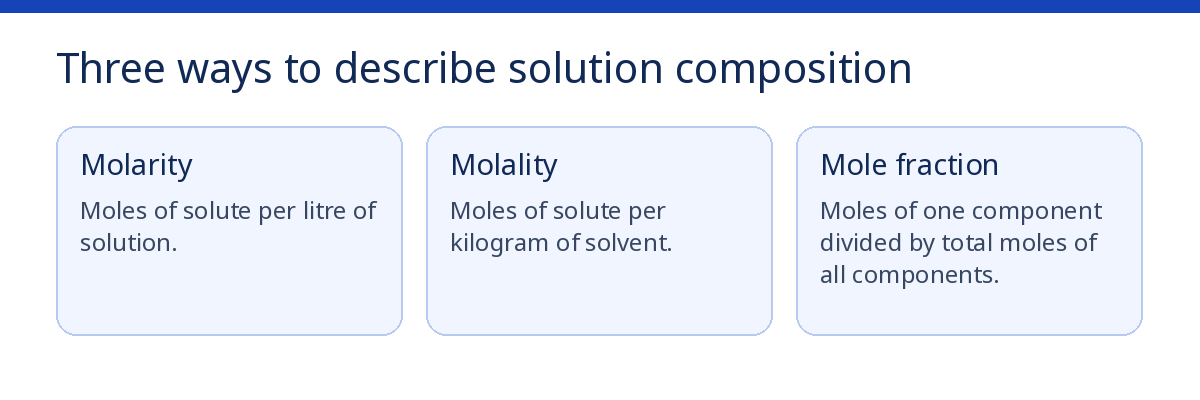
In the concentration case, look at what the amount of solute is being compared with. Molarity uses litres of the whole solution; molality uses kilograms of the solvent alone. For a solution of fixed composition with no material lost, changing temperature does not change the solute amount or the solvent mass. Molality therefore stays the same under those conditions, while molarity can change because the solution volume can change.
Mole fraction compares the amount of one component with the total amount of all components, both expressed in moles. It has no unit. A binary solution has two components; they need not both be liquids. The case also tests mass percentage in a compound. There, compare an element’s mass contribution with the total mass of the compound on the same basis, then multiply by 100. A mole fraction compares amounts in moles, whereas a mass percentage compares masses.
When the smallest reactant amount is not the limiting one
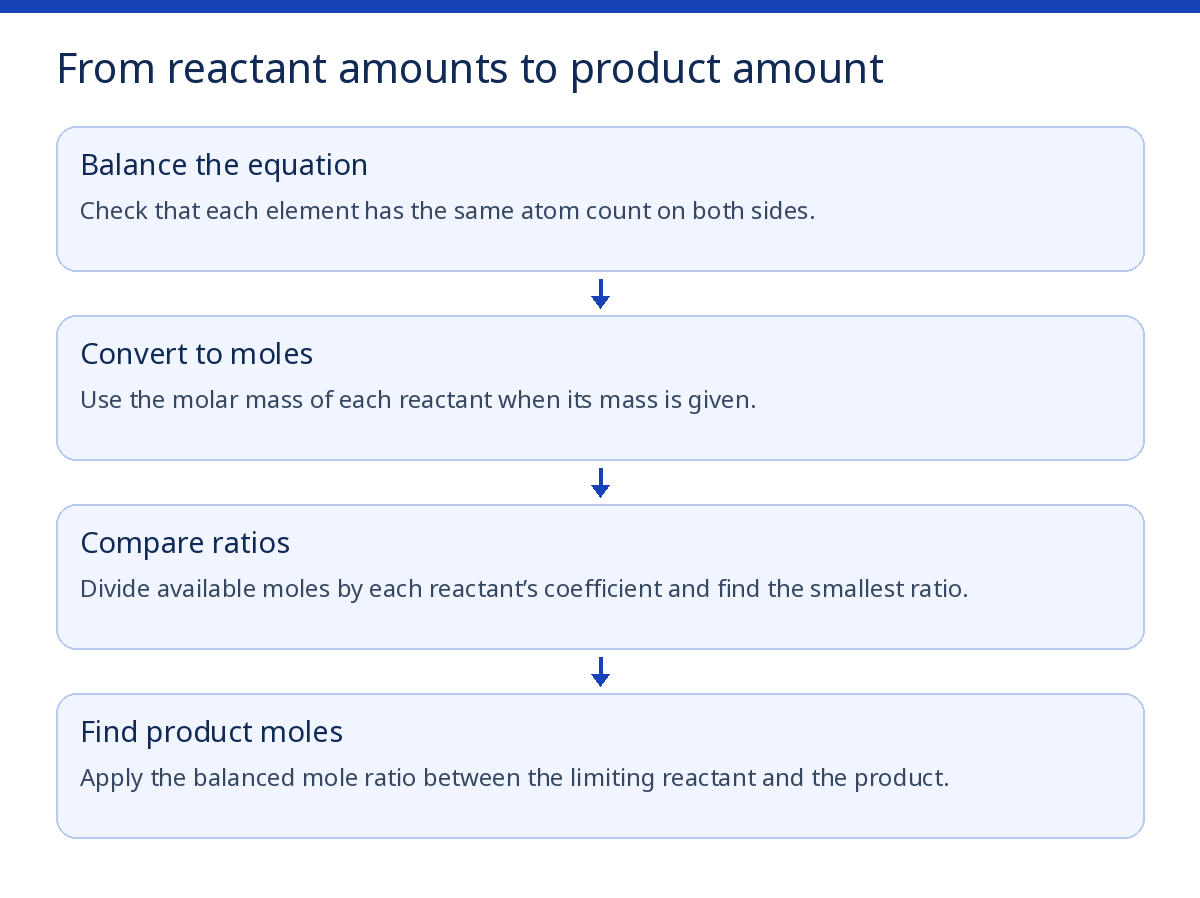
The last case uses a balanced equation to turn available reactant amounts into a predicted product amount. Balancing preserves the number of atoms of each element and provides the mole ratios for the calculation. The coefficients tell you how many moles react together, not how many grams. Comparing the given masses directly can therefore point to the wrong reactant.
Convert each reactant amount to moles, then divide by its coefficient in the balanced equation. The smallest ratio shows which reactant runs out first if the reaction proceeds to completion. If the ratios are equal, the reactants are supplied in exact stoichiometric proportion and neither is in excess. Use the balanced mole ratio between the limiting reactant and the product to find the product amount. Convert that amount to mass only if the question calls for it.
Use the solution notes to check your reasoning
When reviewing a multiple-choice case, write down the quantity and unit you expect before looking at the options. For a numerical question, check the balanced equation and the mole ratio before comparing the arithmetic. This helps you tell a wrong setup from a rounding or unit issue.
The file places correction and ambiguity notes beside the affected solutions. Read those notes along with the working rather than treating every printed option as a model answer. This guide leaves out the disputed mole-fraction option and the proposed molality of pure water. The first involves a mismatch between standard rounding and the listed choices; the second does not identify a distinct solute, as the conventional definition requires.
Spotted an error? Report a correction. Practise this in the app: notes, formula sheets and mind maps.
Loading comments…