CBSE Class 11 Chemistry: Thermodynamics Case-Based Assessment
CBSEChemistryThermodynamics
This CBSE Class 11 Chemistry assessment uses eight case studies to connect thermodynamics rules with physical situations. Use the linked solutions to check whether you chose the right system boundary, sign convention and conditions for each rule.
How the assessment is organised
The PDF contains 31 subquestions across eight passages, with multiple-choice, short-answer and calculation tasks. The cases begin with systems, internal energy and pressure–volume work, then move through enthalpy, calorimetry, ionic solids and solutions. The final two cases address entropy near absolute zero and spontaneity under given conditions.
The clickable index separates questions from solutions, and each subquestion links directly to its worked explanation. Read the passage and commit to a reason for your answer before following the link. When a solution states an assumption about an incomplete question, check whether that assumption was in the passage or had to be added. That distinction matters in cases where changing the setup changes which rule applies.
Thermodynamics | Class 11 | Case-based Assessment
In the StudentCurio app
A collection of Class 11 case-based questions and worked solutions covering thermodynamic systems, pressure–volume work, enthalpy, calorimetry, Hess’s law, entropy and spontaneity. It helps CBSE Chemistry students practise applying thermodynamics concepts to passages and scenarios.
Start by drawing the system boundary
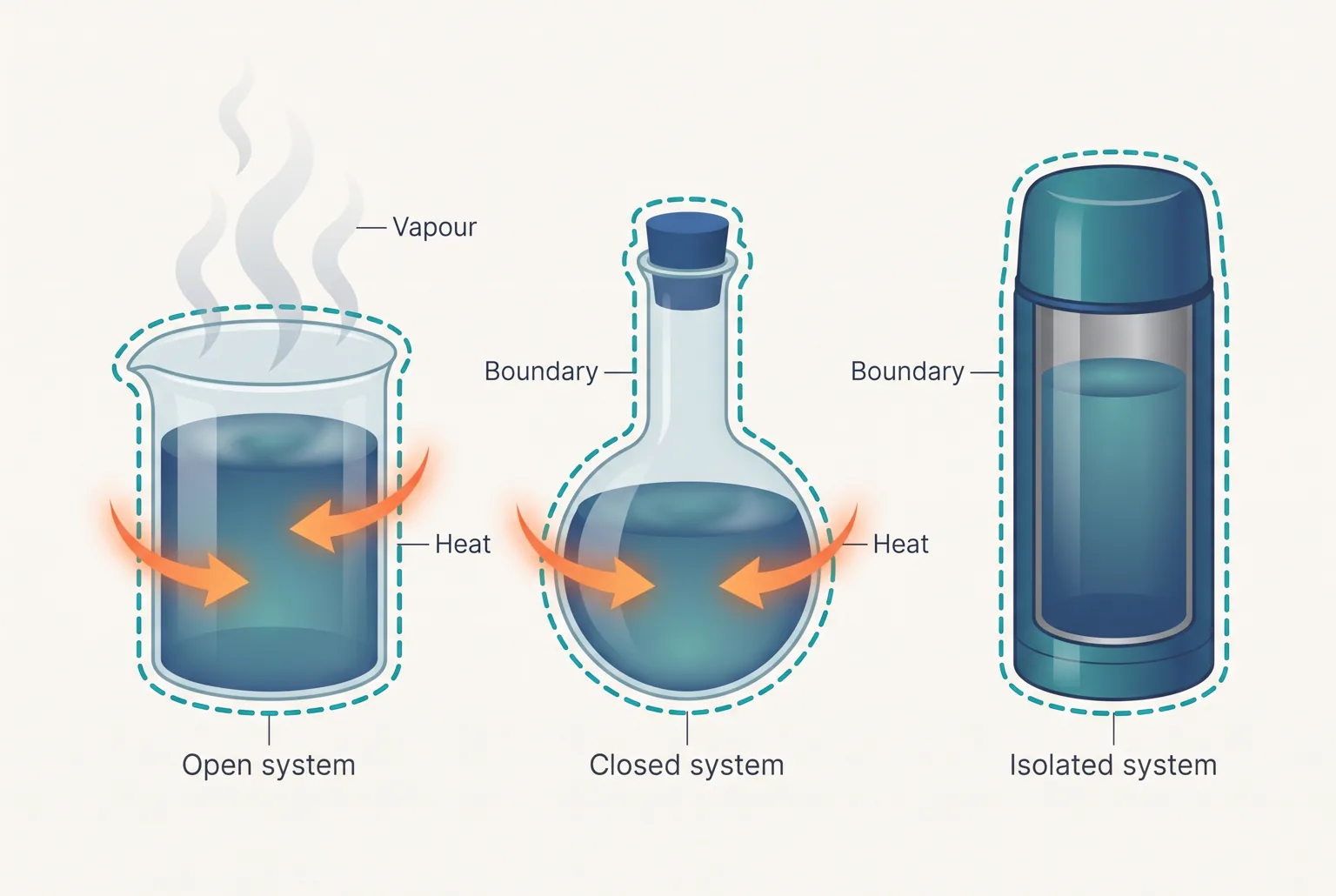
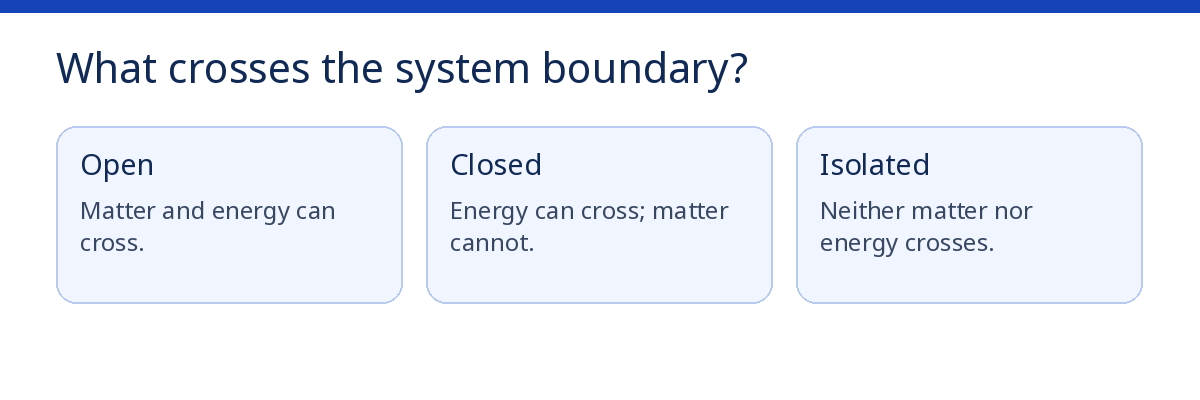
A thermodynamic system is the part of the situation you choose to study; everything outside its boundary is the surroundings. An open system can exchange both matter and energy. A closed system can exchange energy but not matter. An isolated system exchanges neither matter nor energy, whether by heat or by work.
The first case is useful because the classification depends on how the apparatus is operating, not just what it is called. Before classifying a vessel, ask whether vapour can cross the chosen boundary and, separately, whether energy can cross it. A real thermos is only an approximation to an isolated system. In an energy-balance question, that same boundary tells you whose internal energy is changing and which transfers to count.
Common mistake: mixing work-sign conventions
The assessment’s cover uses the chemistry convention : heat entering the system makes positive, and work done on the system makes positive. If a passage instead defines as work done by the system, the same balance is written . These equations describe the same energy transfers; the work symbols have different definitions.
For pressure–volume work against a constant external pressure, the chemistry work term is , where . Use the external pressure and put heat and work into compatible units before adding them. The sign of work alone does not determine the sign of the internal-energy change. Case 2 switches conventions between its passage and key and includes duplicated compression options, so this guide leaves those options and disputed answers out.
When enthalpy and calorimetry rules apply
Enthalpy is defined as ; it is a state function, not heat stored in a system. For a closed system at constant pressure with only pressure–volume work, the heat transferred equals the enthalpy change. Hess’s law follows from enthalpy being a state function: the overall change depends on the initial and final states, not the route. When combining thermochemical equations, reversing a step reverses its enthalpy sign, and scaling the equation scales its enthalpy change by the same factor.
Calorimetry starts with a measured temperature change. In , is the heat capacity of the particular body whose temperature change is measured. Total heat capacity has units of joules per kelvin; specific and molar heat capacities are expressed per unit mass and per mole, respectively. Before assigning that heat to a reaction, identify what warmed or cooled and whether the setup lets you neglect heat exchange with the outside.
A useful connection: lattice enthalpy and dilution
The Born–Haber cycle applies Hess’s law to ionic solids. It uses other enthalpy changes to infer lattice enthalpy indirectly. Before interpreting a sign, read the process direction: separating an ionic solid into gaseous ions requires energy, whereas forming the solid from those ions releases energy. The guide omits the numerical lattice item whose wording mixes separation with energy release.
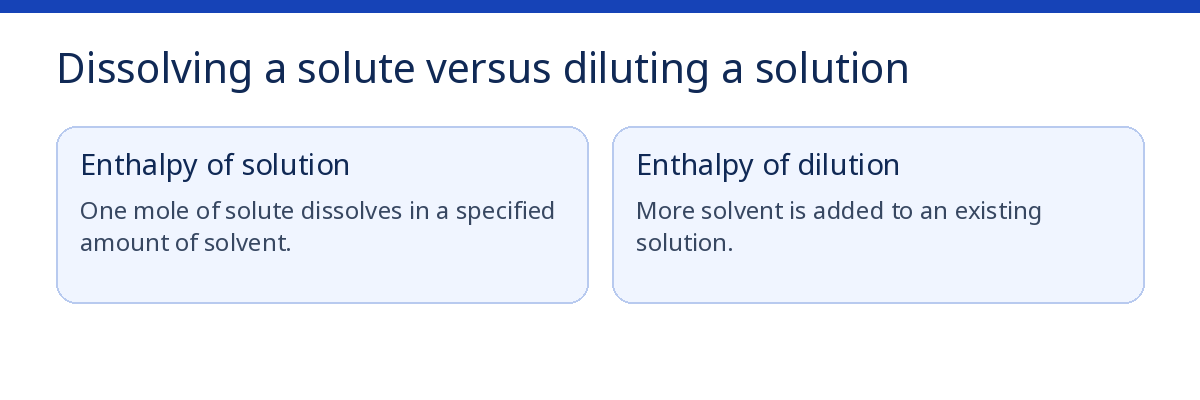
The solution cases introduce a different distinction. Enthalpy of solution refers to dissolving one mole of solute in a specified amount of solvent. Enthalpy of dilution concerns adding solvent to a solution that already exists, so the starting concentration and amount of solvent added matter. At the limit of infinite dilution, further addition of solvent produces no appreciable heat effect. That limiting behaviour does not mean dissolving the solute in the first place has zero enthalpy change.
Quick self-check: reference states and spontaneity
The third-law case asks how entropy is referenced near absolute zero. The standard zero-entropy statement applies to a perfect crystal at absolute zero; residual entropy can occur when configurational disorder remains. The Nernst statement in the passage concerns a limiting change in entropy for transitions between condensed phases, rather than assigning an absolute entropy to every system. This guide omits the passage’s broader zero-entropy claim and its numerical residual-entropy example.
The melting case shifts from an entropy reference to the direction of a process. Spontaneity depends on the conditions, and the second-law criterion considers the total entropy change of the system and surroundings, not the system alone. Before opening the linked solution, ask: Have I stated the conditions? Am I discussing an entropy value or an entropy change? If I am arguing for a spontaneous direction, have I accounted for the surroundings?
Spotted an error? Report a correction. Practise this in the app: notes, formula sheets and mind maps.
Loading comments…