CBSE Class 11 Organic Chemistry: Case-Based Assessment Guide
CBSEChemistryOrganic Chemistry: Some Basic Principles and Techniques
This CBSE Class 11 Chemistry assessment uses six cases to connect organic structures and electron movement with reaction mechanisms, purification and quantitative analysis. Use the questions-first layout to test your reasoning before opening the worked solutions and their correction notes.
What the six cases ask you to do
The assessment covers Chapter 8, Organic Chemistry: Some Basic Principles and Techniques. The classification, reaction-mechanism and steam-distillation cases use multiple-choice questions. The other three ask for short responses involving structures, explanations or a formula. That distinction matters: recognising a feature in a drawing is not the same as being able to draw it, and selecting a statement about an electronic effect is not the same as explaining why it applies.
The clickable index takes you to each case or its solution section. Try the question first, then use the Solution and Back to question links to compare your reasoning with the explanation. Read any correction note beside the solution before deciding what to revise: some notes address the wording or notation of the question itself.
Organic Chemistry: Some Basic Principles and Techniques | Class 11 | Case-based Assessment
In the StudentCurio app
Case-based questions and worked solutions cover organic compound classification, aromaticity, structures, electronic effects, reaction mechanisms, steam distillation and the Carius method. Helps Class 11 students practise core organic chemistry concepts and techniques.
Read the ring before naming the class
The first two cases build a skill that carries into the rest of the chapter: identifying which features of a structure determine its classification. Catenation is the ability of an element to bond covalently to itself. Carbon’s catenation allows chains as well as rings. In fused structures, neighbouring rings share an edge: two atoms and the bond between them. When sketching a fused system, check the shared edges as well as the number of rings; ring count alone does not specify how the rings are joined.
Good to remember: A heteroatom makes a ring heterocyclic only if it is part of the ring skeleton. Aromaticity is a separate test: Hückel’s count applies to a planar, cyclic, continuously conjugated system, with a non-negative integer. Only after establishing aromaticity should you distinguish benzenoid systems, which contain at least one benzene ring, from non-benzenoid aromatics.
Separate changes in connectivity from resonance
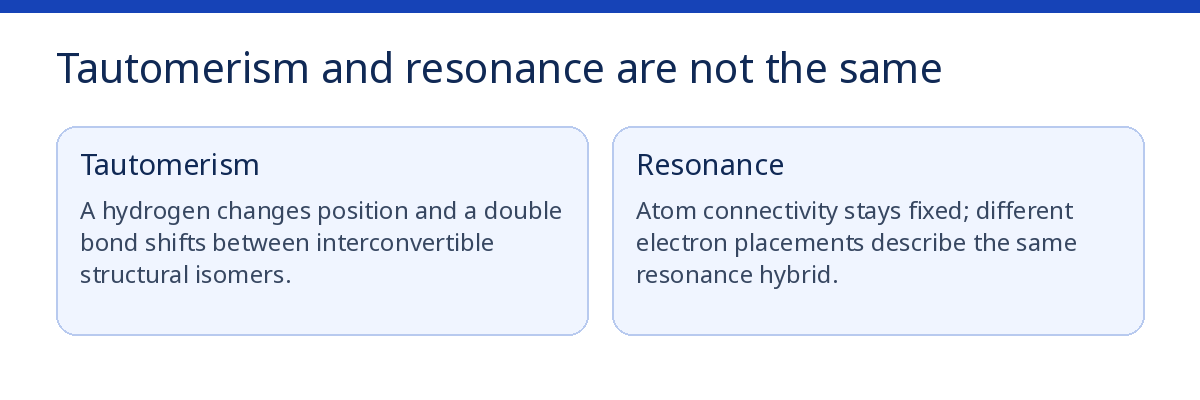
The urea case introduces a distinction that helps when you reach the reaction-mechanism case. Tautomers are interconvertible structural isomers. In the type discussed here, a hydrogen changes position and a double bond shifts. An equilibrium drawing shows that the forms can interconvert; it does not tell you that they are present in equal amounts. The urea item’s premise that tautomerism excludes isomerism is incorrect and is not used here as a valid comparison.
In resonance, the atoms retain their connectivity; it is the placement of electrons that differs among contributing drawings. Those drawings describe one resonance hybrid, not separate molecules in equilibrium. When comparing two structures, trace the atoms before inspecting the double bonds. A shift in the drawn bond position alone is not evidence that a hydrogen has moved.
Identify the electron source before comparing stability
The hyperconjugation and acidity case asks you to move from identifying an electronic effect to explaining a consequence. Hyperconjugation involves electrons from a sigma bond interacting with a suitably aligned neighbouring orbital. In a carbocation, that neighbouring orbital can be an empty p orbital. Merely spotting a C–H bond somewhere in the structure is not enough: identify where the bond sits relative to the accepting orbital. A sigma-bond electron pair is not a lone pair.
For acidity, compare the conjugate bases: Ask what happens to the species left after proton loss. In comparable structures, an electron-withdrawing inductive effect can increase acidity by stabilising that species. For the substituted phenols in the case, examine the substituent’s position as well as whether it withdraws or releases electron density. Position matters because it can change whether resonance provides additional stabilisation.
Track electron pairs through a mechanism
The mechanism case combines bond cleavage, attacking reagents, intermediates and electronic effects. In homolytic cleavage, each fragment takes one electron from the broken bond; in heterolytic cleavage, one fragment takes both. Keep the resulting species distinct: a carbocation has a positively charged carbon, a carbanion has a negatively charged carbon, and a radical has an unpaired electron. A radical dot and a charge sign convey different information.
For bond formation, identify the electron-pair donor and acceptor before relying on charge as a clue. A nucleophile donates the pair; an electrophile accepts it. An electrophile need not carry an overall positive charge. As you review the multiple-choice explanations, distinguish this donor–acceptor description from a prediction of how strongly a species will react: the resource notes that solvent and steric effects can also matter.
When steam distillation applies
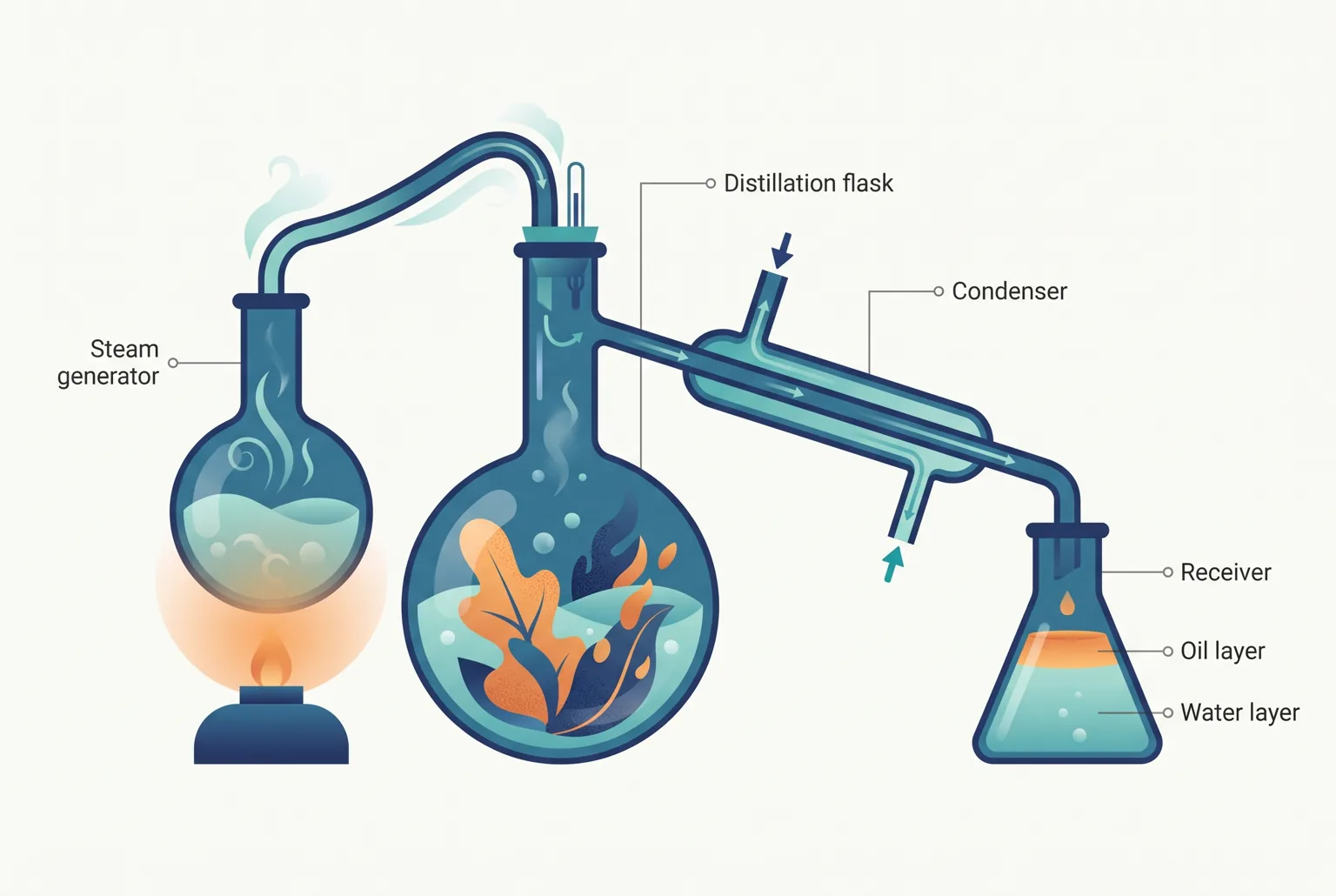
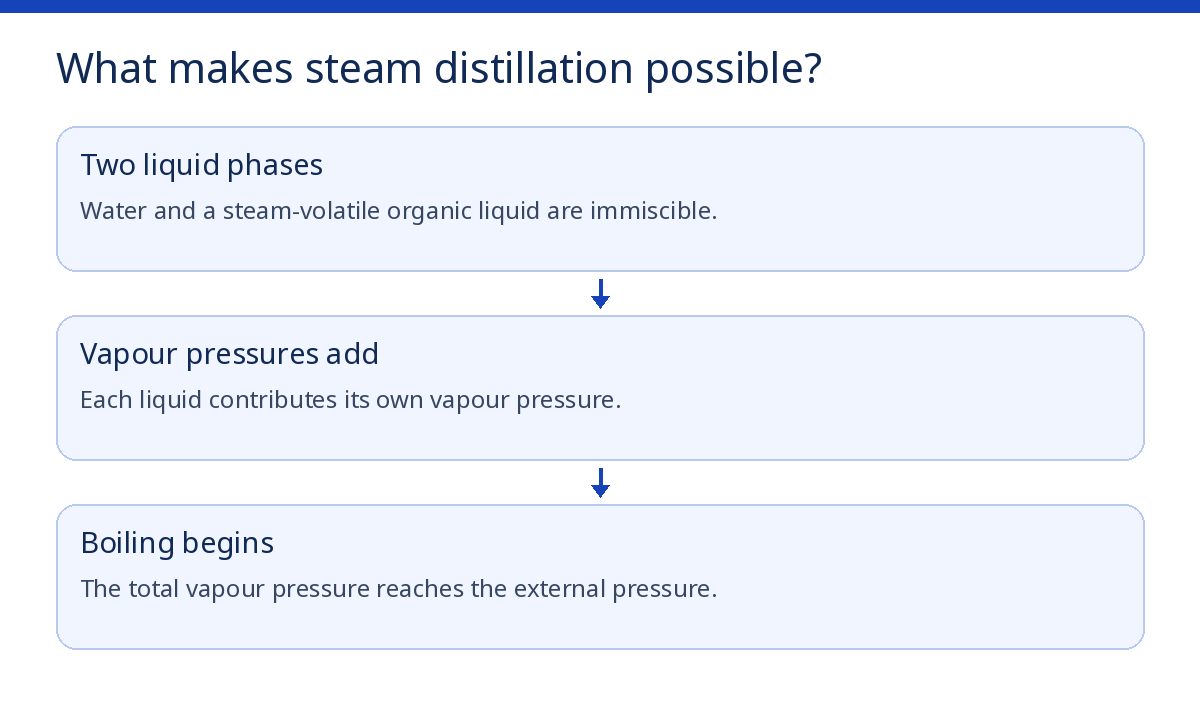
The essential-oil case puts a purification method in context. Steam distillation is suitable for an organic substance that is volatile with steam and immiscible or nearly immiscible with water. For two immiscible liquids, each contributes its own vapour pressure. Boiling begins when the sum reaches the external pressure, allowing the organic substance to distil below its normal boiling point at atmospheric pressure.
Use that principle to distinguish steam distillation from methods chosen because components differ in boiling point or distribute differently between solvents. The passage describes several ways to extract oils, so the fact that a sample comes from a plant is not enough to select a method. Look for the physical properties that make the proposed separation possible.
What the Carius method measures
The final case shifts from separating an organic substance to determining its composition. The Carius method is presented here as quantitative halogen analysis. Its logic is gravimetric: start with a known mass of organic sample and use the mass and composition of a halogen-containing product to infer the mass of halogen in that sample. The measured product contains more than just the halogen, so its entire mass cannot count towards the halogen percentage.
Before checking the formula, label the quantities in words: original sample mass, measured product mass and inferred halogen mass. Then check which quantity belongs in the numerator of the percentage and which provides the whole against which it is measured. This makes the formula a statement about the original sample rather than a string of symbols to memorise.
Spotted an error? Report a correction. Practise this in the app: notes, formula sheets and mind maps.



Loading comments…