Hydrocarbons Case-Based Assessment for CBSE Class 11
CBSEChemistryHydrocarbons
This CBSE Class 11 Chemistry assessment uses four cases to connect hydrocarbon structure with stability and reactivity. The linked explanations help you check not just what you chose, but which structural feature, reagent or condition justified your reasoning.
What the four cases ask you to do
The assessment moves from rotation about a carbon–carbon single bond to reactions at multiple bonds, then to the structure and reactions of benzene. The first and fourth cases use multiple-choice questions. The middle two use short answers and reaction schemes. In the reaction case, some entries are already displayed as conversions rather than posed as separate questions. Use those as prompts to explain what changes at each arrow and what the reagent does.
The file places the questions before the worked explanations. The index takes you to each case, and the links between individual questions and explanations let you review a sticking point without reading the rest of the section first. For a multiple-choice item, write down the deciding feature before opening the explanation; for a scheme, identify the bond or functional group that changes.
Hydrocarbons | Class 11 | Case-based Assessment
In the StudentCurio app
A Class 11 case-based assessment with worked solutions on Hydrocarbons, including alkene and alkyne reactions, conformations, and benzene structure and reactions. It helps students practise applying reaction concepts and aromaticity to case-based questions.
Read a conformation along the bond axis
The first case asks you to distinguish a change in conformation from a change in how atoms are connected. In a Newman projection, you look along a chosen bond and compare the groups on the front and rear carbons. As one end rotates relative to the other, the dihedral angle changes. In the rigid-bond model used in the explanations, that rotation does not require bond cleavage or a change in bond lengths or ordinary bond angles.
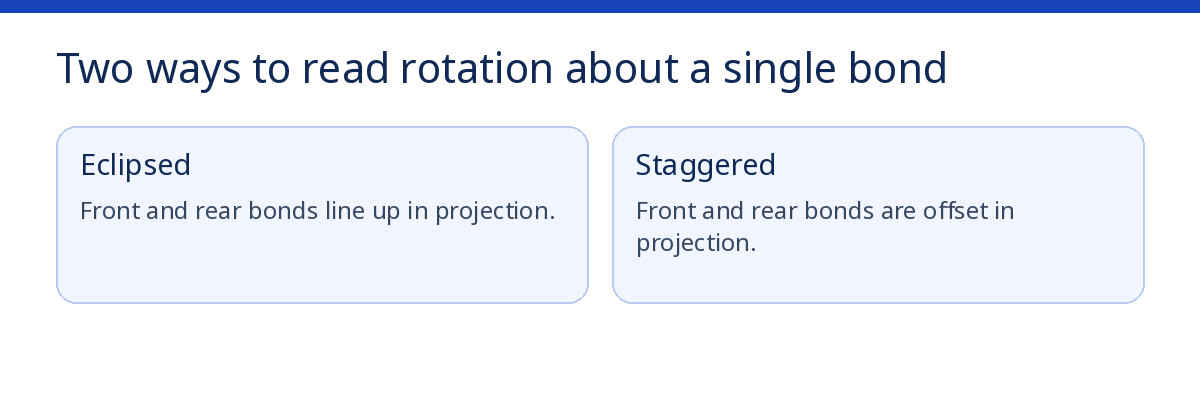
An eclipsed drawing shows bonds on adjacent carbons lining up in projection; a staggered drawing shows them offset. That distinction helps you reason about torsional strain. When larger groups are present, also consider steric repulsion between them. For a substituted molecule, first identify the pair of groups you are comparing before using the labels anti or gauche. Both labels can describe staggered arrangements; gauche is not a third category alongside eclipsed and staggered.
When the addition rule applies
An alkene double bond consists of one sigma bond and one pi bond. In electrophilic addition, the pi bond supplies electron density, and new bonds form at the carbons that made up the double bond. For an unsymmetrical alkene, the two carbons are not equivalent: regioselectivity tells you which end of the reagent attaches to which carbon.
In the usual ionic addition of a hydrogen halide to a simple unsymmetrical alkene, Markovnikov orientation places hydrogen on the less substituted double-bond carbon and the halogen on the more substituted one. But the reagent name alone does not always settle the orientation. With radical initiation by peroxides, HBr can add to an alkene in the opposite orientation; HCl and HI do not show that same peroxide effect. In an alkyne scheme, check the amount of reagent too: the first addition can leave a double bond available for another addition.
Read oxidation and carbon-chain changes separately
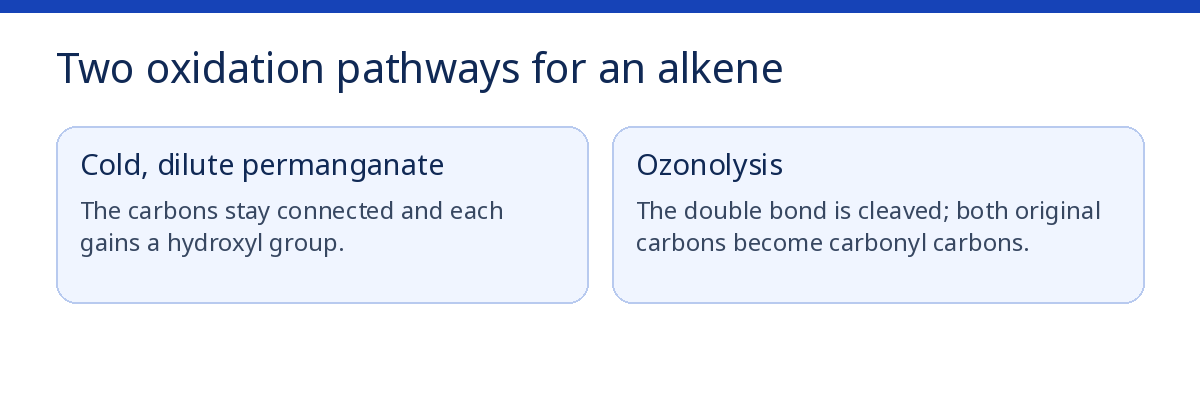
The second case contrasts two ways an alkene double bond can change. Under cold, dilute potassium permanganate conditions, the carbon skeleton stays connected and neighbouring carbons gain hydroxyl groups. Permanganate is the oxidising agent, not merely a catalyst for adding water. In ozonolysis, by contrast, the bond between the original double-bond carbons is cleaved, and those carbons become carbonyl carbons. The work-up matters: a reductive work-up can preserve an aldehyde, whereas an oxidative one can oxidise it further.
The terminal-alkyne material illustrates a different change: making a new carbon–carbon bond. A base removes a terminal hydrogen to form an acetylide, which can then react with a suitable alkyl halide. Read deprotonation and carbon–carbon bond formation as separate operations, even when a printed scheme compresses them.
Connect benzene’s bonding to its reactions
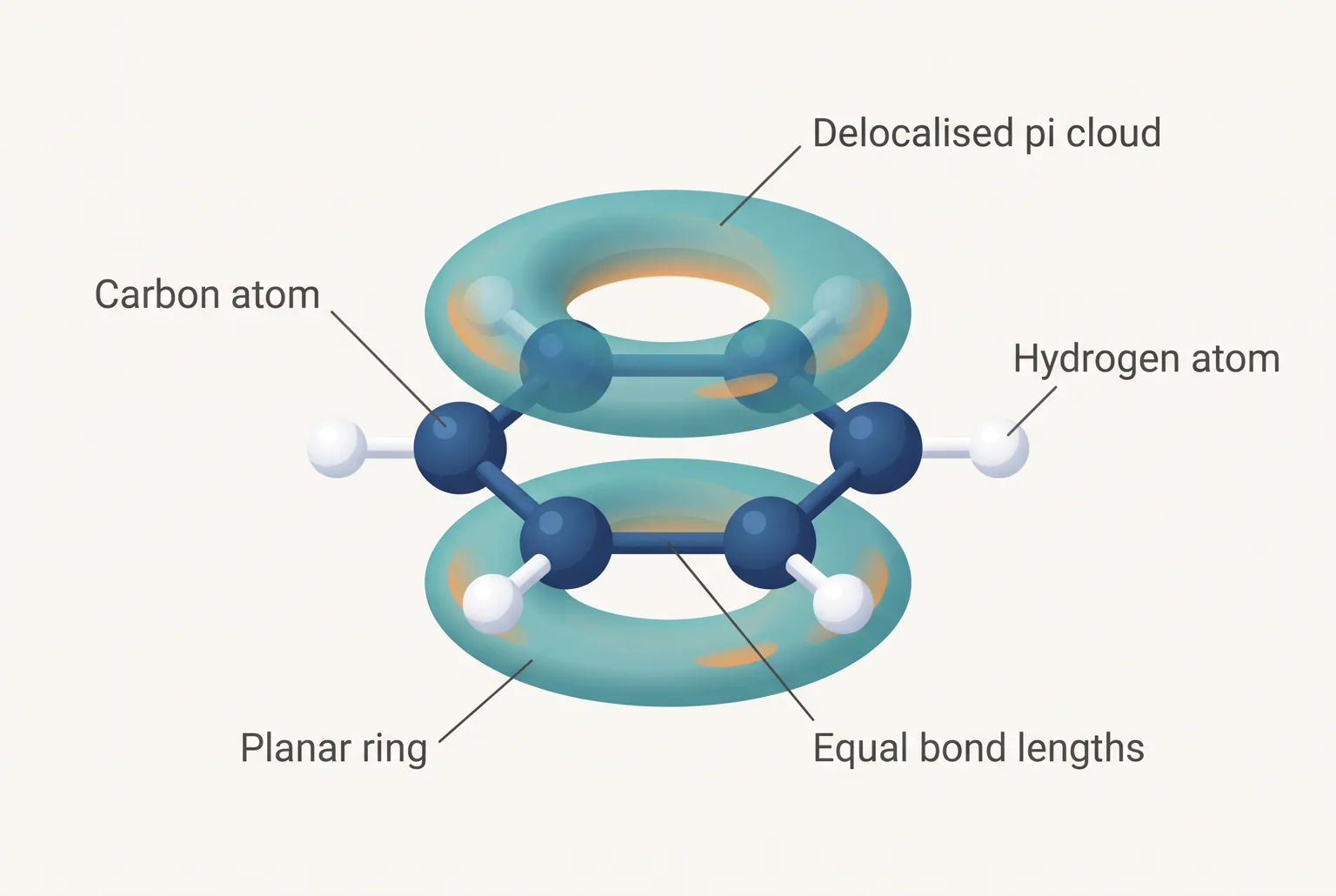
The last two cases link benzene’s structure to the reactions it favours. The ring is planar, with overlapping p orbitals that allow pi electron density to be delocalised above and below the ring. The six carbon–carbon bonds are equivalent, with lengths of about , intermediate between typical single and double bonds. The alternating-bond drawings are resonance contributors to one delocalised structure, not separate molecules or a picture of three fixed double bonds.
That stabilisation helps explain why electrophilic aromatic substitution differs from ordinary alkene addition. In nitration, the acid mixture generates an electrophile. The ring temporarily loses aromaticity when a new bond forms, then regains it when a proton is lost. Hydrogenation, by contrast, removes aromatic stabilisation and requires vigorous conditions. To use Hückel’s rule beyond benzene, first check that the system is cyclic, planar and continuously conjugated; only then test whether its pi-electron count fits , where is a non-negative integer.
Quick self-check: position is not reaction rate
Before reviewing the nitration case, ask two separate questions about a substituent already on a ring: does it make further electrophilic substitution slower than in benzene, and which positions does it favour? Deactivating describes the first effect; meta-directing describes the second. A meta director favours positions 3 and 5 relative to itself. Halogens show why the terms are not interchangeable: they deactivate the ring but direct substitution to the ortho and para positions.
Use the notes beside the worked explanations to distinguish a general rule from an assumption made for a particular item. This guide leaves out the disputed conformer rankings, the malformed addition example, and the incomplete or unclear multiple-choice items in the final case. The independently supported concepts remain useful without those answer choices.
Spotted an error? Report a correction. Practise this in the app: notes, formula sheets and mind maps.
Loading comments…