CBSE Class 11 Chemistry: Equilibrium Case-Based Assessment
CBSEChemistryEquilibrium
This Chapter 6 assessment uses nine case studies to connect physical, chemical and ionic equilibrium. Use its passages, mixed question formats and linked solutions to practise identifying which conditions matter before choosing a rule or setting up a calculation.
How to use the questions and linked solutions
The file puts the questions before the solutions. Its clickable index lists the cases by topic and question type, so you can start with a short-answer explanation, a multiple-choice passage or a calculation. Each subquestion has a direct solution link, and each solution links back. That makes it possible to check one step without reading ahead to the rest of the case.
On a first pass, identify what the question is asking you to predict: the direction of change, the new equilibrium composition, the value of a constant or the time taken to reach equilibrium. These are different outcomes. When you open a worked answer, compare its starting assumptions with yours before comparing the final line. The index also notes that affected solutions include correction or ambiguity notes and that assumptions used for incomplete questions are stated.

Equilibrium | Class 11 | Case-based Assessment
In the StudentCurio app
Case-based questions and worked answers cover chemical and ionic equilibrium, including equilibrium constants, Le Chatelier’s principle, acid–base concepts, pH, buffers and solubility. Helps Class 11 students practise contextual and calculation-based equilibrium problems.
Physical equilibrium: identify what is being exchanged
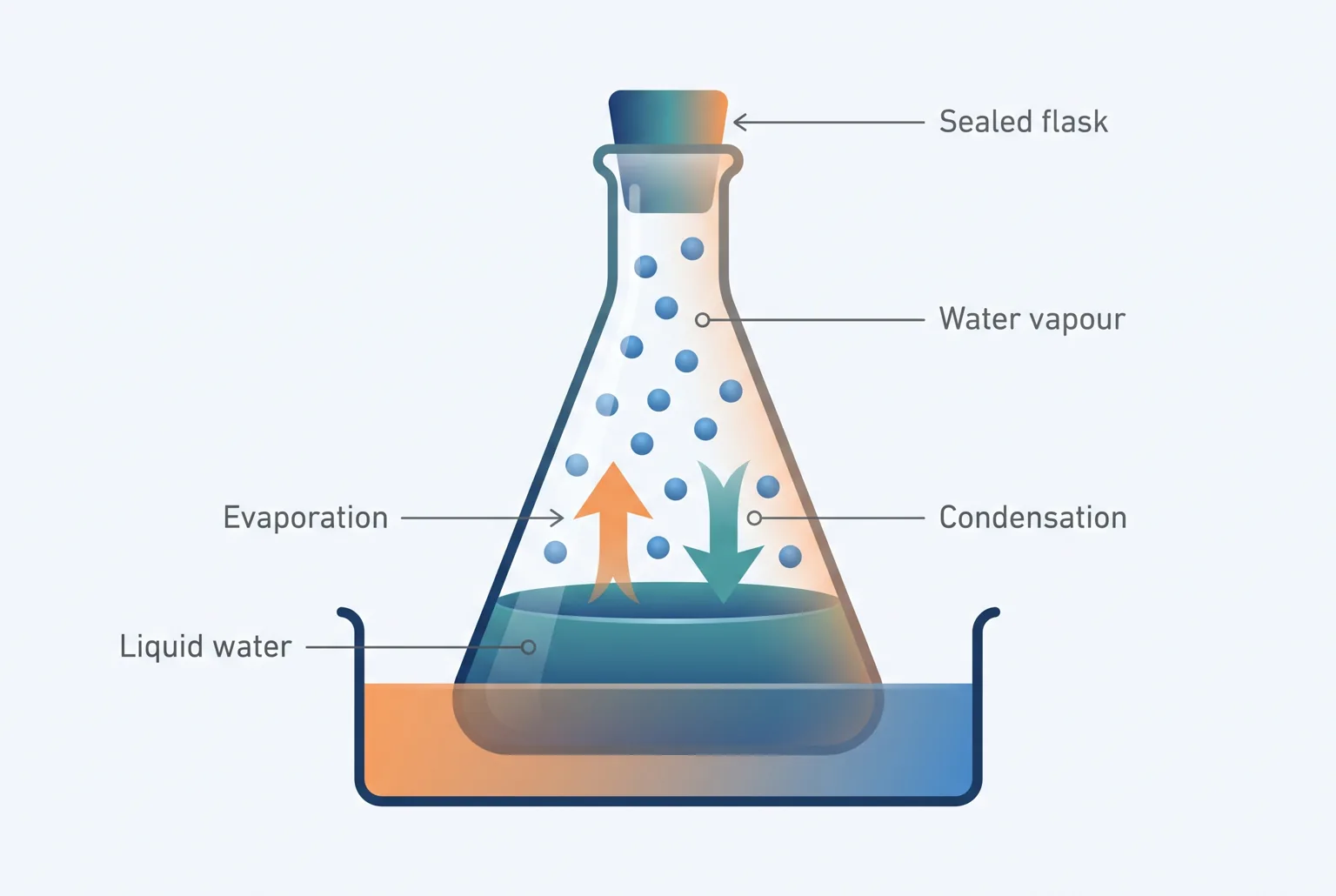
The opening cases move from a familiar change of state to the conditions for equilibrium between phases. In a physical equilibrium, a substance can pass between phases without changing its chemical identity. A chemical equilibrium, by contrast, involves interconversion between reactants and products. In either case, a steady observable composition does not mean that the opposing processes have stopped.
The phase-equilibrium passage separates thermal, mechanical and chemical conditions. A temperature difference can drive heat flow. The passage treats uniform hydrostatic pressure as a mechanical condition in its simplified setting, while noting that gravity or membranes require qualifications. For a substance that can transfer between phases, equality of its chemical potential across those phases is the condition for no net transfer. Read each condition in terms of the process it governs rather than treating temperature, pressure and chemical potential as interchangeable descriptions.
A useful connection: compare the current mixture with equilibrium
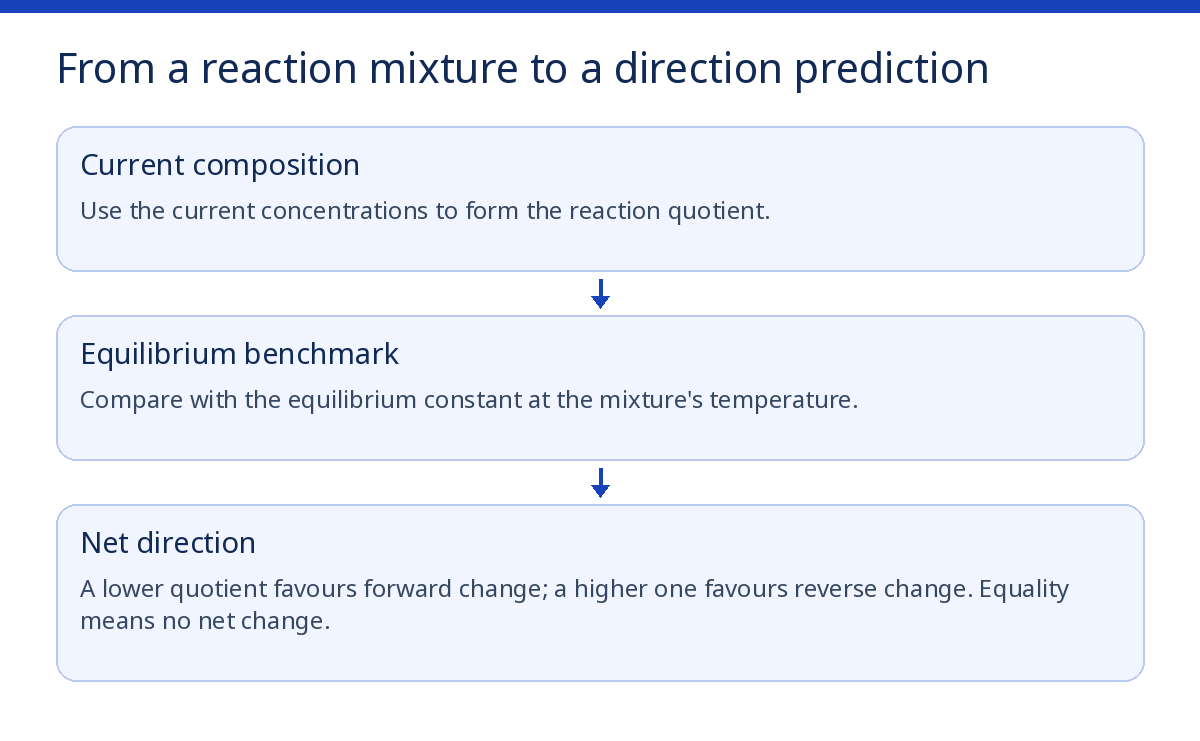
The cases on equilibrium constants and reaction quotients ask you to distinguish a mixture's composition now from its composition at equilibrium. The reaction quotient uses the current concentrations; is the value of that same expression at equilibrium. Both must refer to the same balanced reaction as written, and the comparison must use the constant at the mixture's temperature.
If , the net change is in the forward direction; if , it is in the reverse direction. Equality means there is no net reaction. This comparison tells you which way the mixture tends to change, not how far it will move or how quickly it will get there. Likewise, a large equilibrium constant indicates that the reaction as written favours products at equilibrium, but does not tell you the direction of change from an arbitrary starting mixture.
Common mistake: treating every pressure rise as compression
The pressure and Le Chatelier cases are worth reading together because the cause of a disturbance matters. For compression at constant temperature in the ideal-gas treatment, compare the total stoichiometric coefficients of gaseous species on each side. A compression favours the side with fewer moles of gas if those totals differ. If a pressure rise instead comes from adding another gas, check what is held fixed and whether the reacting gases' partial pressures change. Total pressure alone is not enough to make the prediction.
Le Chatelier's principle describes a response that counteracts a disturbance, not one that necessarily cancels it. A change in composition or volume at fixed temperature can change the quotient without changing the equilibrium constant. Temperature can change the constant; to reason about which direction heating favours, identify whether the forward reaction absorbs or releases heat. Catalysis concerns the rate of approach to equilibrium, not its position.
Acid–base models, salt hydrolysis and pH
The acid–base cases switch from the Arrhenius model, which describes increases in hydronium or hydroxide in water, to the Brønsted model, which describes proton transfer. In the latter model, an acid donates a proton and a base accepts one. To identify conjugate partners, look for species that differ by one proton. The strength relationship then gives that pairing meaning: a stronger acid has a weaker conjugate base.
The pH case applies acid–base reasoning to salts and dilution. For a salt in water, ask whether one of its ions reacts with water before deciding whether the solution is acidic or basic. In calculation questions, identify whether the given quantity is an acid concentration, a dissociation constant or a pH; these are not interchangeable starting points. Neutrality means hydronium and hydroxide concentrations are equal, corresponding to pH 7 when .
Before you calculate: distinguish solubility from buffer capacity
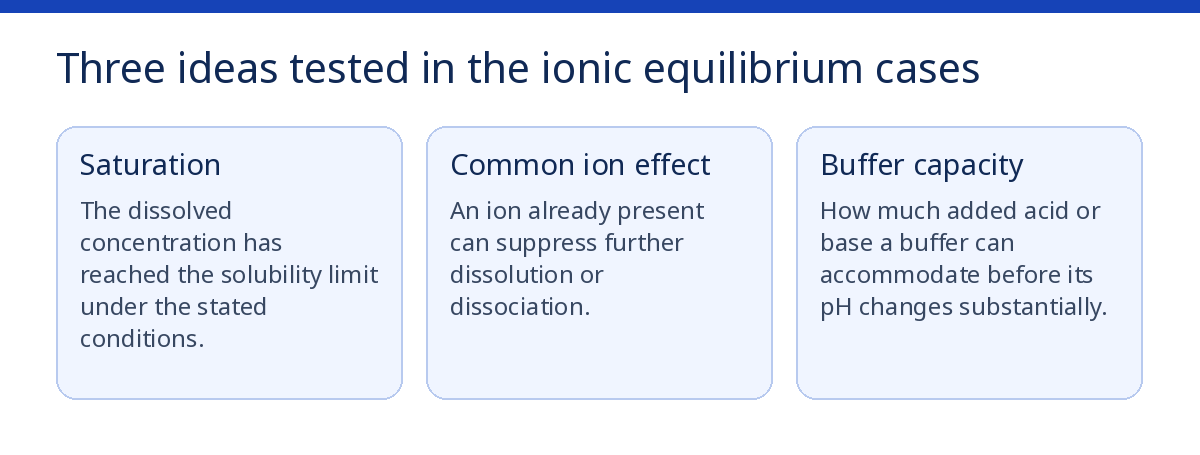
In the solubility case, saturated describes a solution in relation to its solubility limit under the stated conditions; concentrated describes how much solute it contains. A sparingly soluble salt can therefore give a saturated solution even when the dissolved concentration is low. When relating molar solubility to , write the dissolution equation first. Its coefficients determine how much of each ion is released per mole dissolved. A common ion already present in solution must be accounted for separately.
The common ion effect also connects this case to weak acid and base equilibria: adding an ion already present can suppress dissociation. Buffer capacity asks a different question: how much added acid or base a buffer can accommodate before its pH changes substantially. Do not infer capacity from the starting pH alone.
What this guide leaves out
This guide does not reproduce or endorse ambiguous options in the phase-equilibrium and weak-acid cases, incomplete or garbled calculation prompts in the constants and quotient cases, or the catalyst case's temperature-choice item, which does not state the reaction's heat change. It also leaves out the inconsistent pH wording in the final passage and uses the condition for neutrality instead.
Spotted an error? Report a correction. Practise this in the app: notes, formula sheets and mind maps.



Loading comments…