CBSE Class 11 Chemistry: Periodicity Case-Based Assessment
CBSEChemistryClassification of Elements and Periodicity in Properties
This CBSE Class 11 Chemistry assessment uses six case studies to connect periodic-table position and electronic configuration with trends in size, metallic character and enthalpy. Use the questions and linked explanations to practise deciding when a periodic trend applies and when an exception needs a different explanation.
How to use the assessment and its linked solutions
This file covers Chapter 3, Classification of Elements and Periodicity in Properties, through short-answer, multiple-choice and assertion–reason questions. The cases move from the structure of the periodic table to comparisons of atoms and ions, then to the energy changes associated with adding or removing electrons. The questions come first, and the index and two-way links let you move between an individual subquestion and its explanation.
Before opening a solution, write down the property being tested, the species being compared and the rule you think applies. Then check whether the explanation uses the same basis for comparison. The notes beside the solutions matter: some entries in the original key for the classification cases were attached to the wrong questions, and other notes flag wording or notation that affects how a question can be read.
Classification of Elements and Periodicity in Properties | Class 11 | Case-based Assessment
In the StudentCurio app
CBSE Class 11 case-based questions and worked solutions cover periodic-table classification, atomic and ionic radii, metallic character, electron gain enthalpy and ionisation enthalpy, including periodic trends and exceptions. Useful for practising application and explanation of periodic properties.
Read periods, groups and blocks as different labels
The modern periodic table orders elements by increasing atomic number, or proton count, rather than by atomic mass. Its horizontal rows are periods and its vertical columns are groups. The four blocks describe the type of subshell being filled in the electronic configuration. The first case uses the Aufbau principle to connect the order of subshell filling and subshell capacity with the different lengths of the periods.
The two inner-transition series are drawn below the main table to keep it compact; this layout does not give them separate periods. The next case shifts the focus from layout to classification. When reading an assertion–reason item, distinguish a group placement based on shared chemical properties from a block assignment based on configuration. A reason about resemblance to one group need not apply to an entire block. The guide leaves out the answer choice for the assertion–reason item because the solution notes that its interpretation depends on how broadly the printed reason is read.
Radius comparisons: check the charge before the trend
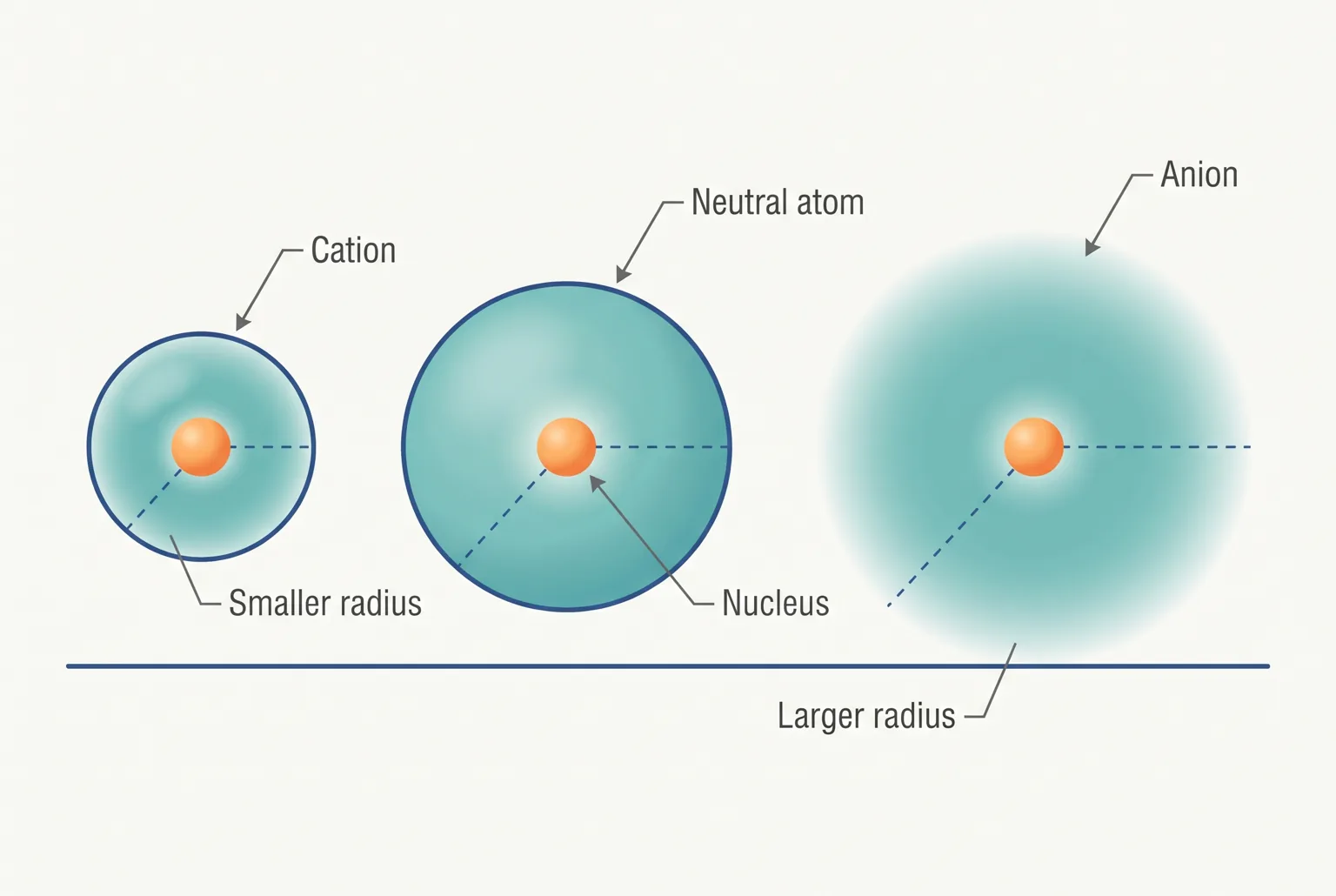
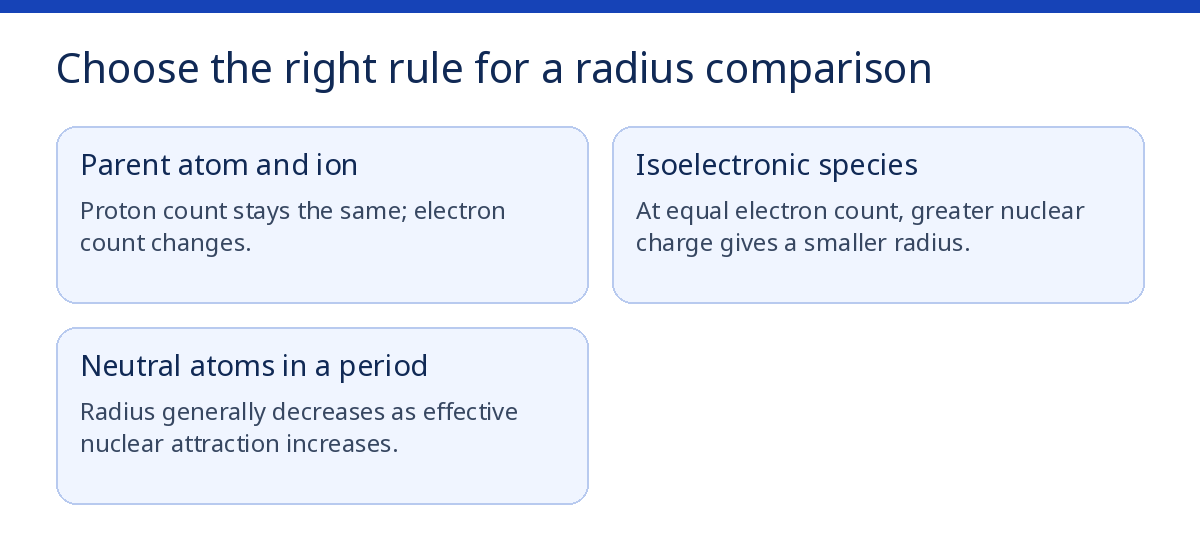
Separate three comparisons: a neutral atom and its own ion, species with the same electron count, and neutral atoms across a period. A cation is usually smaller than its parent atom, while an anion is usually larger. Adding electrons does not change the proton count; it changes electron–electron repulsion and shielding. An anion does not have to overcome or cancel the nuclear charge for its electron cloud to expand.
For an isoelectronic series, first establish that the species have the same number of electrons. Then compare proton counts: the greater nuclear charge attracts that electron population more strongly, giving a smaller radius. For neutral atoms across a period, radius generally decreases as effective nuclear attraction increases. The radius case has missing minus signs in its printed species list. The solution states its assumed charges, so this guide omits the conditional ranking and focuses on how to choose the right comparison.
Metallic character: compare positions before ranking
The metals case distinguishes metals, non-metals and metalloids, which have properties intermediate between those typically associated with metals and non-metals. Properties such as conductivity and malleability are useful clues, but the passage’s descriptions are general patterns, not tests that every element in a category must pass.
Metallic character generally decreases from left to right across a period as the tendency to lose electrons decreases, and increases down a group. These trends have a clear direction when the two elements share a row or a column. If they differ in both period and group, do not treat either trend as a universal ranking rule. The case shows why the elements’ classifications can provide additional evidence where a single directional trend cannot settle the comparison.
Electron gain enthalpy: keep the sign in view
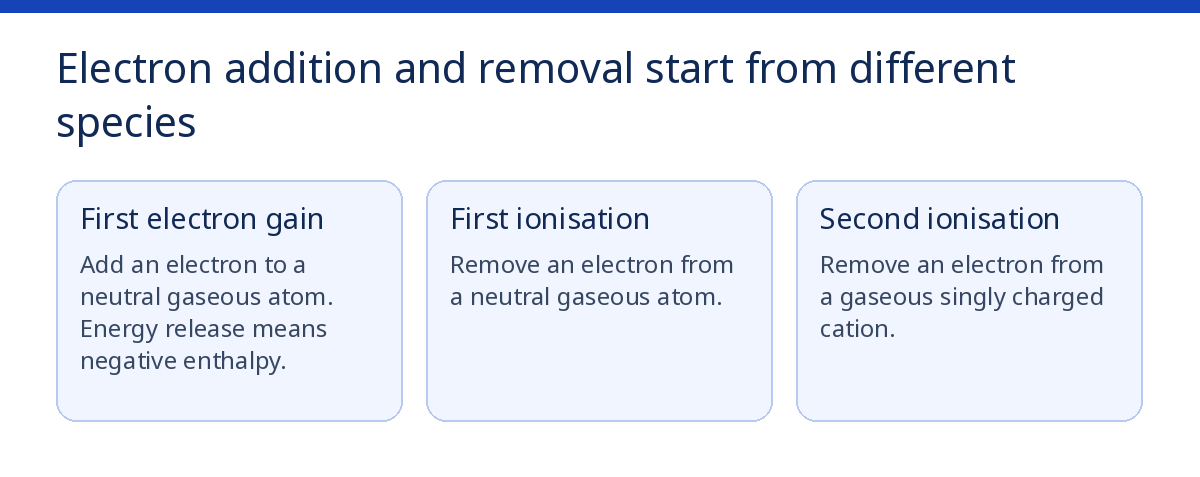
First electron gain enthalpy is the enthalpy change when an electron is added to an isolated gaseous atom. If the addition releases energy, the value is negative; a greater release means a more negative value, not a larger numerical value. First addition is not always exothermic. Second addition starts with a gaseous anion rather than a neutral atom and requires energy to overcome repulsion.
First electron gain enthalpy generally becomes more negative across a period and less negative down a group, but size alone is not enough to predict the result. A compact subshell can crowd the incoming electron, and the stability of the starting configuration can also affect how favourable addition is. The multiple-choice explanations make these qualifications explicit. The guide omits the answer choices where the solution notes correct the original key or flag qualified wording.
Ionisation enthalpy: identify what loses the electron
First ionisation enthalpy concerns removal of an electron from an isolated gaseous atom. Second ionisation starts from the gaseous singly charged cation. That change in starting species matters when interpreting a jump between successive values: removing another outer-shell electron is different from removing one from a closed inner shell.
First ionisation enthalpy generally increases across a period and decreases down a group, but electronic configuration can explain departures from those directions. For the final short-answer case, use configurations to track which electron is removed at each step rather than trying to rank successive ionisations by position alone. The case also asks about silicon in solar panels; the supplied solution excerpt ends during the first subquestion, so it does not provide a basis for summarising the silicon explanation.
Quick self-check: name the condition behind your rule
Before returning to the linked explanations, try stating one condition for each kind of comparison. What must be equal before you use nuclear charge to compare the sizes of isoelectronic species? How would you tell whether a phrase such as “greater energy release” calls for a more negative enthalpy? What changes in the starting species between first and second ionisation? If you can name the condition as well as the trend, you can check the reasoning in your response rather than only whether it matches the key.
Spotted an error? Report a correction. Practise this in the app: notes, formula sheets and mind maps.






Loading comments…