Chemical Bonding: CBSE Class 11 Case-Based Assessment
CBSEChemistryChemical Bonding and Molecular Structure
This CBSE Class 11 Chemistry assessment uses short passages to test how you apply bonding models, from Lewis structures to molecular orbitals. Use the linked explanations to check not just your conclusions, but also whether you chose the right model for each question.
What the assessment covers
The file covers Chapter 4, Chemical Bonding and Molecular Structure, through multiple-choice questions, short answers, structure drawing and calculations. The earlier cases focus on electron bookkeeping, ionic lattices and bond properties. The later cases ask you to move from three-dimensional shape and polarity to orbital occupancy, magnetism and interactions between molecules. These are different tasks: a Lewis structure can help you locate lone pairs, for example, but it does not by itself tell you how electrons occupy molecular orbitals.
The question and solution indexes are separate, and links take you from a subquestion to its explanation and back. Case 9 is a documented gap: it repeats the hydrogen-bonding passage in Case 10 and supplies no questions of its own.
Chemical Bonding and Molecular Structure | Class 11 | Case-based Assessment
In the StudentCurio app
Case-based questions and worked explanations cover VSEPR and molecular shapes, bond angles, hybridisation, molecular orbital theory, hydrogen bonding, resonance, and bond properties. Useful for Class 11 students practising and reviewing chemical bonding concepts.
From Lewis structures to resonance
Start with what a Lewis structure records: which atoms are connected, which electron pairs are shared, and which remain as lone pairs. Count valence electrons for the whole species before placing them; an ionic charge changes that total. When comparing otherwise reasonable structures, smaller formal-charge magnitudes and less charge separation are useful preferences. That does not mean each atom must have zero formal charge: the charges on the atoms must add up to the overall charge. Treat the octet rule as a guide, not a requirement that every valid structure must meet.
The bond-properties case extends this bookkeeping to resonance. Contributors keep the same arrangement of nuclei and differ in how electrons are represented. The molecule or ion is described by the hybrid, not by structures that alternate in time. When comparing bond lengths or strengths, use bond order as a trend for comparable bonds rather than as the only factor across unrelated species.
Before comparing lattice energies, check the sign
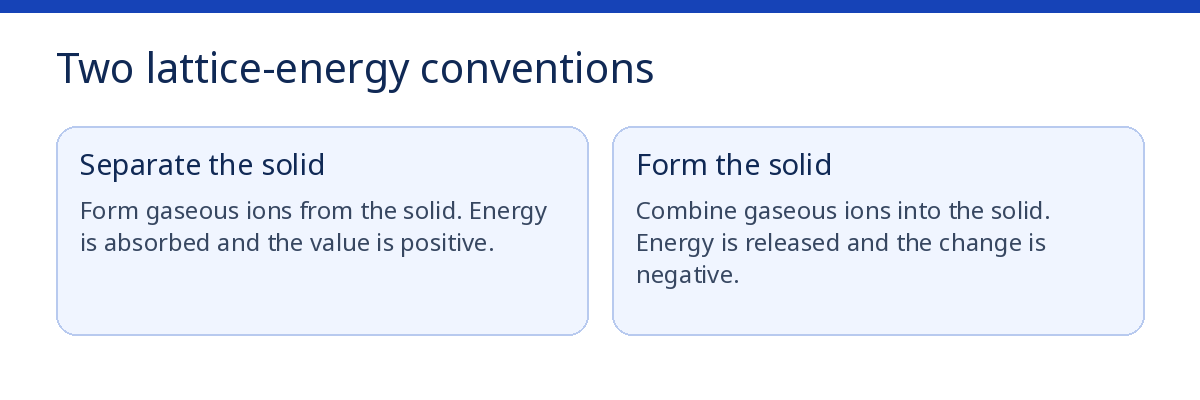
The ionic-lattice case gives two conventions for lattice energy, expressed in . Separating a mole of ionic solid into gaseous ions requires energy, so the dissociation convention gives a positive value. Forming the solid from gaseous ions is the reverse process, so the formation convention gives a negative value. A stronger lattice can therefore have a more negative formation value, even though it takes more energy to separate.
State the convention before writing a comparison. When other factors are comparable, greater ionic charge magnitudes and shorter distances between oppositely charged ions favour stronger attraction. Use both charge and size when deciding whether a simple trend is justified.
Keep electron arrangement, shape and polarity separate
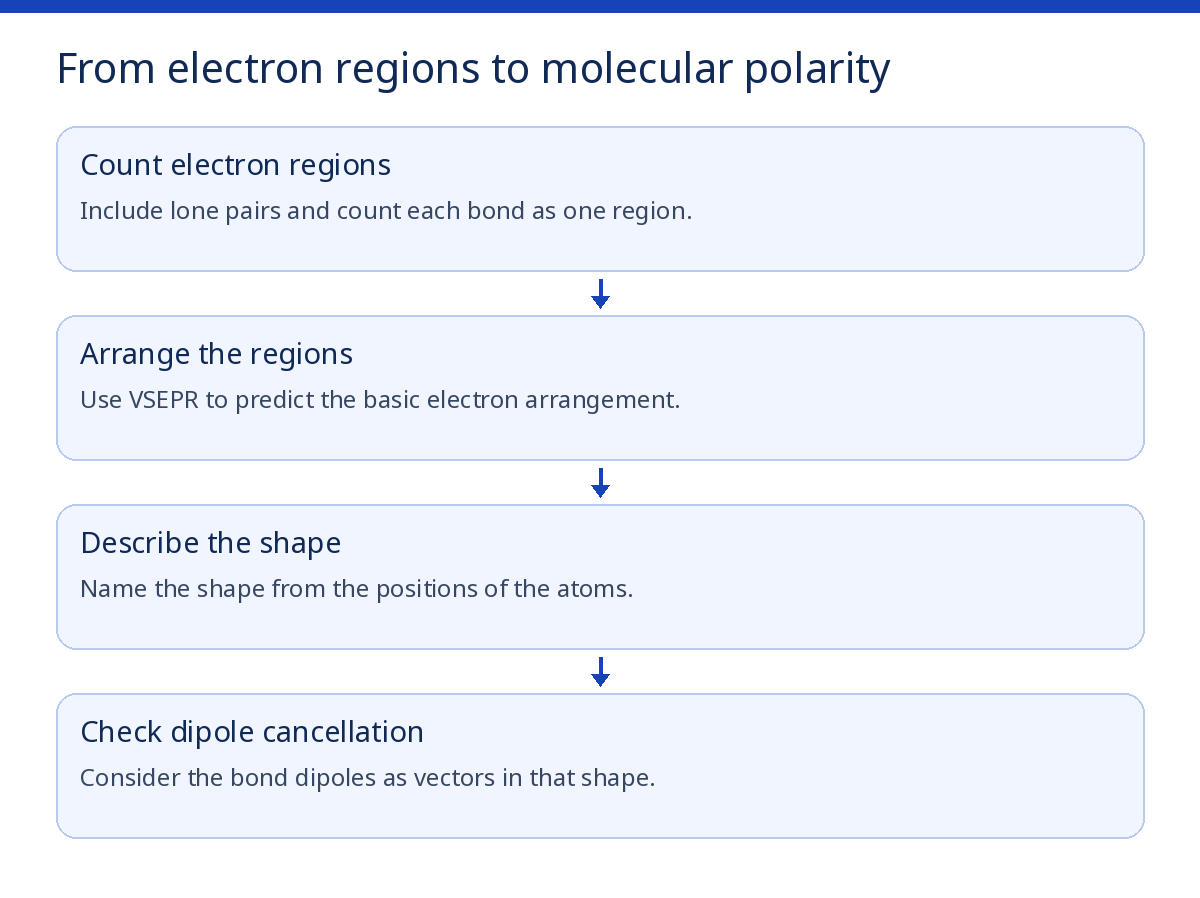
In the VSEPR and hybridisation cases, begin by identifying the electron regions around the central atom. A single, double or triple bond counts as one region when establishing the basic arrangement; this counting rule does not mean that all bonds have identical effects on actual angles. Lone pairs count when you determine the electron-region arrangement, but molecular shape describes the positions of the atoms. Keeping those two descriptions separate helps explain why a lone pair can affect a bond angle without appearing as a bonded atom in a sketch.
Use hybridisation as a model for describing bonding geometry, not as a guarantee of an exact measured angle. For polarity, consider the bond dipoles in the geometry you have drawn. Polar bonds alone do not establish a polar molecule: if their dipoles cancel as vectors, the net dipole moment is zero.
Read molecular orbitals in two ways
Case 7 shifts the focus from localised electron pairs to orbitals that extend over the molecule. When two suitable atomic orbitals combine, the bonding combination is lower in energy and the antibonding combination is higher than the parent orbitals. Before filling the diagram, choose the energy ordering appropriate to the species. The case shows why that choice matters: the relative order of the bonding sigma and pi orbitals derived from the subshell is not the same for every diatomic species it discusses.
Read the completed diagram twice. For bond order, take half the difference between the numbers of bonding and antibonding electrons. For magnetism, look for unpaired electrons. These checks answer different questions; knowing the bond order is not a substitute for inspecting how the electrons are paired.
Connect hydrogen bonding to boiling-point trends
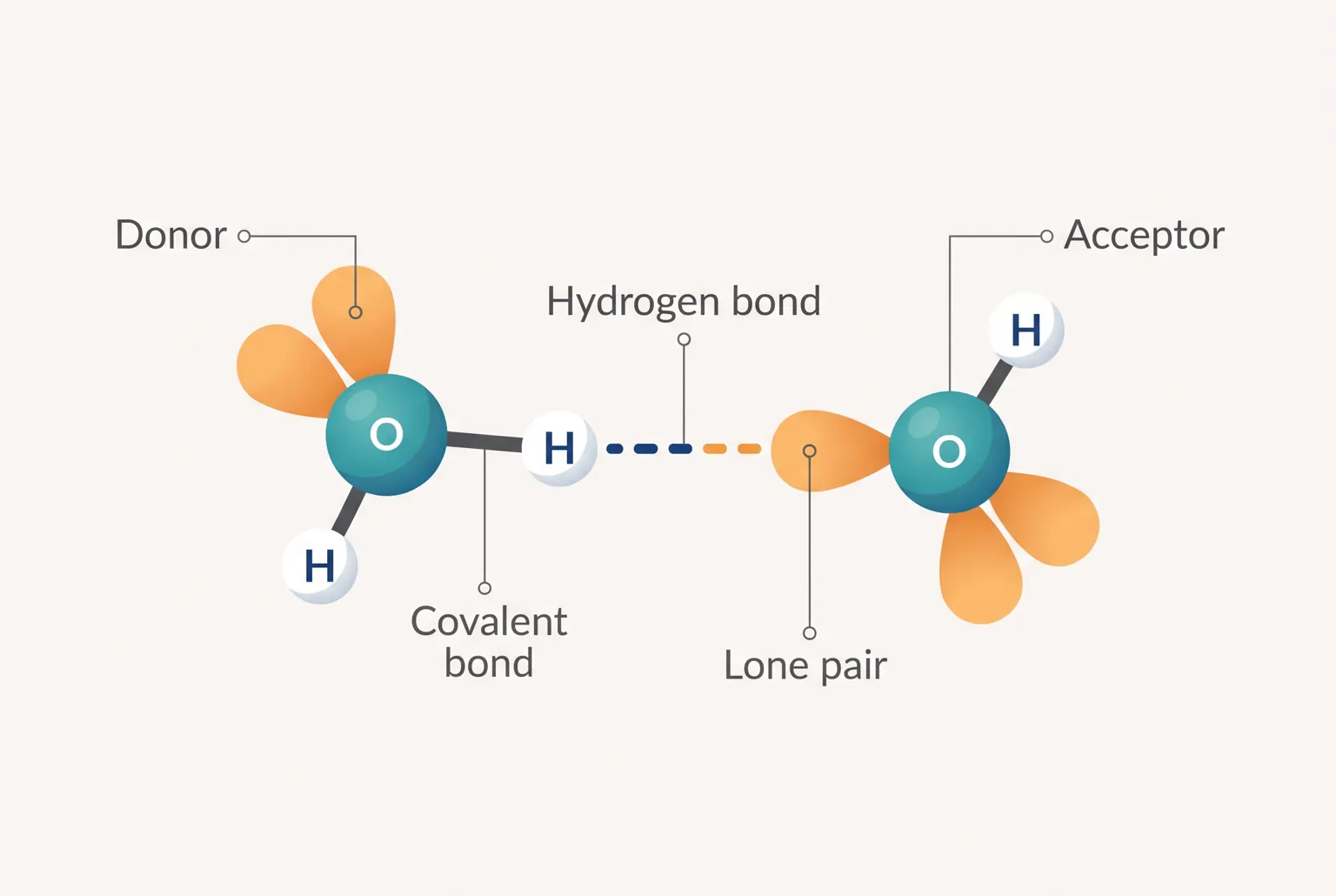
The hydrogen-bonding cases connect a local interaction with a bulk property. In the familiar Class 11 examples, the donor supplies a hydrogen bonded to an electronegative atom, and the acceptor supplies an available lone pair. For boiling-point comparisons, distinguish attractions between molecules from hydrogen bonding within a molecule. Intermolecular hydrogen bonding can make molecules harder to separate into the vapour; an internal hydrogen bond does not directly link one molecule to another.
The boiling-point passage also discusses dispersion forces. A trend associated with increasing molar mass is most useful when comparing similar substances whose intermolecular interactions are otherwise comparable. When hydrogen bonding differs across a set, a ranking based on mass alone can miss the interaction that matters.
Self-check: name the decision before opening a solution
For each attempt, write the decision that drives your reasoning: which electron regions count, which lattice-energy convention you are using, or which orbital ordering applies. Then open the linked explanation and compare that decision with the method shown. If you disagree, return to the question and check whether the difference comes from the model, the arithmetic or an assumption about the wording.
Read the file’s correction and ambiguity notes alongside the affected solutions rather than treating every option as definitive. This guide leaves out disputed answer choices, the passage’s unclear wording about resonance energy and a fixed hydrogen-bond count for hydronium without a specified environment.
Spotted an error? Report a correction. Practise this in the app: notes, formula sheets and mind maps.

Loading comments…