JEE 2023 · Atomic Physics
JEEPhysicsAtomic Physics2023
A read-only public preview of this previous-year question set.
4 of 22 questions
You're seeing 4 of 22 questions. Answers and worked solutions are in the free app, with every question in this set.
Question 1
Single-correct MCQA photon is emitted in the hydrogen transition . The corresponding wavelength is (given )Question 2
NumericalUsing , the wavelength emitted by a hydrogen electron jumping from the second excited state to the first excited state is . For a jump from the third excited state to the second orbit, the wavelength is . Find .Question 3
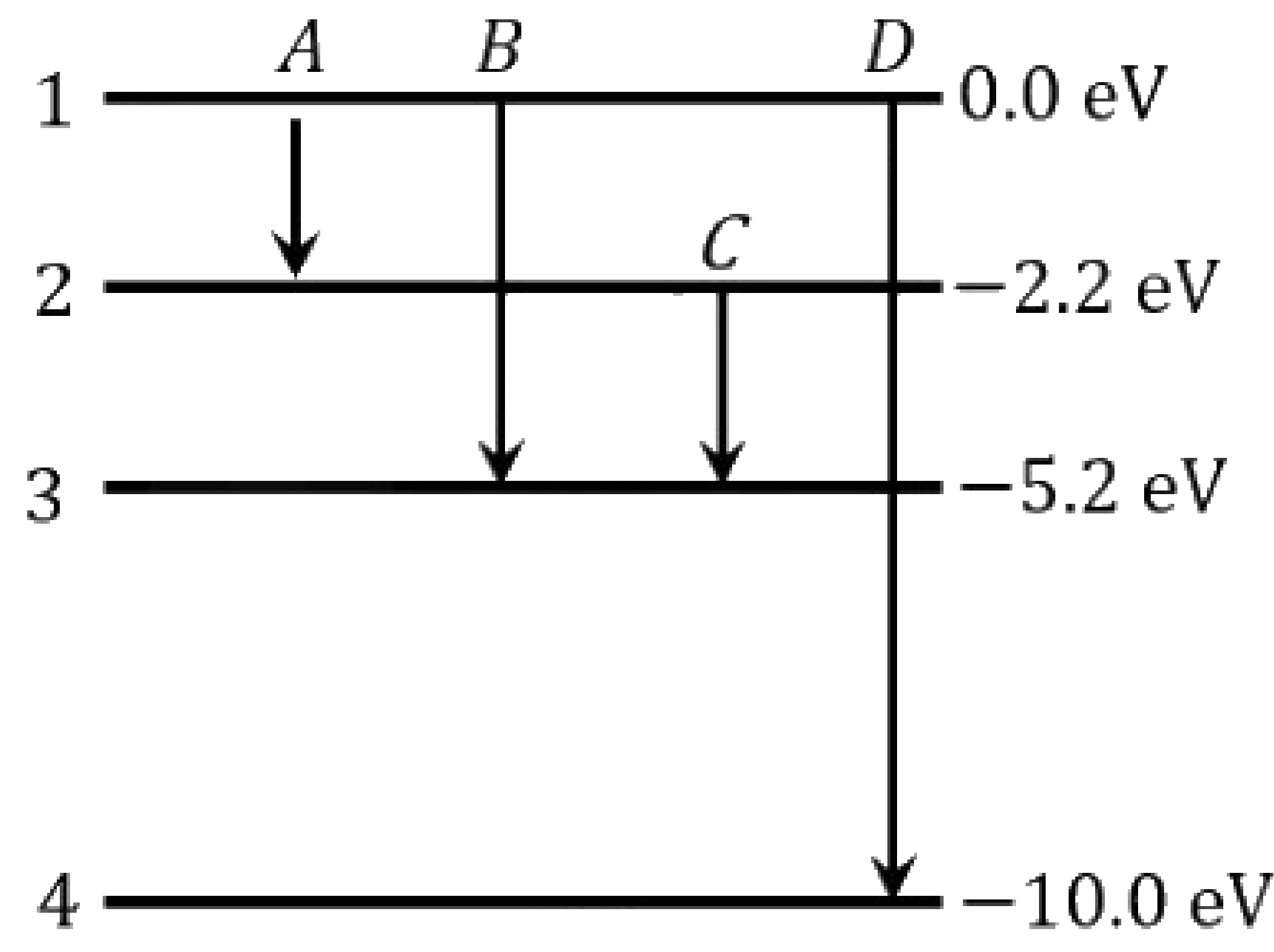
Single-correct MCQThe atomic energy levels are shown in the figure. Which transition emits a photon of wavelength ? Given .Question 4
Single-correct MCQAn electron speed in the seventh Bohr orbit of hydrogen is . The corresponding speed in the third orbit, in , is
That's the preview. Sign in once and you'll come straight back to this set, with answers and worked solutions for all 22 questions.
Sign in free to practise all 22