JEE 2021 · Electrostatics
JEEPhysicsElectrostatics2021
A read-only public preview of this previous-year question set.
6 of 30 questions
You're seeing 6 of 30 questions. Answers and worked solutions are in the free app, with every question in this set.
Question 1
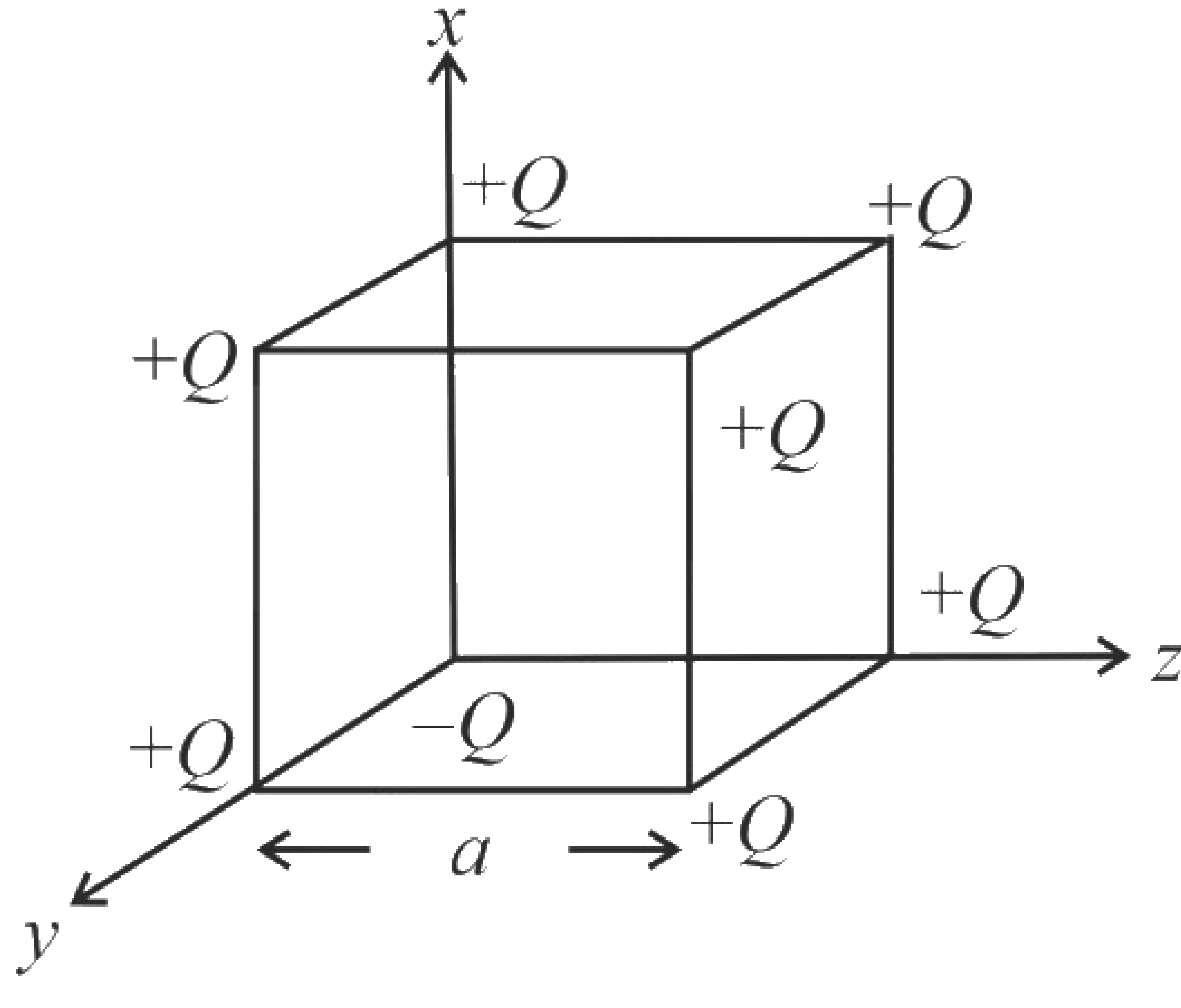
Single-correct MCQA cube of side a has charge at each vertex except the origin, which carries . Its edges from the origin follow the positive coordinate axes shown. Find the field at its centre.Question 2
Single-correct MCQTwo fixed electrons are separated by . A proton at their midpoint is displaced a small distance perpendicular to their joining line. Find its angular frequency of small oscillation. Here m is the proton mass and q is the elementary-charge magnitude.Question 3
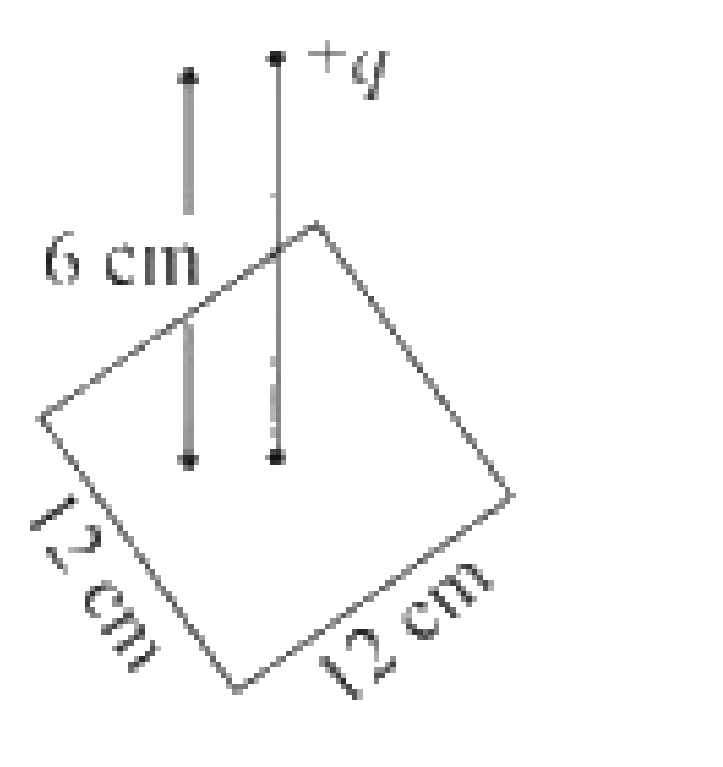
NumericalA charge is 6 cm vertically above the centre of a square of side 12 cm, as shown. Find the magnitude of its flux through the square in units of , rounded to the nearest integer.Question 4
Numerical512 identical mercury drops, each charged to potential 2 V, coalesce into one spherical drop. Find its potential in volts.Question 5
NumericalThe uniform field is . The flux-magnitude ratio through rectangles of areas parallel to yz and parallel to xz is . Find a.Question 6
NumericalTwo identical tiny conducting spheres carry and . They touch, then are separated by 0.5 m. Find their repulsive force in units of . Take in SI.
That's the preview. Sign in once and you'll come straight back to this set, with answers and worked solutions for all 30 questions.
Sign in free to practise all 30