Skip to content

JEE 2020 · Electrostatics

JEEPhysicsElectrostatics2020

A read-only public preview of this previous-year question set.

You're seeing 4 of 20 questions. Answers and worked solutions are in the free app, with every question in this set.

  1. Question 1

    Single-correct MCQ
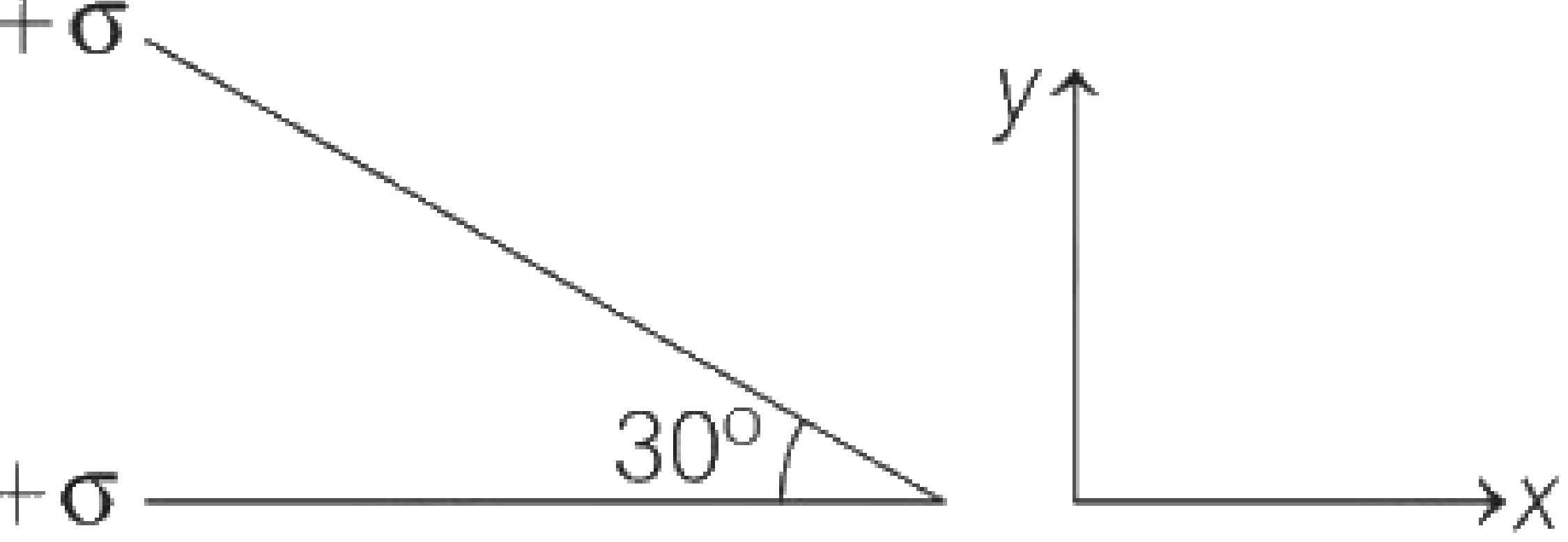
    Two infinite planes each carry uniform positive surface density σ\sigma and intersect at 30∘30^\circ as shown. One is horizontal, the other slopes down towards positive x. Find the field in the indicated wedge above the horizontal plane and below the tilted one.
    Diagram for sample question 1
    1. Option A.
      σ[(1+3)j^−i^/2]/(2ϵ0)\sigma[(1+\sqrt3)\hat{\mathbf j}-\hat{\mathbf i}/2]/(2\epsilon_0)
    2. Option B.
      σ[(1+3/2)j^+i^/2]/ϵ0\sigma[(1+\sqrt3/2)\hat{\mathbf j}+\hat{\mathbf i}/2]/\epsilon_0
    3. Option C.
      σ[(1+3)j^+i^/2]/(2ϵ0)\sigma[(1+\sqrt3)\hat{\mathbf j}+\hat{\mathbf i}/2]/(2\epsilon_0)
    4. Option D.
      σ[(1−3/2)j^−i^/2]/(2ϵ0)\sigma[(1-\sqrt3/2)\hat{\mathbf j}-\hat{\mathbf i}/2]/(2\epsilon_0)
  2. Question 2

    Single-correct MCQ
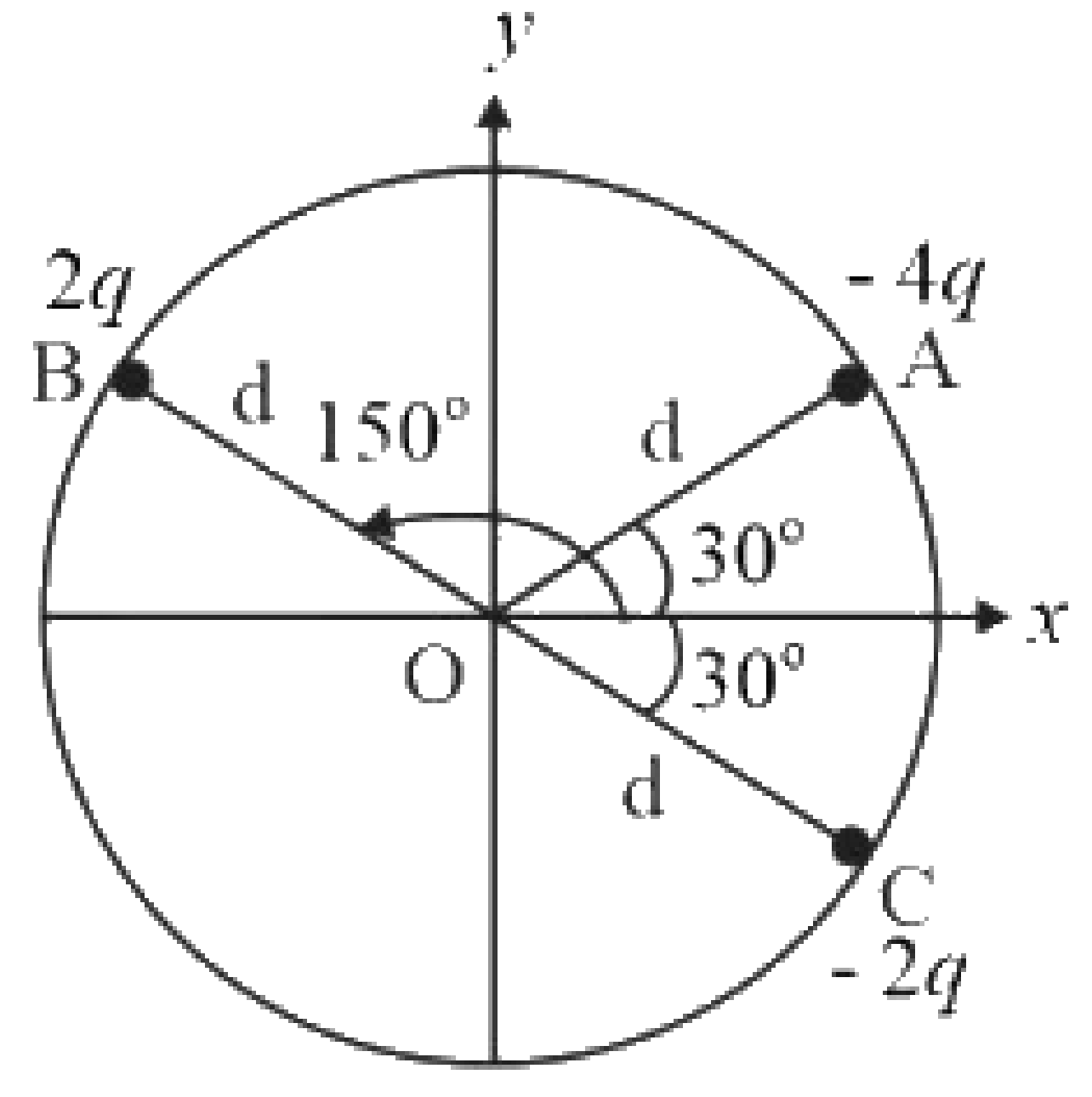
    Charges A,B,C of −4q,+2q,−2q-4q,+2q,-2q lie on a circle of radius d at polar angles 30∘,150∘,−30∘30^\circ,150^\circ,-30^\circ, respectively, as shown; A,C,O form an equilateral triangle. Find the electric-field magnitude at centre O.
    Diagram for sample question 2
    1. Option A.
      3q/(πϵ0d2)\sqrt3q/(\pi\epsilon_0d^2)
    2. Option B.
      23q/(πϵ0d2)2\sqrt3q/(\pi\epsilon_0d^2)
    3. Option C.
      3q/(4πϵ0d2)\sqrt3q/(4\pi\epsilon_0d^2)
    4. Option D.
      33q/(4πϵ0d2)3\sqrt3q/(4\pi\epsilon_0d^2)
  3. Question 3

    Single-correct MCQ
    To infer field magnitude using the simplified Gauss-law formula ∣E∣=qenc/(ϵ0A)\lvert\mathbf E\rvert=q_{enc}/(\epsilon_0A), where A is Gaussian-surface area, which condition is required in the standard symmetric outward-field case?
    1. Option A.
      Surface equipotential only
    2. Option B.
      Surface equipotential and field magnitude constant on it
    3. Option C.
      Field magnitude constant on the surface only
    4. Option D.
      Any Gaussian surface
  4. Question 4

    Single-correct MCQ
    Two isolated charged metallic spheres have radii R1,R2R_1,R_2, surface fields E1,E2E_1,E_2 and potentials V1,V2V_1,V_2. If E1/E2=R1/R2E_1/E_2=R_1/R_2, find V1/V2V_1/V_2.
    1. Option A.
      R1/R2R_1/R_2
    2. Option B.
      (R1/R2)2(R_1/R_2)^2
    3. Option C.
      R2/R1R_2/R_1
    4. Option D.
      (R1/R2)3(R_1/R_2)^3

That's the preview. Sign in once and you'll come straight back to this set, with answers and worked solutions for all 20 questions.

Sign in free to practise all 20