Vector Algebra: CBSE Class 12 Mathematics Assessment
CBSEMathematicsVector Algebra
This Chapter 10 assessment contains 161 questions with worked solutions. Use the four topic sets to practise individual methods, then try the chapter set to see whether you can choose the right method without a topic heading to guide you.
How the assessment is organised
The file begins with four topic sets: Basic Concepts (27 questions), Vector Joining Two Points (19), Scalar Product of Two Vectors (35), and Vector (Cross) Product of Two Vectors (26). The final Chapter Practice set has 54 questions, including two case-based questions. The topic sets and the chapter set all include objective, very short answer, and two types of short answer questions.
The clickable index lets you open a question or its worked solution by number. Because numbering restarts in each set, note the set name as well as the number when marking a question to revisit. Start with a topic set if you know which skill needs attention; start with chapter practice if you want to find out where your method breaks down.

Vector Algebra | Class 12 | CBSE Assessment
In the StudentCurio app
CBSE assessment questions with worked solutions cover vector basics, components, addition, scalar and vector products, projections, angles, perpendicularity, and geometric applications such as areas. Helps Class 12 students practise objective and written questions and check their methods.
Components, magnitude and direction
The basic concepts set moves between component calculations and geometric reasoning. It asks you to find magnitudes, add vectors, construct vectors of a specified length, and interpret direction cosines. The cover diagram shows the parallelogram rule: when the two vectors share an initial point, the diagonal from that point represents their sum. The triangle rule describes the same addition by placing one vector after the other, head to tail.
Good to remember: To obtain a unit vector in the direction of , divide it by its magnitude, and do so only if is nonzero. Its components in the standard coordinate basis are the direction cosines: the cosines of the angles with the positive coordinate axes. Their signs matter, so replacing negative components with absolute values can change the direction.
From position vectors to directed segments
The second topic set separates two ideas that are easy to confuse. A position vector runs from the origin to a point. A displacement vector such as runs from one point to another and is found by subtracting the position vector of the initial point from that of the terminal point. Reversing the order negates the displacement but leaves its length unchanged. This distinction matters when a question names two points and specifies which way the vector is directed.
The set also covers internal and external division, collinearity, and line intersections. For a division question, sketch the endpoints and mark whether the required point is between them or beyond one of them. That gives you a geometric check on the position vector you calculate, especially when the same ratio appears in both an internal and an external division question.
What the dot product tells you
The scalar product set uses the dot product to connect component calculations with angles, perpendicularity, and lengths of sums or differences. For two nonzero vectors, dividing their dot product by the product of their magnitudes gives the cosine of their angle. The sign therefore distinguishes acute angles from obtuse ones, with a zero dot product indicating a right angle. A zero vector also gives a zero dot product, but it does not define an angle with another vector.
The written questions give you practice using the dot product even when the question does not ask for one directly. For instance, a magnitude condition can be expressed through the dot product of a vector with itself. That connection lets you use information about lengths in a question about directions.
Common mix-up: scalar and vector projections
Check what kind of answer the question asks for before writing a projection formula. The scalar projection of on a nonzero vector is . It is a signed number, so a negative result is not automatically an error. The vector projection is that signed number multiplied by the unit vector in the direction of . The denominator uses the magnitude of the vector you are projecting onto, not the magnitude of the vector being projected.
The scalar product set also asks you to split a vector into parts parallel and perpendicular to a specified direction. In that setting, the vector projection gives the parallel part; the difference between the original vector and that projection gives the perpendicular part.
Cross products: normals, parallelism and area
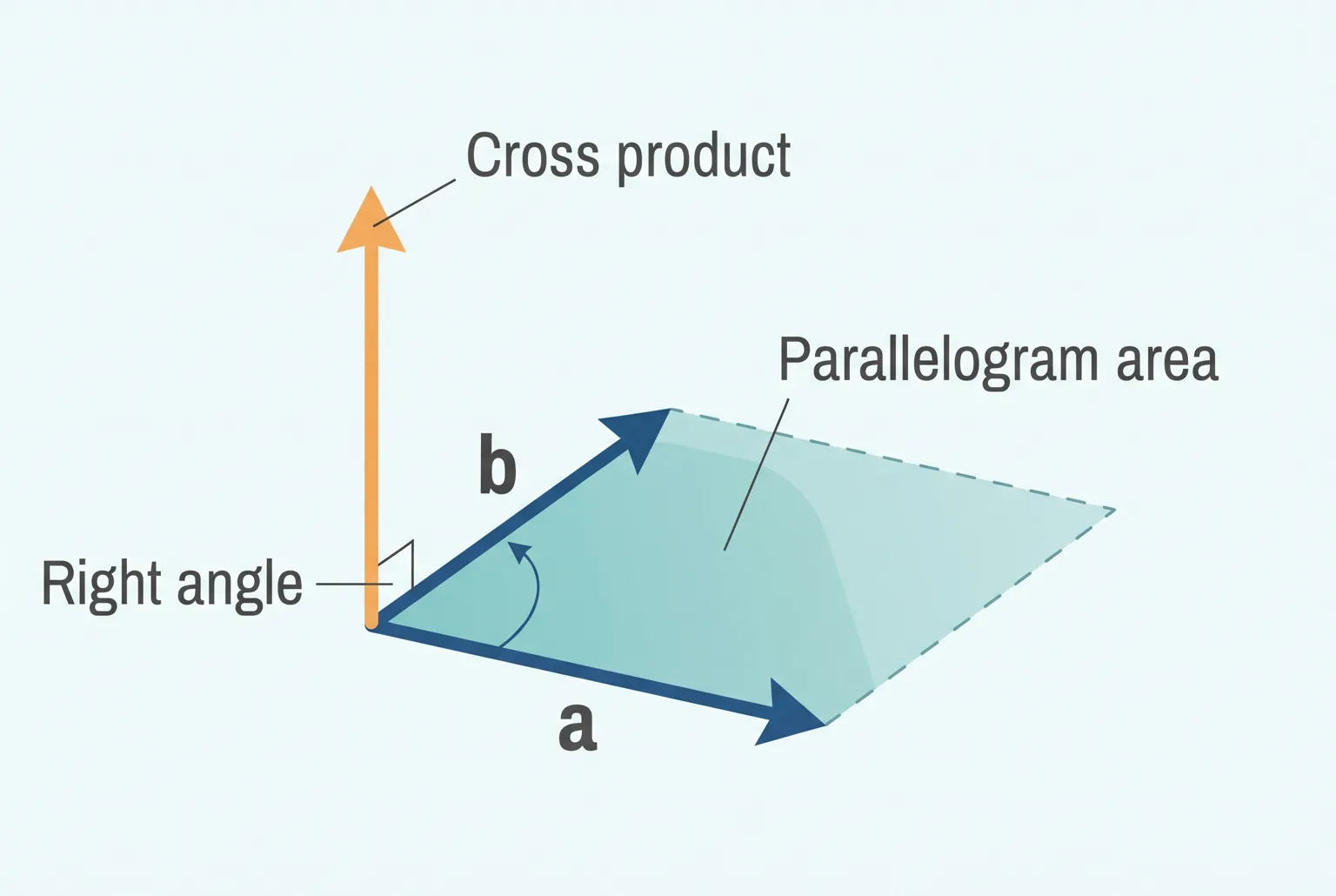
The cross product gives a vector perpendicular to both input vectors when they are nonparallel and nonzero. If the cross product vanishes, it cannot be normalised to obtain a unit normal. For two nonzero vectors, a vanishing cross product instead indicates that they are parallel. Reversing the order of the inputs reverses the cross product but does not change its magnitude.
That magnitude gives the area of the parallelogram formed by the two vectors as adjacent sides. For a triangle, use two side vectors drawn from the same vertex and take half the cross-product magnitude. The assessment includes area questions with vertices given as coordinates, so forming the correct side vectors is part of the work, not just a preliminary calculation.
Use chapter practice to check method choice
The mixed set includes case-based questions on vectors in a regular hexagon and on side vectors and triangle area. It also brings together ideas practised separately: a triangle question can require you to form side vectors, test perpendicularity with a dot product, and use a cross-product magnitude for area. Before opening the worked solution, write down what the problem requires: a scalar, a direction, or a geometric measurement.
When comparing your work with the solution, look for the first point at which your methods differ. A wrong endpoint order sends you back to directed segments; a signed number where a vector is required points to projection. Use that distinction to choose a specific topic set to revisit rather than repeating the whole chapter.
Spotted an error? Report a correction. Practise this in the app: notes, formula sheets and mind maps.





























































































































































Loading comments…