CBSE Class 12 Vector Algebra: Case-Based Assessment
CBSEMathematicsVector Algebra
This CBSE Class 12 Mathematics assessment uses routes, forces and three-dimensional figures to test how you choose and apply vector operations. Its 18 case studies combine multiple-choice and short-answer practice with linked step-by-step solutions.
What the assessment contains
The PDF covers Chapter 10, Vector Algebra, through 18 case studies and 86 subquestions, including OR alternatives. Cases 5–8 are short-answer sets; the other cases are multiple choice. All questions come before the worked solutions, which follow the same case order. The clickable index lets you open either part of a case, while links beside individual subquestions take you to the corresponding solution.
There is no separate topic-practice section, so use the index to choose what to practise. The class-test case brings together the section formula, projection and orthogonality. The school bulletin-board and air plant holder cases link coordinates to triangle geometry. The journey and tug-of-war cases give you practice interpreting components in context.

Vector Algebra | Class 12 | Case-based Assessment
In the StudentCurio app
Case-based questions apply vector addition, components, magnitudes, unit vectors, projections, scalar and vector products, and geometric applications. Includes multiple-choice and short-answer practice, with worked solutions to help Class 12 students prepare for CBSE assessments.
Start with the arrow, not the coordinates
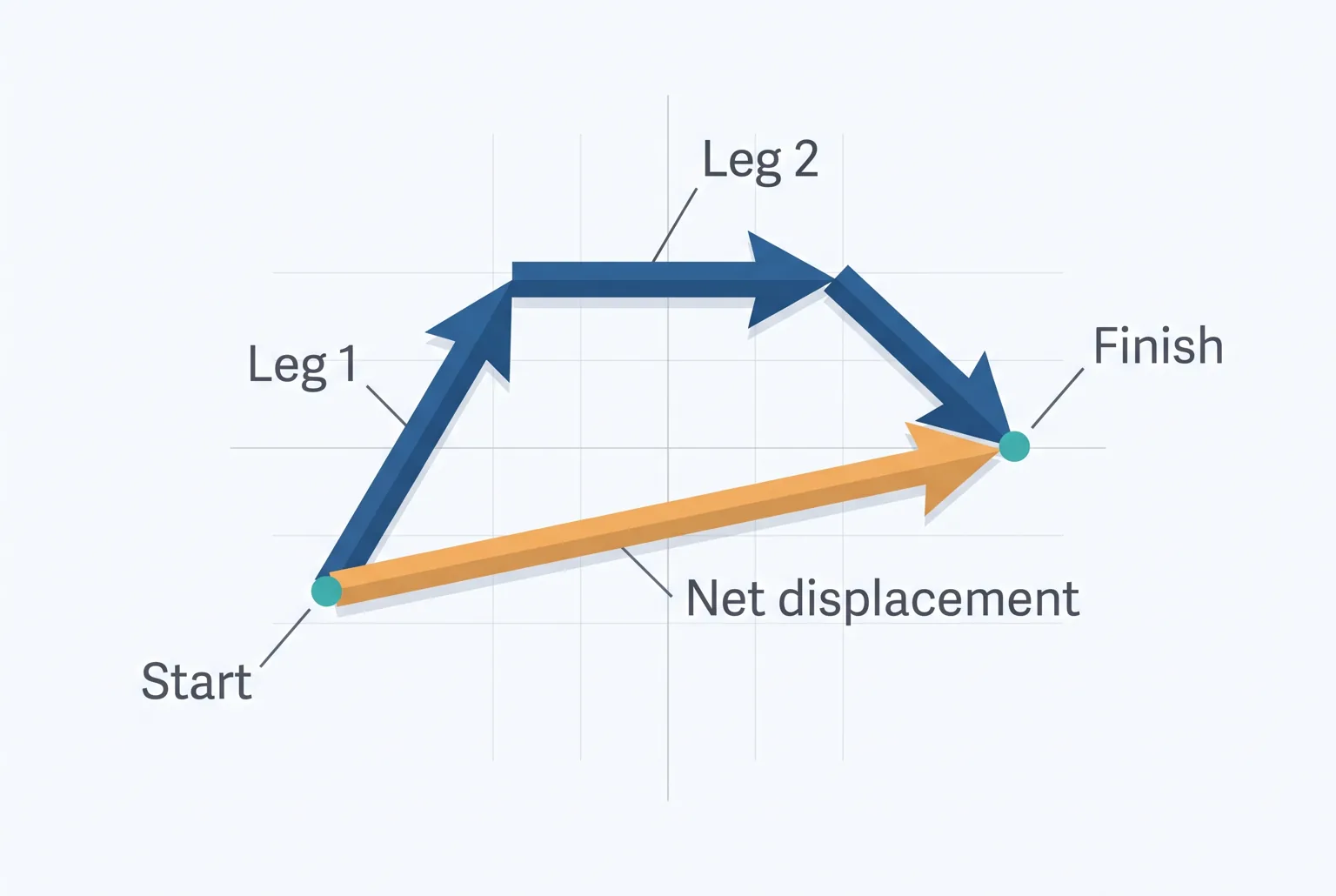
A position vector runs from the origin to a point. A vector between two points instead describes the change from its tail to its head: subtract the tail’s position vector from the head’s. Reversing the arrow changes the signs of the components but leaves the magnitude unchanged. That distinction matters when a case moves from reading a plotted point to describing a leg of a journey.
For the triangle law, place the tail of the second vector at the head of the first. The sum runs from the starting point of the first arrow to the endpoint of the second. In the parallelogram and triangle-law cases, mark the directions before working with the diagonals or combining sides. The name of a segment alone does not tell you which way its vector points.
Common mix-up: distance and displacement
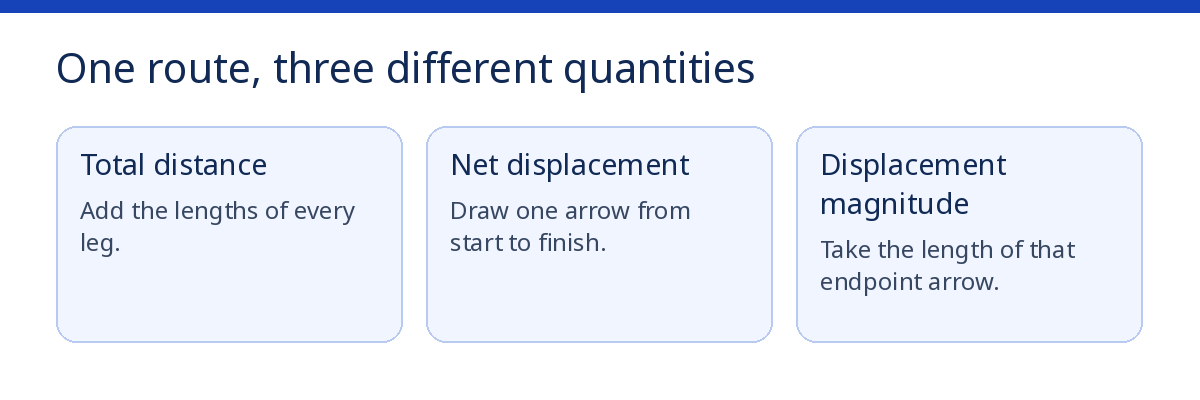
Ritika’s route and Geetika’s journey ask you to distinguish the length of a route from the change in position. Total distance is the sum of the lengths of the individual legs. Net displacement is the vector sum of those legs and depends only on the start and finish. The magnitude of that displacement is the straight-line distance between the endpoints, not necessarily the distance travelled.
When reading a route, label each quantity before calculating: is it a directed change, the length of one leg, or the length of the whole path? The same distinction helps with unit vectors. Dividing a non-zero vector by its magnitude keeps its direction and gives it length one; the zero vector cannot be normalised because its magnitude is zero.
When scalar projection applies
In the class-test and air plant holder cases, a projection asks how much of one vector lies along a specified direction. The scalar projection of along is , provided . The result is a signed number, not a vector. A negative result means the component lies opposite to the direction specified by ; taking an absolute value would lose that information.
Read the order carefully. Although the dot product is symmetric, exchanging the vectors also changes which magnitude appears in the denominator. For an orthogonality question, the dot product itself is the useful test: two non-zero vectors are perpendicular when their dot product is zero.
Use the cross product for area and a normal
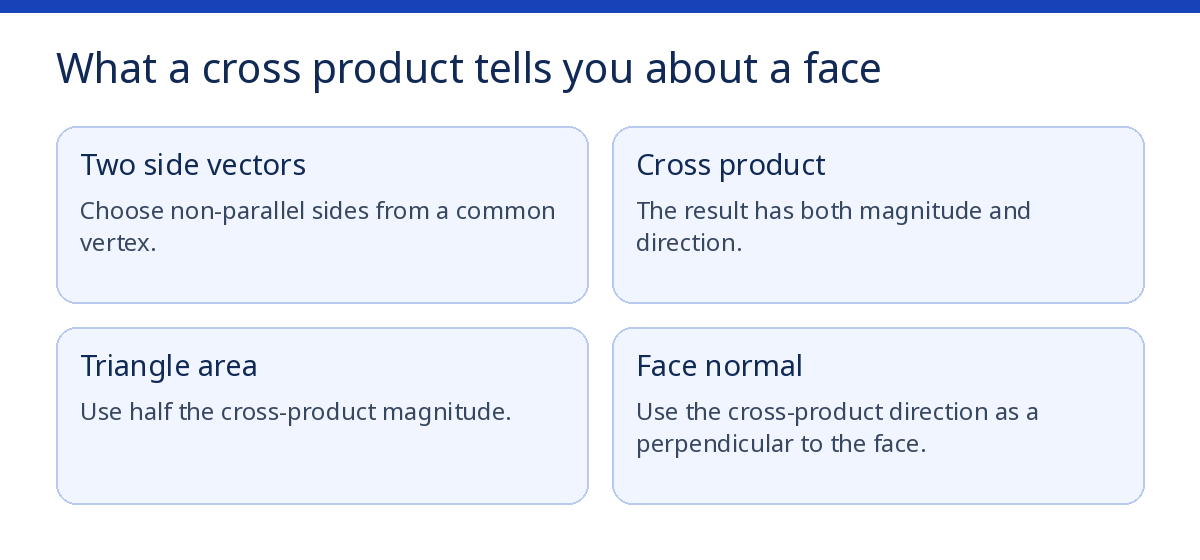
The vector product, or cross product, connects the side vectors of a figure to its area. For two side vectors drawn from a common vertex, the magnitude of their cross product gives the area of the parallelogram they span. Use half that magnitude for the triangle formed by those sides. Swapping the vectors reverses the cross-product vector but does not change the area.
In the triangular-pyramid cases, keep the area of a face distinct from the perpendicular height to it. Two non-parallel sides of the face produce a non-zero cross product normal to the face. To obtain the height, take the absolute value of the scalar projection along that normal of a vector from a point on the face to the opposite vertex. A sloping edge is not a height merely because it reaches that vertex.
Quick self-check: what does the resultant describe?
In the tug-of-war cases, add the signed force components along each axis before finding the magnitude of the resultant. The combined force is not the sum of the individual magnitudes: components pointing in opposite directions can cancel. Before judging a direction, ask whether the signs of the resultant components agree with the quadrant you have chosen.
The plane case adds a different check: relative to what? Ground velocity is the vector sum of the aircraft’s velocity relative to the air and the wind velocity. For a leg with constant ground velocity, multiplying that vector by elapsed time gives the displacement vector. If you use metres per second, express the time in seconds to obtain a displacement in metres.
Review your setup before checking the answer
Attempt a case in the questions section first. For multiple choice, write the operation you need before comparing options. For short answer, show which vectors you formed and why the operation fits the quantity requested. After attempting the assigned branch, use an OR alternative as another exercise. When opening a linked solution, compare the first step where your work differs, then use the return link to revisit the question.
This guide leaves out Case 3 Q1–Q2 because the wording and worked solution refer to different centroids. It also leaves out Case 13 parts (iv)–(v) because the second-leg speed is not clearly identified as airspeed or ground speed. The PDF’s solution notes flag both issues.
Spotted an error? Report a correction. Practise this in the app: notes, formula sheets and mind maps.





























































































































































Loading comments…