Significant Figures and Precision in Class 11 Physics Measurements
CBSEPhysicsUnits and Measurements
Master the rules of significant figures, rounding conventions, and precision in multi-step calculations with this case-based assessment guide for Class 11 Physics.
Measuring with Certainty and Uncertainty
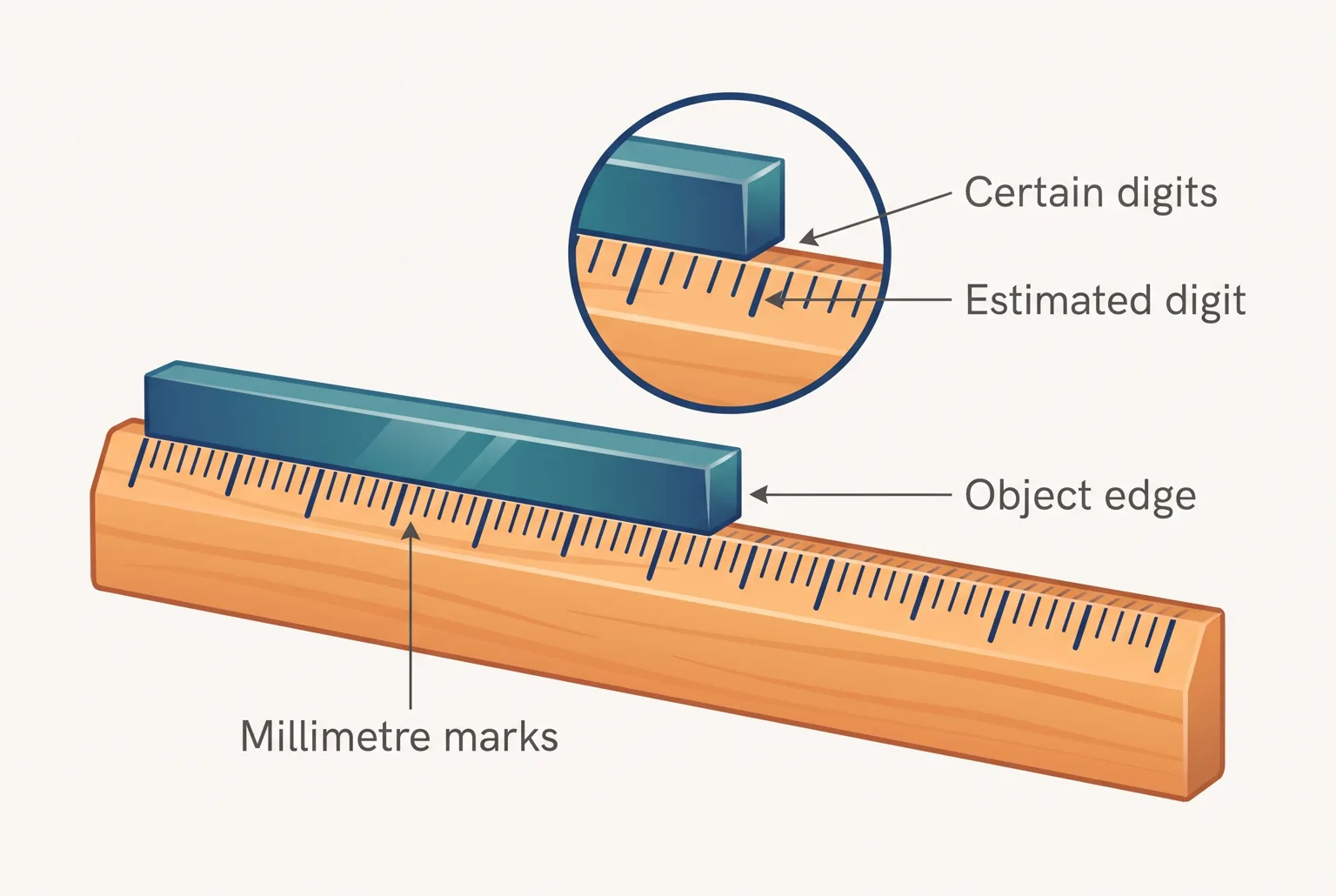
Measurement in Physics is more than a simple mathematical exercise; it is an indication of how reliably we know a physical quantity. This resource focuses on the distinction between certain and uncertain digits in scientific reporting. According to the source material, measuring a quantity rarely provides a perfectly accurate answer. Only ideal gadgets would offer perfection, but in practice, every measurement results in a combination of reliable (certain) digits and one dubious (estimated) digit. These are collectively referred to as significant figures.
The reliability of a measurement is communicated through the number of digits used to represent it. Writing down extra digits does not improve the accuracy of a measurement; rather, it misrepresents the precision of the tool used. For example, a ruler that only measures to the nearest millimetre cannot justify a reading reported to the hundredth of a millimetre. Understanding how to identify and report these digits is essential for success in the CBSE Units and Measurements curriculum.

Units and Measurement Class 11 |Physics | CBSE Case Based Assessment
In the StudentCurio app
A collection of case-based questions and detailed solutions for Class 11 Physics, focusing on significant figures, rounding rules, and precision in scientific measurements.
The Three Fundamental Rules of Significant Figures
Identifying significant figures depends on three primary rules outlined in this assessment. First, all nonzero digits are always significant. For instance, the number contains three significant figures. Second, any zeros captured between two nonzero digits are considered significant. The value has four significant figures because the zeros are trapped between the and the .
Third, leading zeros in a decimal are not significant. When a zero is placed to the left of the decimal point or between the decimal point and the first nonzero digit, it acts only as a placeholder to locate the decimal point. In the example , there are only two significant figures: and . Mastery of these rules prevents the common error of over-counting digits that do not represent measured precision.
The Ambiguity of Trailing Zeros
A critical distinction in this resource is how trailing zeros are treated differently in whole numbers versus decimals. In the assessment's case study, the number is treated as having only two significant figures. This follows a common school convention where trailing zeros in a whole number without a visible decimal point are treated as placeholders rather than measured values. To avoid ambiguity, the source recommends using scientific notation, where clearly shows two significant figures, while would indicate four.
Conversely, trailing zeros in a decimal number are always significant. In the number , the first two zeros are placeholders (leading zeros), but the final two zeros are significant because they appear after the decimal and after the nonzero digits. This measurement indicates a precision of four significant figures (, , , and ). These zeros are kept specifically to tell the reader that the instrument was precise enough to measure those positions as exactly zero.
Precision Limits in Multiplication and Division
Calculations involving measurements cannot magically increase the precision of the original data. The resource highlights that the product or quotient of a group of measurements cannot be more precise than the least precise input. When multiplying or dividing, the final result must be rounded to match the fewest number of significant figures present in the given data.
Take the example of finding the cross-sectional area of a wire (). If the radius is cm (two significant figures) and is approximated as (four significant figures), the final area must be rounded to two significant figures. Even if the raw calculation yields , the reported answer must be to respect the precision of the radius measurement. This rule ensures that the final result remains physically meaningful.
Distinguishing Measured Values from Exact Counts
One of the more nuanced concepts in the assessment is the treatment of exact numbers. Unlike measurements, which have inherent uncertainty, exact counts (like the number of spheres) have infinite precision. They do not limit the significant figures of the final answer.
In a problem where you calculate the total volume of spheres where each sphere is cm, the number is an exact count. You do not treat it as having only two significant figures. Instead, you maintain the three significant figures of the measured volume (). The raw product is rounded to cm to preserve those three figures. The final zero is essential; writing just would incorrectly suggest the precision has dropped to only two digits.
Rounding Conventions and Unit Consistency
Rounding is the process of trimming digits to fit the required precision. The source illustrates a standard rule: if the first digit to be discarded is greater than , the preceding digit is increased by one. For example, rounding to two significant figures requires looking at the third digit (). Since is greater than , the preceding becomes , resulting in .
Furthermore, the assessment warns learners to be vigilant about units. In one case study involving a rectangular block with dimensions m and m, the area must be reported in square metres (). Reporting an answer in without a massive scale conversion () is a physical error. A result like is only correct if both the numerical significant figures and the units are accurately preserved.
Good to remember
- Leading zeros (like those in ) never count toward significant figures.
- Trailing decimal zeros (like those in ) always count toward significant figures.
- Exact numbers (counts or defined constants) have infinite significant figures and should not be used to limit the precision of your final answer.
- When rounding, if the first digit you are dropping is or greater, round up the last kept digit.
- Scientific notation is the most reliable way to express significant figures without ambiguity.
Common mistakes
- Over-reporting precision: Retaining all digits from a calculator (e.g., ) instead of rounding to the limiting significant figures of the input data.
- Confusing rules for addition and multiplication: Multiplication depends on the total number of significant figures, whereas addition depends on the decimal place (the least precise column).
- Ignoring units: Calculating the correct number but failing to match the unit (m vs cm) provided in the initial measurements.
- Treating counting numbers as measurements: Limiting the precision of a result based on an exact count (like items) instead of the measured value.
Frequently asked questions
How do you determine the number of significant figures in a whole number like 1200?
According to the convention used in this resource, trailing zeros in a whole number without a decimal point are not significant. Therefore, 1200 has two significant figures (1 and 2). To show more precision, scientific notation should be used.
Why does 29.04 cm³ round to 29.0 cm³ when multiplying 12 spheres by 2.42 cm³?
Because 12 is an exact count, it has infinite precision. The measurement 2.42 has three significant figures. Therefore, the result must be rounded to three significant figures, making the final zero in 29.0 necessary to indicate that precision.
What happens if the first digit you discard during rounding is exactly 5?
While this specific resource notes that digits greater than 5 require rounding up (like 1.69 becoming 1.7), standard rounding rules usually dictate rounding to the nearest even digit or rounding up; check your specific textbook for the tie-breaking rule if the discarded digit is exactly 5 followed by zeros.
Spotted an error? Report a correction. Practise this in the app: notes, formula sheets and mind maps.








































Loading comments…