Thermal Properties of Matter: Class 11 CBSE Assessment
CBSEPhysicsThermal Properties of Matter
This CBSE Class 11 Physics assessment pairs topic-wise questions with worked solutions and mixed chapter practice. Use it to check whether you can choose the right thermal model, state its assumptions and explain what your result means.
How the assessment is organised
The file divides the chapter into Temperature and its Measurement and Calorimetry and Heat Transfer. Each topic has a Practice Questions set and a separate Topic Assessment. Both include objective, very short, short and long answers. The final Chapter Practice mixes material from across the chapter and adds assertion–reason and case-based questions. This structure lets you practise a topic on its own before testing whether you can recognise it without a topic label.
The clickable index has separate views for questions and solutions. The Solution link beside a question opens its worked answer; Back to question returns you to the prompt. Try the Practice Questions first and use the worked steps to locate your first mistake, not just to compare final results. Then attempt the Topic Assessment without the links open. In a written response, check whether you explained why your method applies rather than simply naming a law.

Thermal Properties of Matter | Class 11 | CBSE Assessment
In the StudentCurio app
Chapter-wise assessment questions and worked solutions cover thermal expansion, calorimetry, phase changes, heat transfer, radiation laws and Newton’s law of cooling. Useful for Class 11 students reviewing concepts and practising objective, case-based and written problems.
Temperature readings and thermometer calibration
The first topic moves between temperature scales and the physical properties used to measure temperature, including liquid volume, gas pressure and electrical resistance. Keep the instrument reading separate from the temperature it represents: a measurable property becomes useful for thermometry when its relationship to temperature is known. For a gas thermometer that uses pressure as its reading, the volume must be held fixed.
A scale reading is not a temperature interval. To convert an actual Celsius reading to kelvin, use . A change of one Celsius degree, however, has the same magnitude as a change of one kelvin. The offset cancels when you subtract two readings. Fahrenheit intervals have a different size, so they need a scale factor even when no offset is needed. Before substituting, label the quantity as a reading or a change.
Expansion: check what is free to move
The expansion questions use rods, calibrated scales and constrained wires to test more than substitution. The linear approximation describes the length change of a freely expanding solid when the temperature is uniform and the coefficient can be treated as constant over the interval. Here is the length at the starting temperature. For a material with positive , cooling gives a negative length change. If the ends cannot move, the free length change is not the actual change: the constraint can produce thermal stress instead.
Common mistake: using a linear coefficient for a volume change. For an isotropic solid and small strains, the area and volume expansion coefficients are approximately twice and three times the linear coefficient, respectively. The factors come from counting the dimensions that expand, not from a change of units. One unclearly worded question about expansion coefficients is not discussed here; the guide relies on the other expansion items.
When to use specific heat or latent heat
Start a calorimetry problem by listing what exchanges energy and whether each substance changes temperature, changes phase or does both in stages. Use for a temperature change without a phase transition when the specific heat can be treated as constant. Use for the energy absorbed in melting or vaporising a mass at the transition temperature. Match the mass unit to the unit in which the specific heat or latent heat is given.
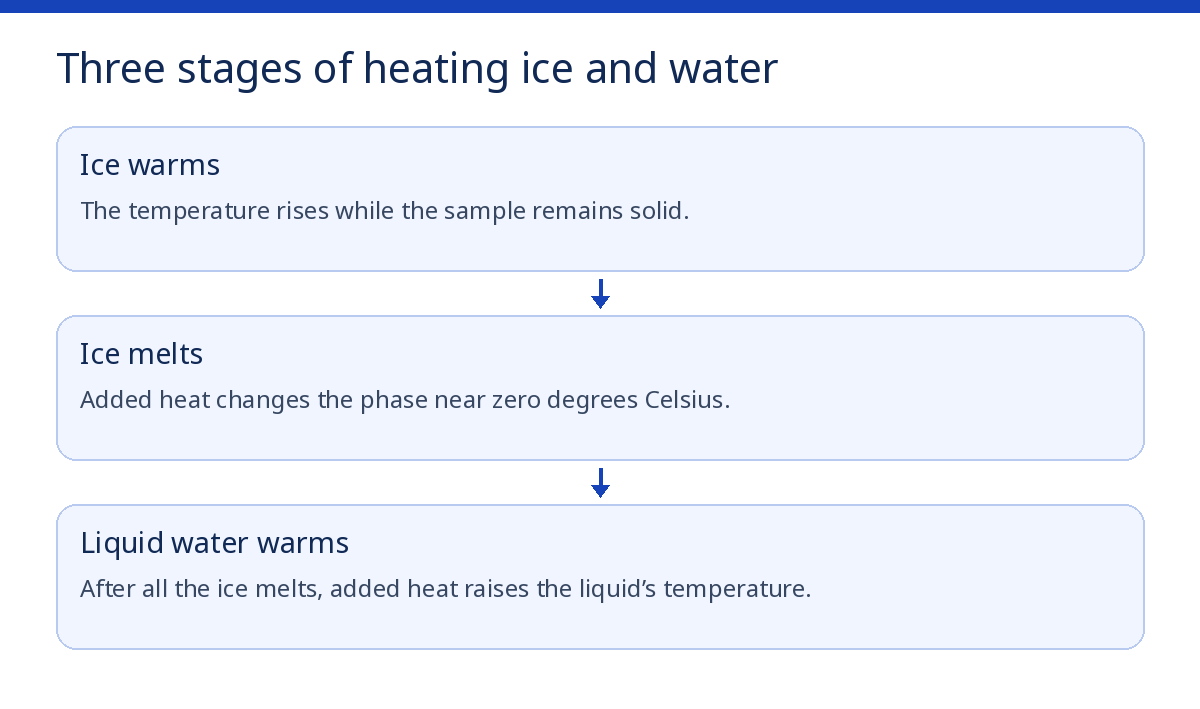
The cover’s ice-and-water heating curve shows why a single temperature-change calculation cannot describe the entire process. At about one atmosphere, ice warms to near zero degrees Celsius, melts at nearly constant temperature, and then the liquid water warms once melting is complete. In a mixing problem, heat lost equals heat gained only if energy exchange with the surroundings is negligible and all participating bodies, including the container if relevant, are accounted for. The final temperature is not generally the arithmetic mean of the initial temperatures.
Identify the transfer mechanism before the law
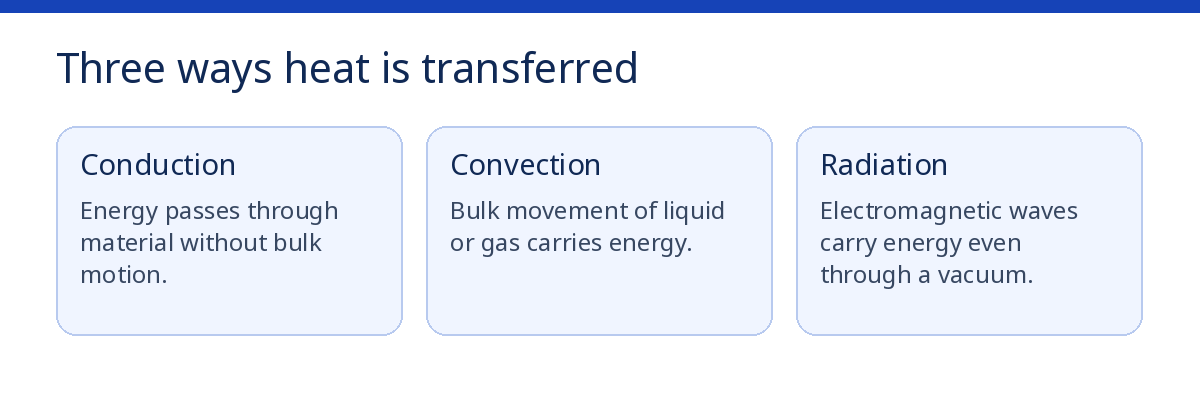
Conduction transfers energy through a material without bulk movement of the material. In steady conduction through a uniform flat wall, the heat-transfer rate depends on thermal conductivity, wall area, thickness and the temperature difference across it. That is why a comparison of two materials must account for geometry and temperature difference, rather than treating the faster transfer rate as a direct measure of conductivity in every setup.
Convection involves bulk motion of a liquid or gas. Radiation transfers energy by electromagnetic waves and does not require a material medium. The assessment’s examples involving vessels, insulation and hot surfaces give you practice distinguishing these mechanisms. More than one can operate at once, so say whether you are identifying the dominant mechanism or using a simplifying assumption stated in the question.
Quick self-check: when does Newton’s law apply?
Newton’s law of cooling approximates the cooling rate as proportional to the body’s temperature excess over its surroundings when that difference is sufficiently small and the surroundings and heat-transfer conditions stay effectively constant. It does not predict a constant drop in temperature per minute. Also distinguish thermal radiation emitted by a surface from net radiative loss, since the surface can absorb radiation from its surroundings as well.
Before opening a worked solution in Chapter Practice, ask: What is my system? Am I finding an energy, an energy-transfer rate or a temperature-change rate? Which assumption connects those quantities? For an assertion–reason item, check each statement separately before deciding whether the reason explains the assertion. For a case-based item, identify which details determine the model before doing any arithmetic.
Spotted an error? Report a correction. Practise this in the app: notes, formula sheets and mind maps.








































Loading comments…