Solutions: CBSE Class 12 Chemistry Case-Based Assessment
CBSEChemistrySolutions
This CBSE Class 12 Chemistry assessment uses case studies to test how you choose a concentration measure, interpret vapour-pressure and freezing-point data, and decide when a law applies. The PDF separates questions from worked explanations so you can test your reasoning before checking it.
How to use the case-based assessment
The PDF contains 13 case studies with multiple-choice, short-answer, data-based and assertion–reason questions, including OR alternatives. The clickable index takes you to either the questions or the worked solutions for each case. Individual questions also have solution and return links. There is no separate chapter-practice section in the file.
On a first attempt, identify the quantity the question asks for and the conditions in the passage before looking at the options. Then use the solution to check the choice of relationship as well as the arithmetic. In a data-based question, your evidence may come from a graph or table; in an assertion–reason question, a correct statement is not enough unless it explains the assertion.

Solutions | Class 12 Chemistry| CBSE Case-based Assessment
In the StudentCurio app
Solved case-based and assertion–reason questions cover Raoult’s law, ideal and non-ideal solutions, concentration, colligative properties, osmosis and gas solubility. Helps Class 12 students practise CBSE Chemistry assessments and follow worked explanations.
Concentration: check what goes in the denominator
The opening cases distinguish the type of solution, classified by the physical state of the solvent, from its concentration, which describes composition. They also distinguish concentration from solubility: a solution can have a stated concentration without being saturated. The concentration cases ask you to move between ways of expressing composition rather than treat them as interchangeable labels.
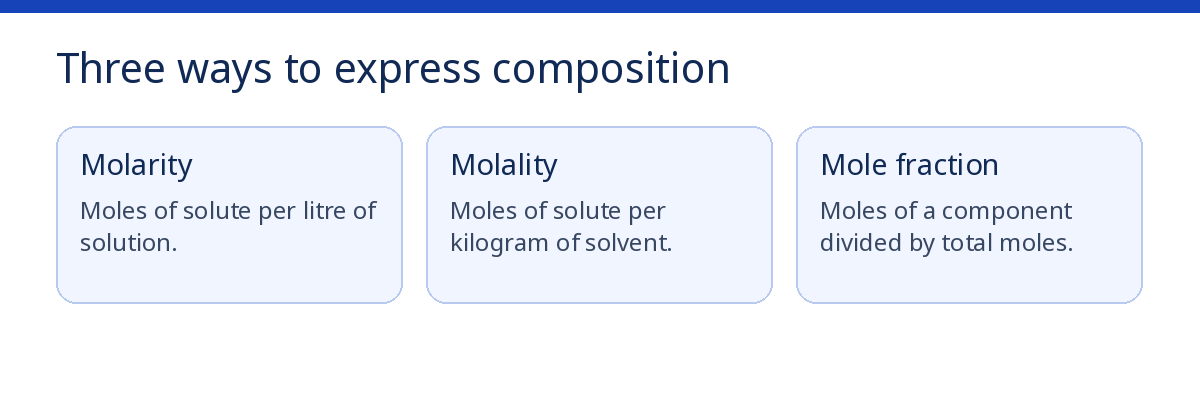
Molarity uses moles of solute per litre of solution; molality uses moles of solute per kilogram of solvent. A component’s mole fraction divides its amount in moles by the total amount in moles. At fixed composition, a temperature change can alter molarity through expansion or contraction, but it does not change molality or mole fraction. When converting mass percentage to molarity, check that the density used is the density of the solution: it is the solution volume you need.
Raoult’s law: keep liquid and vapour compositions separate
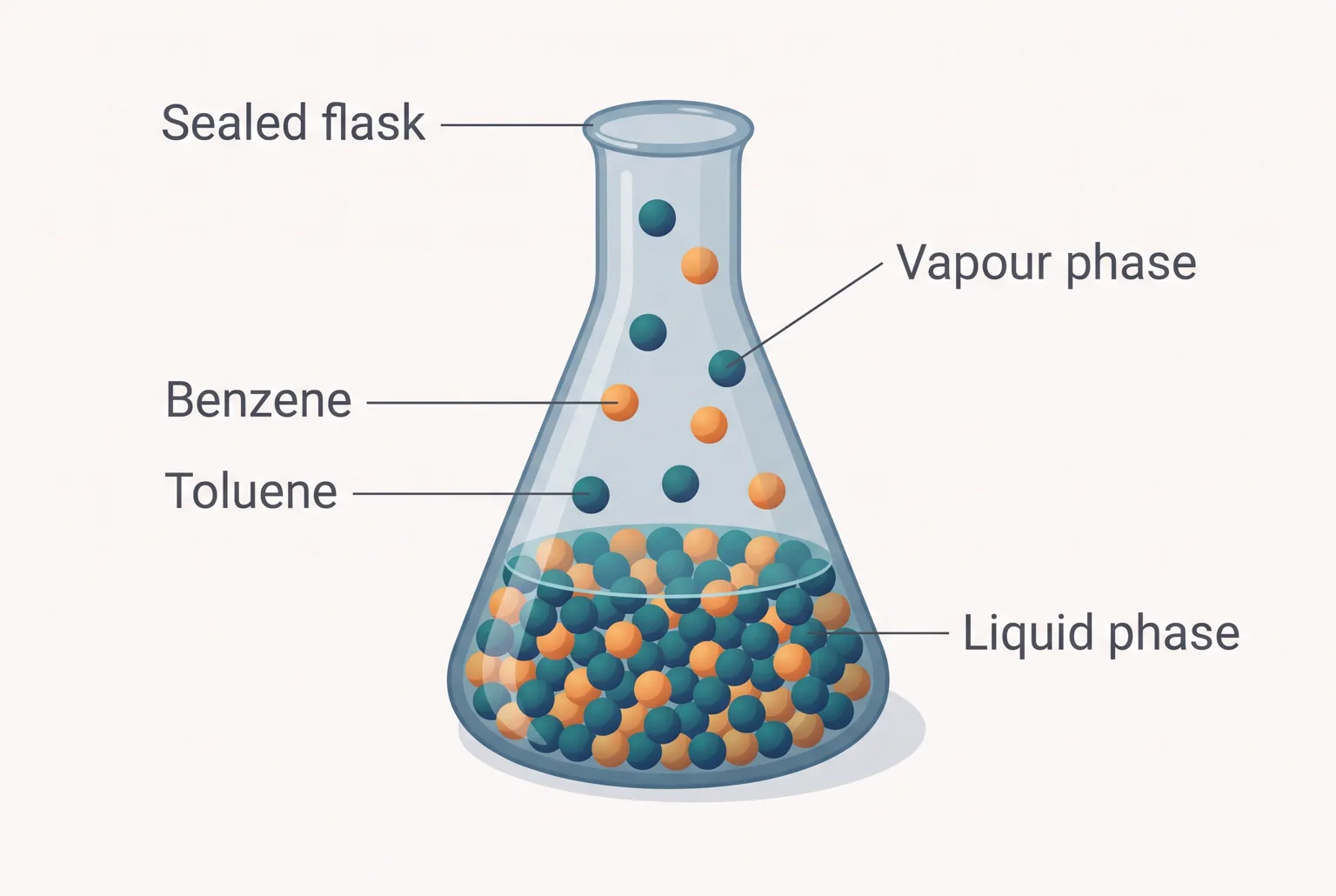
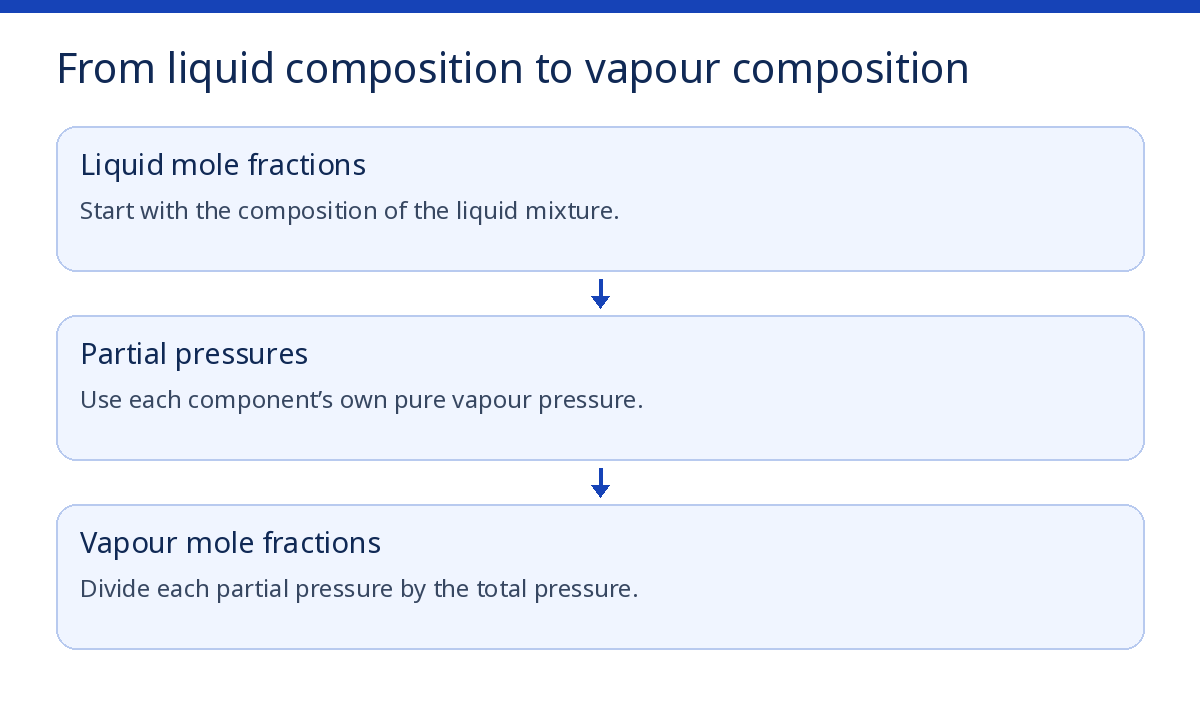
The benzene–toluene case links liquid composition, partial vapour pressure and vapour composition. For an ideal solution at a fixed temperature, Raoult’s law gives , where is the liquid-phase mole fraction and is the vapour pressure of pure component at that temperature. Add the partial pressures to get the total. If the question asks for the component’s mole fraction in the vapour, its share of the total pressure gives that fraction.
An ideal solution follows Raoult’s law across the full composition range. When reading the non-ideal solution graphs, compare the observed pressure with the ideal prediction at the same composition: pressure above that prediction indicates positive deviation, and pressure below it indicates negative deviation. The assessment also connects deviations to differences between like and unlike molecular interactions and introduces azeotropes, which boil with the same liquid and vapour composition at a given pressure.
Henry’s law: use the gas’s partial pressure
The gas-solubility case uses Henry’s law in the form , where is the equilibrium partial pressure of the gas above the solution and is its mole fraction in the liquid. For the same gas–solvent pair at a fixed temperature, a higher partial pressure means a higher dissolved mole fraction within the range where the law applies.
The notation may look like Raoult’s law, but is a Henry’s law constant, not a pure-component vapour pressure. Match the pressure units before taking the ratio. When comparing gases in the same solvent at the same temperature and partial pressure, a larger in this convention corresponds to a smaller dissolved mole fraction.
Colligative properties: choose the right particle measure
The assessment covers four colligative properties: relative lowering of vapour pressure, freezing-point depression, boiling-point elevation and osmotic pressure. In the dilute-solution model, their dependence on dissolved particle concentration makes it possible to infer a solute’s molar mass from a measured effect. But the required measure of concentration is not the same for all four.
For an ideal solution with a nonvolatile nonelectrolyte, the relative vapour-pressure lowering equals the solute mole fraction; unlike the absolute lowering, this ratio has no units. For dilute solutions, and use molality, while uses molarity and absolute temperature. Here is the van’t Hoff factor. Association reduces the effective particle count and gives ; dissociation increases it and gives . The osmosis case applies the pressure relationship to isotonic solutions, which have equal osmotic pressure at the same temperature.
Reading the freezing-point investigation
The experimental case presents two sets of melting-temperature readings for salt solutions prepared with a fixed amount of water. To judge whether a reading fits, first compare the two measurements at the same salt mass, then compare them with the trend across nearby masses. These are different checks: one tests agreement between repeats, while the other tests consistency with the broader pattern.
Keep the recorded temperature separate from the depression. A reading below the pure solvent’s freezing point can be negative on the Celsius scale, but the depression is the positive difference . Also distinguish an observed reading from a prediction beyond the measured range. Repeats help assess consistency; they do not turn an extrapolation into a measurement.
Assertion–reason self-check: does the reason explain the claim?
Read each statement independently before deciding whether the reason explains the assertion. If the claim compares two temperature changes, check whether the concentration basis, particle count and solvent constant support the comparison. If the statements concern cooling, distinguish a temperature drop during dissolution from a shift in the liquid–solid equilibrium temperature. The two effects are not interchangeable just because both involve temperature.
Scope note: This guide leaves out the disputed glucose boiling-point item, the original component B inequality in the positive-deviation passage, the sulphur molar-mass example and the disputed isotonic boiling-point comparison.
Spotted an error? Report a correction. Practise this in the app: notes, formula sheets and mind maps.















































































































































Loading comments…