CBSE Class 11 Mathematics: Sets Assessment Guide
CBSEMathematicsSets, Relations and Functions
This Class 11 CBSE Mathematics assessment covers Chapter 1, Sets, through five topic-wise assessments and a mixed chapter practice section. Use the worked solutions to check how you interpret a domain, select a region in a Venn diagram or account for an overlap.
What the assessment covers and how to navigate it
The five assessments cover set representation, types of sets, subsets and universal sets, Venn diagrams and operations, and applications of set theory. The file focuses on Sets, not relations or functions. Chapter practice brings these topics together through objective, very short, short, long and case-based questions. The shorter formats let you practise recognising notation, while questions that ask you to justify a claim require you to explain why it holds rather than simply choose a symbol or an option.
The PDF has separate clickable indexes for questions and solutions. Use the questions index to choose a topic, then follow the page reference beside a question or use the solutions index to find the corresponding explanation. Keep track of both the assessment title and the question number because numbering restarts in each topic-wise assessment.
Sets| Class 11 | CBSE Assessment
In the StudentCurio app
Assessment questions and worked solutions cover set representation, subsets, Venn diagrams, set operations, complements, identities, cardinality and inclusion–exclusion, including case-based practice. This material helps Class 11 students prepare for CBSE Mathematics assessments and check their solutions.
Read the rule before listing the elements
The representation questions test whether a collection has a definite membership rule and whether you can express the same collection in two ways. Roster form lists the elements; set-builder form states the condition they satisfy. Changing the order of the entries or repeating an entry does not change a set. Likewise, two sets can be described by different rules and still be equal if they contain exactly the same elements.
When converting from set-builder form, identify the domain before applying the condition. A solution over the real numbers may have to be discarded if the question restricts the variable to integers or natural numbers. In this file, the natural numbers begin at one. The interval questions apply the same attention to boundaries: a square bracket includes a finite endpoint, while a parenthesis excludes it. On a number line, a real interval includes all the real numbers between its endpoints, not just the integers you could mark or list.
Common mix-ups: membership, subsets and size
Read as a claim about one object: is it an element of ? Read as a claim about all the elements of : does each also belong to ? The distinction matters when an element is itself a set. Look at the braces to decide whether the entire inner set is being treated as one object or whether its contents are being tested separately.
The PDF uses both and for inclusion that allows equality. A proper subset must also differ from the original set. To check a claim of set equality by inclusion, check both directions; showing that every element of the first set belongs to the second does not rule out extra elements in the second. Also distinguish the empty set, which has no elements, from a singleton whose sole element is the empty set.
Translate operations into Venn regions
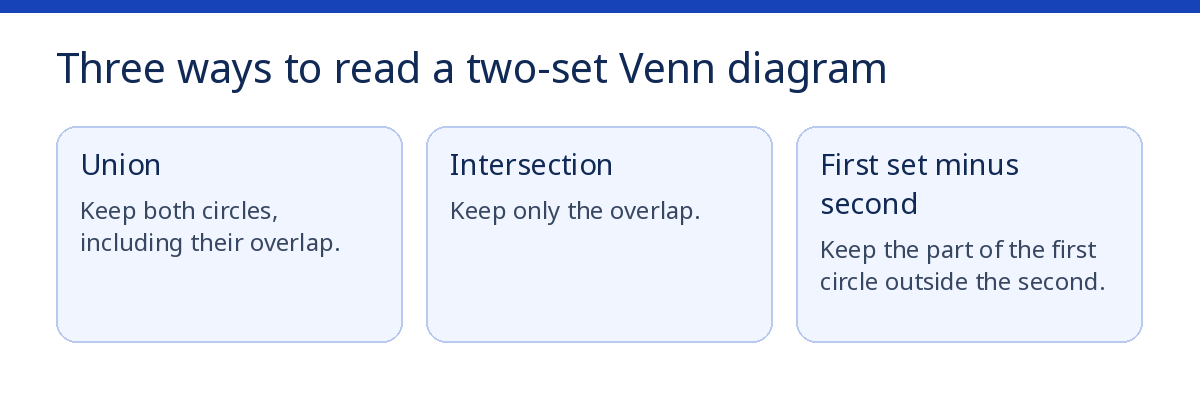
The operations assessment moves between notation, lists of elements and shaded diagrams. For a union, include elements in at least one of the sets, including those in the overlap. For an intersection, keep only those in both. The difference keeps elements in but not in , so reversing the order can change the result. Disjoint sets have no elements in common, so their intersection is empty.
For a complement, first identify the universal set. The complement includes everything inside that universe but outside . If the universe changes, the complement can change even when stays the same. The assessment also distinguishes verifying an identity for supplied sets from proving a general statement. Listing the elements on both sides can verify a particular case. For a general proof, compare the membership conditions on the two sides without relying on specific elements from a roster.
When inclusion–exclusion applies
The applications assessment turns descriptions of groups, such as people who speak particular languages, into questions about cardinality, the number of elements in a set. For two finite sets, . Adding the separate counts includes every member of the overlap twice. Subtracting the overlap once leaves each member of the union counted once.
Before using a stated total as the union count, check what that total describes. The size of a whole class or group equals the size of the union only if everyone belongs to at least one of the two sets. If some belong to neither, they lie outside both circles and are not included in the union. Also distinguish an entire circle from its non-overlapping part: a count for one group includes the overlap unless the wording says that the count is for that group only.
Use the worked solutions to find the first mismatch
Start with the topic where you are least sure what the notation means. Attempt a question before opening its solution, and write down the step that determines your answer: the domain you used, the region you selected or the quantity you counted. When you compare your work with the solution, look for the first step where the reasoning differs rather than only checking the last line.
Then move to chapter practice, where you have to recognise which topic a question draws on. For a case-based question, label the groups and identify what each given quantity counts before choosing an operation. After calculating, reread the question and name the group your result describes. If it is not the group the question asks for, revise the set expression before repeating the arithmetic.
Spotted an error? Report a correction. Practise this in the app: notes, formula sheets and mind maps.
Loading comments…