Relations and Functions: CBSE Class 12 PYQs and Solutions
CBSEMathematicsSets, Relations and Functions
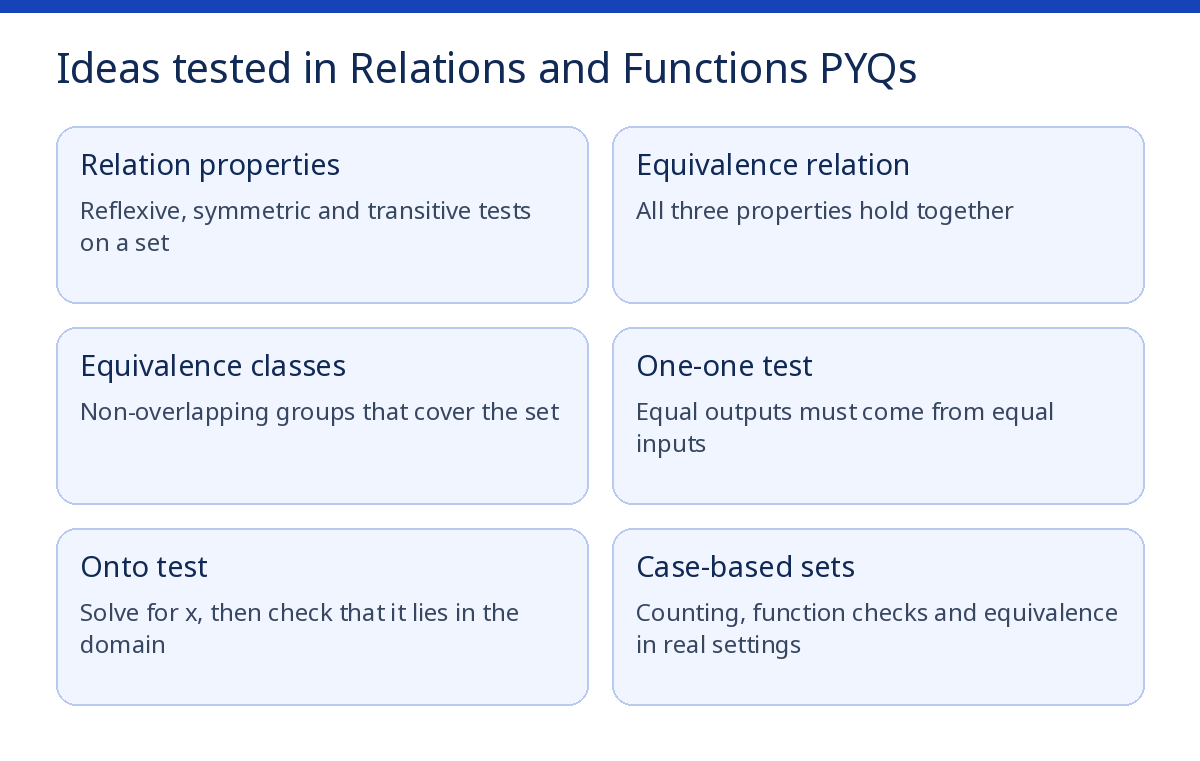
This guide to Relations and Functions for CBSE Class 12 explains how board questions test reflexive, symmetric and transitive relations, equivalence classes, and one-one, onto and bijective functions. It also shows how the 67-question collection, labelled 2023–2026, is organised and how to practise with its added worked solutions.
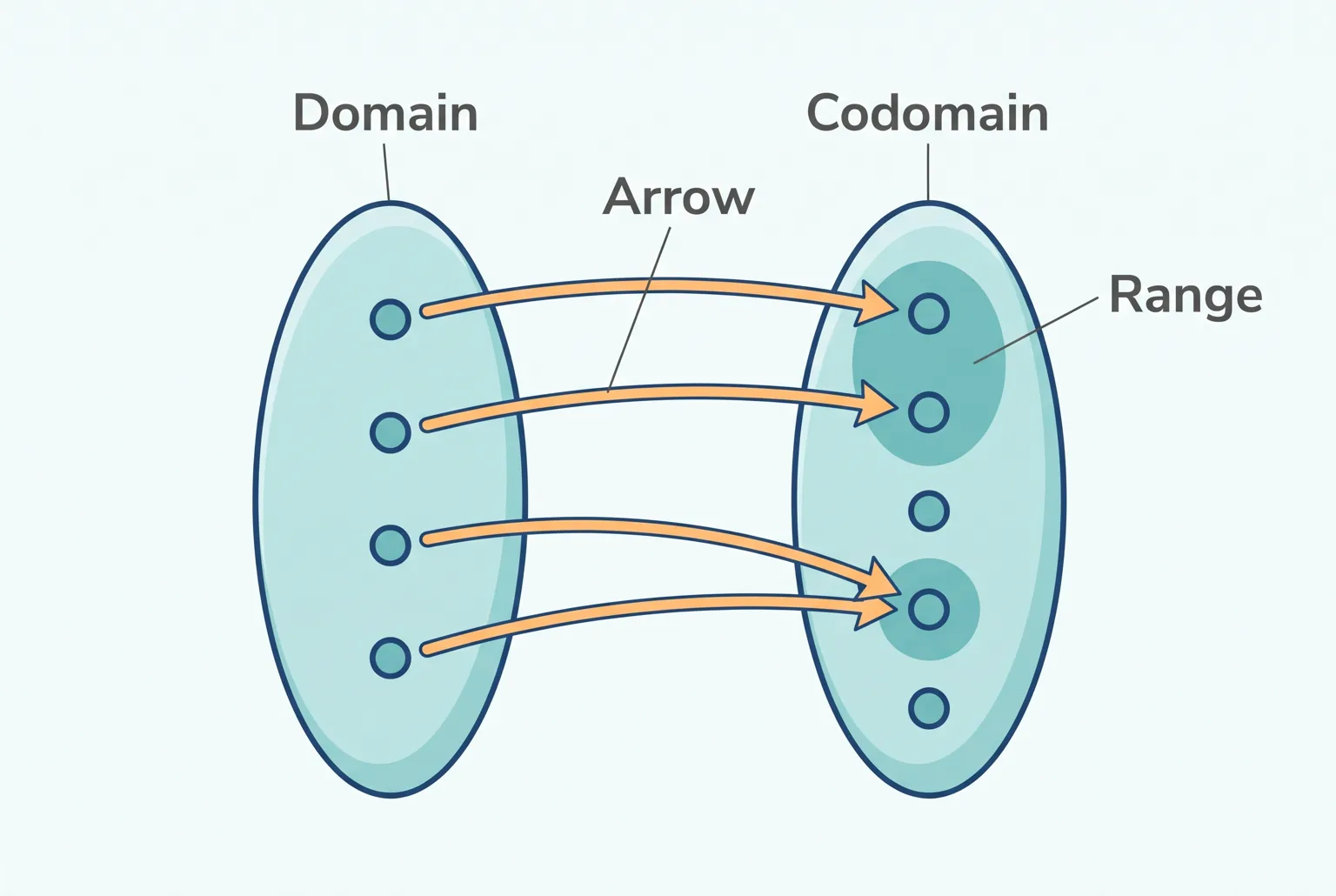
Checking reflexive, symmetric and transitive properties
Every relation question in this chapter starts with three tests on a relation defined on a set :
- Reflexive: for every . One missing element is enough to fail.
- Symmetric: whenever , the pair must also be in .
- Transitive: whenever and , the pair must be in .
The collection presents relations in three ways. Some list ordered pairs on a small set such as , where you check each property pair by pair. Others give a rule on , or , such as conditions on , multiples, or an irrational expression. A third group uses everyday rules, such as one person being 5 cm shorter than another.
To prove that a property holds, argue for arbitrary elements. To show that it fails, give one specific counterexample.

Relations and Functions | Class 12 | Previous Year Paper
In the StudentCurio app
CBSE previous-year questions covering types of relations, equivalence relations and classes, and one-one, into and onto functions. Includes worked solutions and MCQs to help Class 12 students practise exam-style problems and revise key concepts.
Equivalence relations and the classes they create
A relation is an equivalence relation when it is reflexive, symmetric and transitive at once. Subjective questions often ask you to "determine if is an equivalence relation", so you must verify all three properties in writing.
One recurring rule sets related to in when is divisible by a fixed positive integer . Another paraphrased stem places thumb pins on a notice board and relates two pins if they are less than 3 cm apart. Rules based on distance or closeness need careful testing of transitivity.
An equivalence class of an element is the set of all elements related to . The classes split the set into non-overlapping groups that together cover it. Questions ask you to describe these classes or count how many there are.
Proving one-one and onto: the standard two-part method
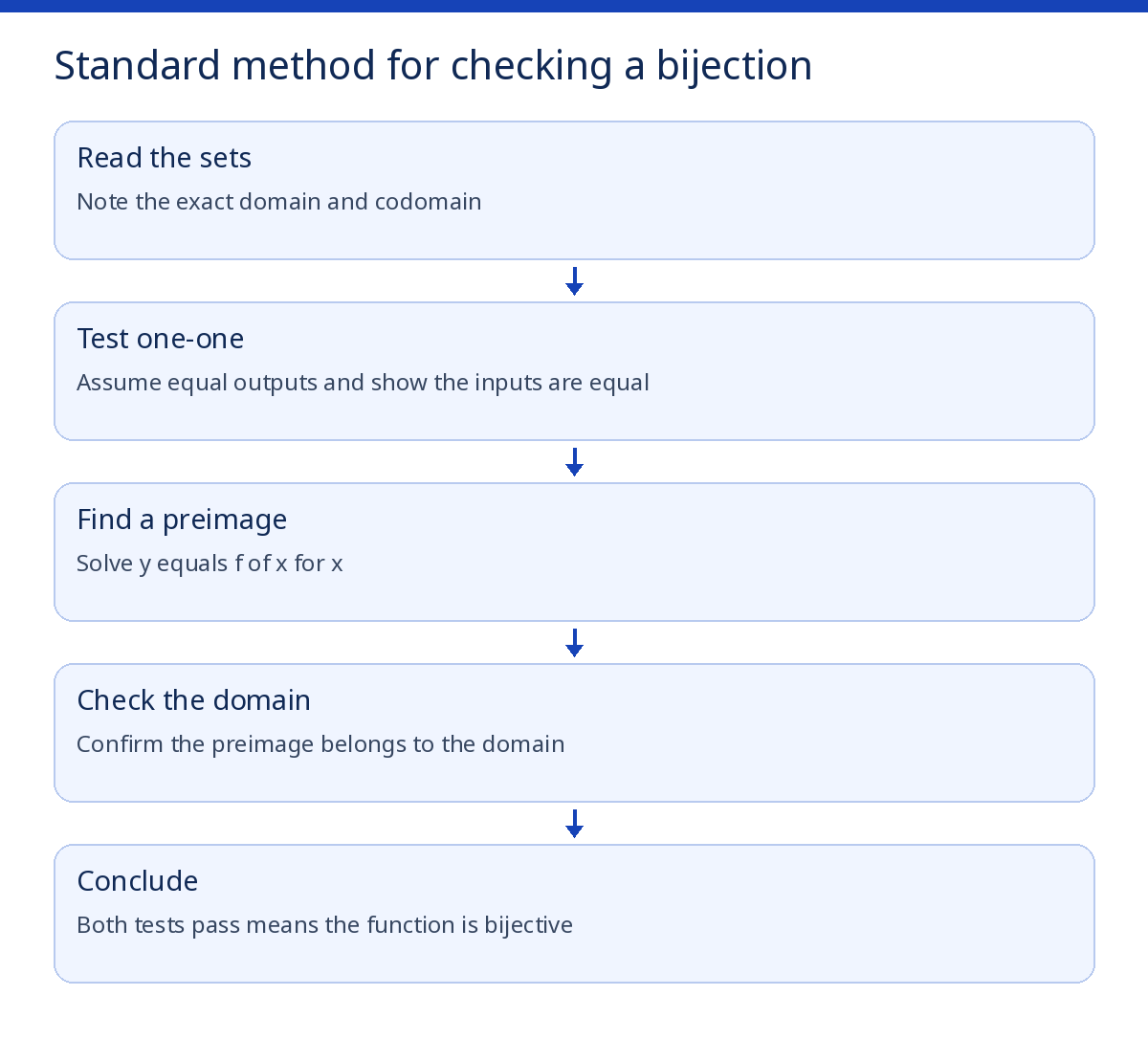
One-one, onto and bijective functions form the largest block in the topic index, with 26 questions. The method has two parts:
- One-one (injective): assume and show that . To disprove it, find two different inputs that give the same output.
- Onto (surjective): take any in the codomain, solve for , and then confirm that this actually lies in the domain. Onto means the range equals the codomain.
A function that is both is bijective. For example, with on , solving gives , which is real for every real .
The added solutions in this collection use these algebraic preimages together with explicit domain checks.
How domain and codomain change the verdict
Many questions reuse similar formulas but change the sets. You will meet , , , punctured domains such as , and codomains such as .
A quadratic can fail the one-one test on but pass it once the domain is restricted to . Similarly, a preimage may exist in but not in .
The collection states its convention that unless a question says otherwise. It also uses each domain exactly as defined in the question.
The chapter tests a few more forms in the same way:
- Piecewise rules, such as with for even and for odd .
- Rational functions on punctured domains.
- Maps on .
- Questions asking which codomain makes a function onto.
Decoding assertion–reason items in this chapter
Several of the 27 MCQs are assertion–reason items with the standard four options. Work through them in three separate steps:
- Decide whether the Assertion is true.
- Decide whether the Reason is true.
- Only if both are true, ask whether the Reason actually explains the Assertion.
In this chapter, a Reason is often a definition or general claim about relations or functions. Examples include statements about intersections of equivalence relations, a criterion for bijectivity, or a counting formula for onto functions. Test such a Reason against the definitions above rather than accepting it because it sounds familiar. A Reason can be a true statement and still fail to explain the specific Assertion.
Case-based questions built on everyday sets
The subjective section includes case-based questions. They set up finite sets drawn from school life, such as girls and boys selected for a project, speakers and judges at a debate, or students and their roll numbers.
The subparts then move through the chapter in order:
- Count the possible relations from one set to another, remembering that a relation is a subset of .
- Check whether a listed set of pairs is a function, and whether that function is injective or bijective.
- Test a relation such as "from the same colony" for equivalence.
With finite sets, compare the sizes of the domain and codomain before claiming a function is one-one or onto. These questions also include internal OR choices, as do many shorter subjective items.
Common slips the added solutions guard against
The compiler's notes say the solutions use explicit set arguments, counterexamples, algebraic preimages and domain checks. That points to the errors worth avoiding:
- Declaring onto without a domain check. Solving for is not enough; the value must belong to the stated domain.
- Disproving with words, not an example. Write specific elements or pairs that break the property.
- Proving only two of the three properties when an equivalence relation is asked for.
- Forgetting the starting value of , which affects ranges and preimages.
Where a printed statement is false or a key conflicts with the wording, the solutions explain the issue instead of proving the claim.
Practising the 67 questions topic by topic
The collection keeps all 67 questions in their original order. It contains 27 single-answer MCQs and 40 subjective questions, including case-based items and alternatives.
The topic index groups the questions as follows:
- Reflexive, symmetric and transitive relations: 13
- Equivalence relations and classes: 12
- One-one, onto and bijective functions: 26
- Counting: 2
- Inverse functions and composition: 1
- Mixed and case-based questions: 13
Exam labels span 2023–2026. They were not checked against original CBSE papers, and marks are not given. The source supplied only an MCQ key, so every worked solution is marked as an added solution. A separate section of source review notes records the issues the compiler found.
A sensible practice order is to start with relations, then equivalence relations, then functions, and finish with the case-based set. Attempt each question before using its View Solution link.
Frequently asked questions
Are the worked solutions official CBSE marking schemes?
No. The source provided only a single-answer MCQ key. Every worked solution was added by the compiler and is marked as an added solution.
Does the collection show marks for each question?
No. Marks are absent from the supplied labels, so they are omitted. Only the exam year, set, region and compartment labels are kept.
Spotted an error? Report a correction. Practise this in the app: notes, formula sheets and mind maps.





























































































































































Loading comments…