Relations and Functions: Class 12 NCERT Textbook Guide
CBSEMathematicsSets, Relations and Functions
This CBSE Class 12 Mathematics chapter builds on the Class 11 language of sets, relations and functions. The supplied pages use worked examples and exercises to develop relation tests, equivalence classes and function types, then introduce composition and invertibility.
From sets to ordered pairs
The chapter begins by recalling domain, codomain and range rather than teaching sets from scratch. Its starting point is the Cartesian product: a relation from to is any subset of . The notation says that the ordered pair belongs to the relation. The school examples make the order meaningful: in a relation based on one student being older than another, the two positions in the pair play different roles.
The focus then shifts to relations on a set , where both entries belong to . The empty relation contains no ordered pairs, while the universal relation contains every pair in . These extremes show why a defining condition must be read together with the set on which it is imposed: the condition selects pairs only from the stated Cartesian product.

Relations and Functions | Class 12 | NCERT Textbook
In the StudentCurio app
This NCERT textbook chapter covers types of relations, equivalence relations and classes, alongside one-one and onto functions, composition, invertibility and binary operations. Worked examples and exercises support Class 12 students studying these concepts.
Common mistakes in the three relation tests
Reflexivity requires every element of the set to be related to itself. When a relation is listed as ordered pairs, check for every diagonal pair, not just for the ones involving elements that already appear elsewhere in the list. A single missing diagonal pair disproves reflexivity.
Symmetry requires the reverse of each pair that is present. It does not require every possible pair to be present. Transitivity tests a different pattern: whenever and are present, must also be present. The second entry of the first pair must match the first entry of the second; two unrelated pairs do not start a transitivity test. In the textbook’s worked examples, triangle congruence illustrates how to prove the properties for arbitrary elements, while perpendicularity of lines shows why symmetry does not guarantee either of the other two properties.
What an equivalence class tells you
A relation is an equivalence relation only when it is reflexive, symmetric and transitive. The payoff is that it partitions the underlying set into equivalence classes. The class of an element consists of all elements related to it. Members of a class are related to one another, members of different classes are not related, and the classes are disjoint and together cover the whole set.
The chapter illustrates this with integers related when their difference is divisible by two. The class containing zero is the set of even integers, and the class containing one is the set of odd integers. The number in brackets names a representative, not a unique label: two different even integers name the same class. The discussion of divisibility by three extends the idea to three classes, including negative integers as well as zero and positive integers.
Quick self-check: inputs or codomain?
For a function , a one-one test starts with two inputs and asks whether equal outputs force those inputs to be equal. An onto test starts with an arbitrary element of the codomain and asks whether some permitted input maps to it. Onto means that the range equals the codomain; it does not say that each output is reached by only one input. A function that passes both tests is bijective.
The worked examples compare the same rule, , as a map from the natural numbers to themselves and as a map from the real numbers to themselves. The first is one-one but not onto; the second is both. Before tackling Exercise 1.2, ask yourself: when you solve an output equation for an input, have you checked that the candidate actually belongs to the stated domain?
When one function can follow another
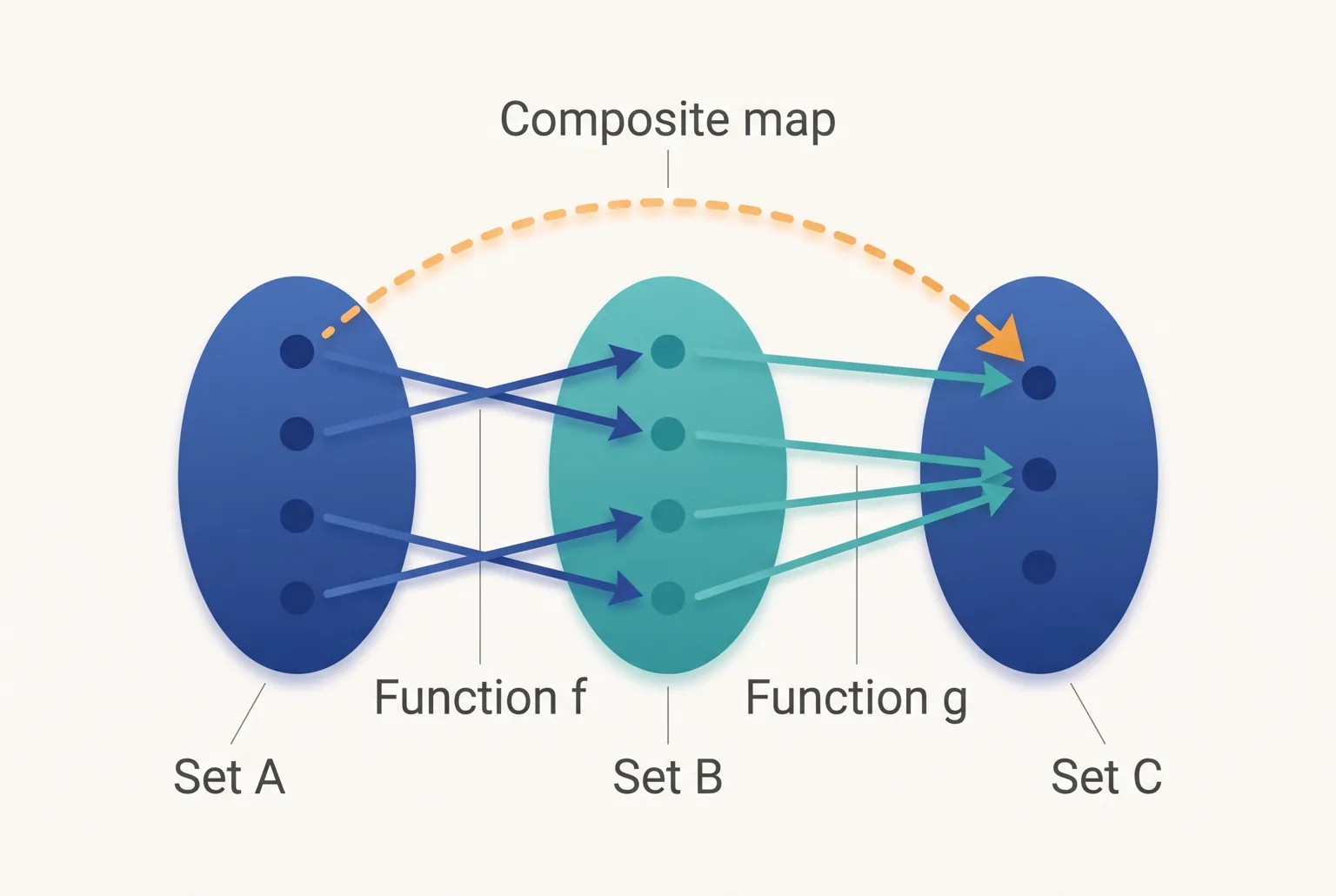
In the textbook’s definition, and have matching intermediate sets, so the output of the first function is a valid input to the second. Their composition is , given by . Read it from the inside out: apply the function on the right first. The worked example on finite sets makes the intermediate step visible by tracing each input through both maps.
For the reverse order, check that the outputs of are valid inputs to before comparing the results. Even when both orders are defined, they need not give the same function. The chapter’s real-valued cosine and quadratic example illustrates that distinction.
Why an inverse needs both properties
An inverse function goes from the original codomain back to the original domain. A function is invertible if there is a function such that and . The first identity recovers every starting input; the second recovers every starting element of the codomain.
The two function tests explain why this works. Surjectivity ensures that each codomain element has a preimage, and injectivity ensures it has only one. Together they let the inverse assign exactly one input to each output. If a question asks only whether the function is invertible, establishing both properties is enough; finding an explicit inverse is a separate task.
How to use the worked examples and exercises
Use Exercise 1.1 to practise switching between a general argument and a counterexample. For a claim that a relation has a property, identify what must hold for arbitrary elements of the stated set. For a claim that it fails, write down precisely which required pair is missing. In Exercise 1.2, write the domain and codomain next to the rule before classifying the function, especially when successive questions keep the same formula but change the sets.
The supplied excerpt reaches the start of a worked inverse example. The chapter introduction also lists binary operations, but that treatment is not shown in these pages.
Spotted an error? Report a correction. Practise this in the app: notes, formula sheets and mind maps.





























































































































































Loading comments…