CBSE Class 12 Physics Supplementary Paper 2025: Set 55/S/1
CBSEPhysics2025 Previous Year Paper
Paper code: 55/S/1 · 2025Use the complete English-language 2025 CBSE Class 12 Physics supplementary paper, set 55/S/1, for a three-hour practice attempt. This year-wise resource includes worked solutions you can use to check whether you chose the right principle, represented the setup correctly and answered every part.
This set is one of the year's papers. See every set from 2025, grouped by series.
What you get in set 55/S/1
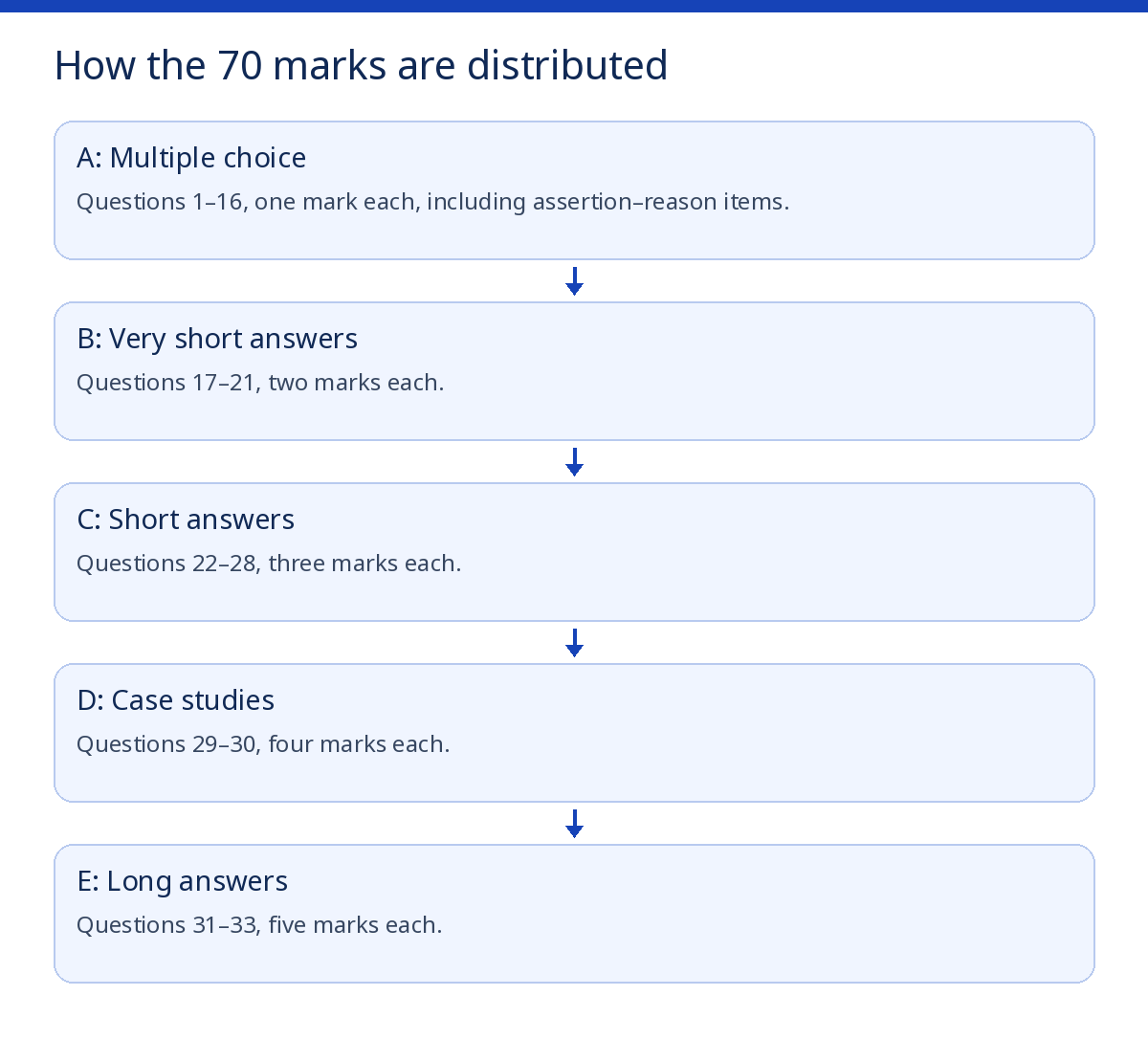
This is a full supplementary/compartment paper, not a chapter-wise question bank. It carries 70 marks and contains 33 questions across five sections. Section A has 16 one-mark questions, including four assertion–reason items. Section B has five two-mark very short answers, Section C has seven three-mark short answers, Section D has two four-mark case studies and Section E has three five-mark long answers.
There is no overall choice. Some questions outside Section A contain an internal choice, so attempt one of the alternatives where an OR is printed rather than treating the question as optional. The PDF keeps the original English questions, options and diagrams, and provides explanations for both alternatives where a choice appears. For a timed attempt, observe the three-hour limit and the no-calculator rule, and refer to the printed constants table when needed.

Physics Supplementary 2025 | Class 12 | Previous Year Paper | Code 55/S/1
In the StudentCurio app
The complete 2025 CBSE Class 12 Physics supplementary paper, set 55/S/1, includes questions spanning the syllabus and worked solutions. It helps students practise board-exam questions and review solution methods.
Common mix-ups: quantities that look similar
In the alternating-current questions, distinguish an rms value, a peak value and a mean over a specified interval. These describe different features of a waveform. Before choosing a relation, identify both the kind of value given and the kind requested. If the task concerns an average, the stated interval matters: a positive half-cycle is not a full cycle.
In photoelectricity, distinguish the threshold frequency, which marks the onset of emission for a particular surface, from the stopping potential, which is used to find the maximum kinetic energy of the emitted electrons. Do not treat a potential in volts as an energy in joules. The photoelectric graph item is not used here as a slope example because the supplied text does not establish the vertical-axis units.
Fields and circuits: read the setup before calculating
The paper moves between electric flux, a resistor network with battery internal resistance, electromagnetic induction and the torque on a current loop. The first decision is often geometric rather than numerical. For flux, identify the surface and its normal; if you invoke Gauss’s law, identify the closed surface to which it applies. A single open face can be part of that surface, but the law gives the net flux through the entire closed surface, not directly through that face.
In the circuit question, trace the connections before deciding which resistors combine in series or parallel, and account for the battery’s internal resistance in the source model. In the magnetic questions, distinguish the dot product used for flux from the cross product used for torque. A sketch showing the relevant directions is a useful check before you evaluate vector components.
Optics: choose the representation that matches the task
The optics questions include a lens combination, a lens-and-mirror system, Young’s double-slit interference, prism refraction and a wavefront derivation. In an image-formation problem with successive optical elements, mark which image from the first element serves as the object for the next. Assign distances relative to the element you are analysing, rather than carrying a signed distance over unchanged from the previous step.
The interference question asks you to relate fringe width to wavelength. Before comparing two patterns, check that the slit separation and screen distance are unchanged; otherwise wavelength alone does not determine the change in fringe width. In the longer optics questions, distinguish a ray diagram, which traces light paths, from a Huygens construction, which tracks wavefronts at the interface.
Case studies: identify what changes between subparts
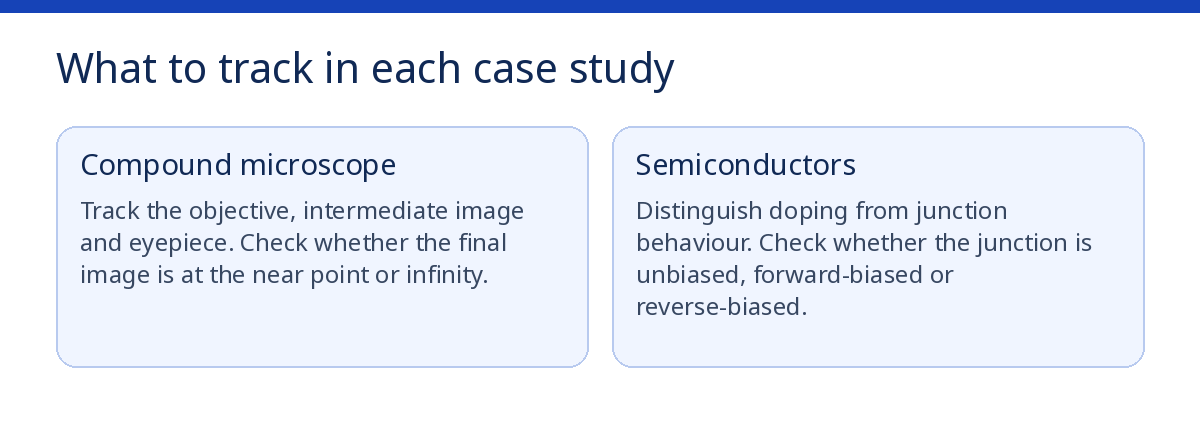
Section D covers the compound microscope and semiconductors. For the microscope, label the objective, intermediate image and eyepiece before working with magnifying power. The passage distinguishes a final image at the near point from one at infinity. That condition determines which eyepiece expression is appropriate, so check it afresh in each subpart.
For semiconductors, separate two levels of explanation. The distinction between intrinsic and extrinsic material concerns whether it has been doped. The discussion of diffusion, drift, the depletion region and the potential barrier concerns what happens at a junction. Read each prompt for whether it describes an unbiased junction or applies an external voltage before using the passage to reason about it.
Long answers: make each requested step visible
Section E offers alternatives on AC circuits, electrostatics and optics. A series circuit derivation asks for a phasor diagram as well as expressions and a phase relationship, so a final formula alone does not address the whole task. In the capacitor alternative, mark when the battery is disconnected and define the system before deciding where charge conservation applies. For the prism alternative, distinguish the minimum-deviation geometry used in the derivation from the separate condition for light to emerge at the opposite face.
Quick self-check before opening a solution
After the timed attempt, use the question-number links to review the items you marked. The worked pages separate the formula, the concept and the explanation in steps. Find the first place where your reasoning diverged: did you misread a diagram, miss a condition, choose the wrong relationship or make an algebraic error?
For assertion–reason items, ask whether you checked each statement independently before deciding if one explains the other. For an internal choice, review the branch you attempted first, then try the unused branch separately. That lets you practise both topics without confusing what you completed under the original time limit.
Spotted an error? Report a correction. Practise this in the app: notes, formula sheets and mind maps.













































































































































































Loading comments…