CBSE Class 12 Physics 2024 Supplementary Paper and Solutions
CBSEPhysics2024 Previous Year Paper
Paper code: 55/S/3 · 2024Use the full 2024 CBSE Class 12 Physics supplementary paper (55/S/3) for a timed board-exam attempt, then use the worked solutions to check your choice of principle, your reasoning and how you present it.
This set is one of the year's papers. See every set from 2024, grouped by series.
Read the paper pattern before you start
This English-language supplementary or compartment paper is organised by year, not by chapter. It has a three-hour time limit, carries 70 marks and contains 33 questions. Section A has 16 one-mark questions, including assertion–reason items. Section B has five two-mark very short answers, Section C has seven three-mark short answers, Section D has two four-mark case studies, and Section E has three five-mark long answers.
All numbered questions are compulsory. Internal choice means choosing between the printed alternatives within a question, not skipping that question. Some questions in Sections B to E offer this choice; Section A does not. Practise without a calculator, as the paper requires, and use the physical constants provided in its instructions where needed.

Physics Supplementary 2024 | Class 12 | Previous Year Paper | Code 55/S/3
In the StudentCurio app
The 2024 CBSE Class 12 Physics supplementary paper and worked solutions cover questions across electrostatics, current electricity, magnetism, optics, electromagnetic induction, AC and modern physics. It helps students practise board-exam questions and review solution methods.
Use the worked solutions to diagnose your first error
The file retains the original English questions, options and diagrams. Its question-number navigation lets you go directly to a worked solution, which separates the formula, the concept and the explanation in steps. For a mock attempt, stay in the question pages until you finish. Then use those three parts to identify whether you chose the wrong model, applied a valid relation outside its conditions or made an error after setting up the problem correctly.
Review the unattempted internal alternatives only after marking your first attempt. The explanations cover those alternatives too, so you can use them to revisit a different topic without treating both branches as compulsory. For an assertion–reason item, check the truth of each statement separately before deciding whether the reason actually explains the assertion.
Common mix-ups: fields, currents and circuit quantities
The electricity questions move between field superposition, dipoles, cells with internal resistance and a wire whose cross-section varies. Decide first what kind of quantity the question asks for. Electric fields add as vectors, so a sketch of the individual field directions can prevent you from adding magnitudes that belong along different axes. For the dipole field comparison, notice that the paper places the observation points far from the dipole relative to its charge separation; that condition is part of the model.
In circuit review, distinguish a cell’s emf from its terminal voltage when it supplies current. In a steady current through an unbranched wire, the current through each cross-section is the same, but current density also depends on the cross-sectional area. The two quantities need not vary together.
A useful connection: moving from magnetic flux to AC
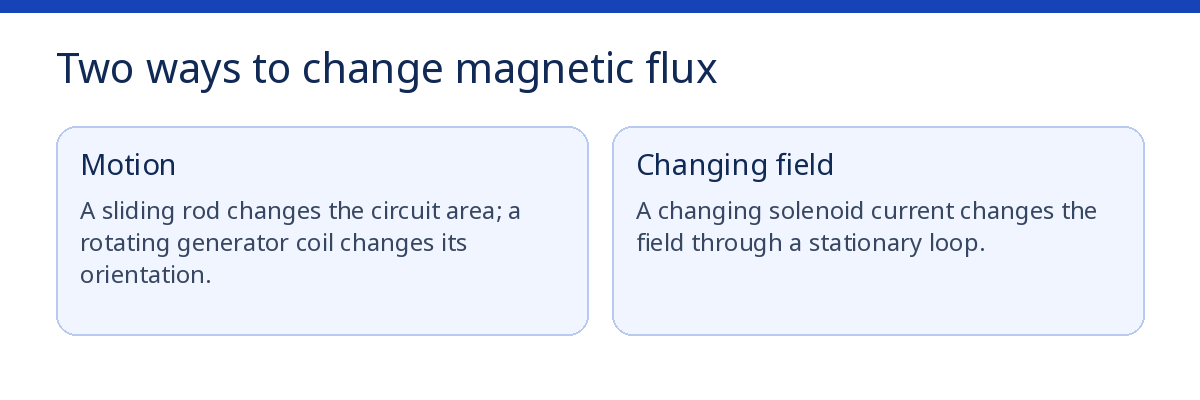
The induction questions include a moving rod, a loop inside a solenoid and an AC generator. Their setups differ, but flux gives you a common starting point. In the rod and generator setups, motion changes the flux through a circuit; in the solenoid setup, a changing current changes the magnetic field through a stationary loop. When using for a flat loop in a uniform field, measure the angle from the area normal, not from the plane. Faraday’s law relates induced emf to the rate of flux change, while Lenz’s law determines its sense.
For alternating current, keep resistance and reactance distinct. Inductive and capacitive reactance depend on frequency in opposite ways. When reviewing a series circuit, distinguish the phase relationship from the magnitude of the current: comparing magnitudes alone does not establish which quantity leads.
Optics: let the diagram determine the method
The optics questions call for different representations: ray geometry for total internal reflection and prisms, a wavefront diagram for Huygens’ principle, and an intensity curve for single-slit diffraction. For total internal reflection, first identify whether light travels from the higher-index medium toward the lower-index medium, then compare the angle of incidence with the critical angle. For a telescope derivation, note the specified final-image position before choosing the ray diagram. For the lens-power derivation, keep the stated condition that the lenses are coaxial and in contact.
The spherical-surface image-sequence example is omitted here because the worked explanation relies on an assumed glass refractive index that the question does not specify.
Modern physics: distinguish what each quantity measures
The modern physics questions draw on photoelectric emission, matter waves, atomic models and nuclear binding. In photoelectric review, separate intensity from frequency: an intensity comparison at fixed frequency is not the same as a comparison that changes the energy per photon. Keep work function distinct from maximum photoelectron kinetic energy; one describes the surface’s emission threshold, while the other describes the fastest emitted electrons.
For the nuclear questions, distinguish total binding energy from binding energy per nucleon. Also check whether the given masses are nuclear or atomic before setting up a mass difference. The carbon question supplies a hydrogen atom mass, so it is especially important not to relabel every listed mass as a bare nuclear mass.
Quick self-check: can you use the case-study figures?
Section D uses rectification and electric and magnetic dipoles as its two case-study contexts. The passage gives the background, but you also have to read each figure or arrangement on its own terms. For rectification, can you trace a conducting path from the indicated polarity and diode orientation before looking at a waveform? For dipoles, can you mark the moment directions before combining vectors or reasoning about torque?
Carry the same habit into the longer answers: make a diagram useful by tying its labels to the explanation or derivation, rather than adding it as decoration. This guide leaves out the paper’s isolated microwave-heating claim; use the independently supported induction, capacitor and optics material for review.
Spotted an error? Report a correction. Practise this in the app: notes, formula sheets and mind maps.













































































































































































Loading comments…