CBSE Class 12 Physics 2023 Supplementary Paper Guide
CBSEPhysics2023 Previous Year Paper
Paper code: 55/C/1 · 2023Use the 2023 CBSE Class 12 Physics supplementary paper to practise a full three-hour exam. This guide maps the paper’s topics and explains how to use the worked solutions to check your reasoning, from circuit diagrams to prism refraction.
This set is one of the year's papers. See every set from 2023, grouped by series.
What this year-wise paper contains
This English-language resource contains the 2023 CBSE Class 12 Physics supplementary paper, code 55/C/1, with worked explanations. It is a full paper, not a chapter-wise collection: electrostatics, circuits, magnetism, optics, modern physics and semiconductor electronics all appear. The paper allows three hours, carries 70 marks and does not permit calculators.
The 35 questions are divided into five sections: 18 one-mark multiple-choice questions, seven two-mark very short answers, five three-mark short answers, three five-mark long answers and two four-mark case-based questions. The final three questions in Section A use the assertion–reason format. There is no overall choice. Where an internal choice is printed, attempt one alternative during a timed run and save the other for revision.

Physics Supplementary 2023 | Class 12 | Previous Year Paper | Code 55/C/1
In the StudentCurio app
A complete CBSE Class 12 Physics supplementary examination paper with worked solutions, covering topics across the syllabus. It also includes a step-by-step solution to a Ray Optics question on prism minimum deviation and refractive index.
Electric fields, capacitors and direct-current circuits
The electrostatics questions ask you to distinguish quantities that describe different things. Electric flux through a closed surface is tied to the net enclosed charge by Gauss’s law; it does not tell you how many charges are inside. Potential difference in a uniform electric field depends on the component of displacement along the field, not simply on the distance between two points. Drawing the field direction before writing an equation helps you keep track of the sign.
The capacitor case study tests both network recognition and physical reasoning about a dielectric. Before analysing a change, identify whether the capacitor remains connected to the battery or has been disconnected. For the direct-current questions, trace which components share a current and which share a potential difference before choosing a power relation or applying Kirchhoff’s rules.
Common mistakes in magnetism, induction and AC
Do not treat magnetic flux, induced emf and induced current as interchangeable. Faraday’s law connects emf to the rate of change of magnetic flux. For a closed conducting loop, the current also depends on the circuit’s opposition to it. This distinction is useful when the paper compares rotating loops made of different materials: separate the geometry and motion that determine the flux change from the electrical properties of the loop.
In the AC questions, distinguish the signed reactance from its magnitude. For an ideal series LC circuit, the signed reactance is , while its magnitude is . The sign tells you whether the net reactance is inductive or capacitive; it is not a measure of how large that reactance is. In a phase question, first trace which component each voltmeter is connected across.
Ray optics: what minimum deviation assumes
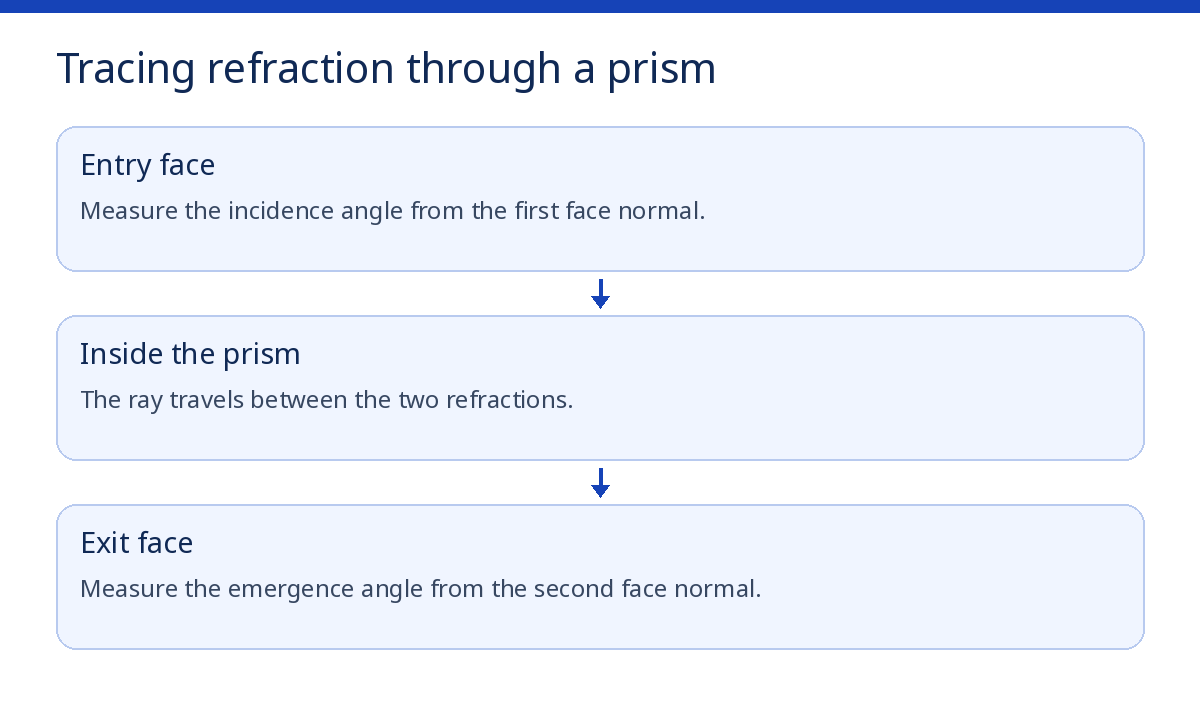
Prism refraction appears both as a long-answer option and in a case study. The long-answer format calls for a labelled ray diagram and a derivation. The case study moves between a deviation-versus-incidence graph, a small-angle approximation and reasoning from a specified ray path. Use the two appearances to practise translating between a diagram, a graph and a mathematical relation.
Measure incidence and refraction angles from the normals to the prism faces. At minimum deviation, with the same surrounding medium at both faces, the ray path is symmetric in the sense that the angles of incidence and emergence are equal. Use that angular symmetry rather than assuming that the internal ray is parallel to the base for every prism shape. Also distinguish the minimum-deviation condition from the additional small-angle assumption needed for the approximation.
Wave optics, photons and atomic models
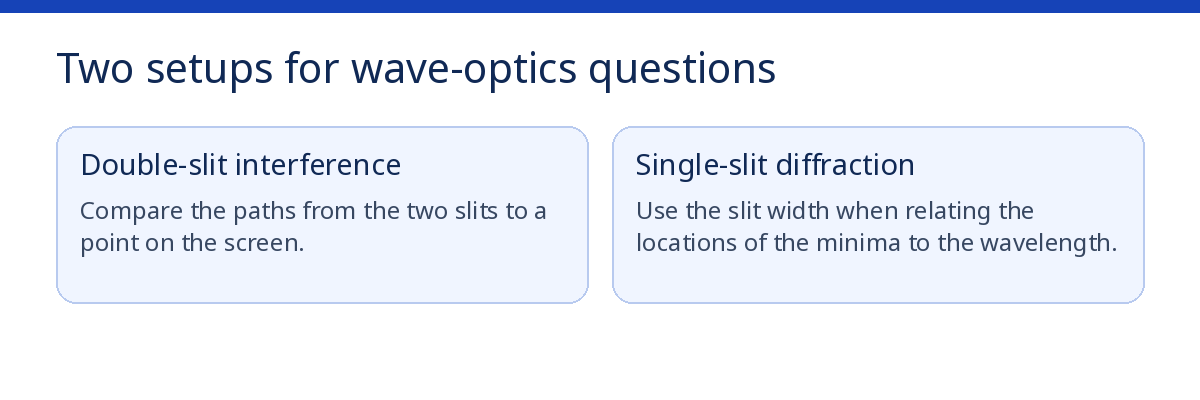
The wave-optics questions give you a reason to distinguish interference from single-slit diffraction before reading fringe positions. In a double-slit setup, the pattern depends on the path difference between waves from the two slits. In single-slit diffraction, the minima depend on the width of the slit. Identify the setup first so that a familiar-looking diagram does not lead you to use the wrong spacing relation.
The photoelectric questions involve both emission and a stopping-potential graph. Separate the energy of an individual photon from the rate at which photons arrive, and check whether the light is above the emission threshold before reasoning about intensity. Elsewhere, the paper asks you to interpret de Broglie wavelength, hydrogen transitions and nuclear scattering. For these questions, name the model and the quantities involved before substituting values.
Quick self-check: diagrams and graphs in electronics
The electronics questions use several representations: a rectifier circuit, a diode current–voltage graph and energy-band diagrams. Each tells you something different. A circuit diagram shows how components are connected; a current–voltage graph describes a device’s response; an energy-band diagram helps explain differences between conductors, insulators and semiconductors.
Before consulting a worked explanation, ask yourself whether you can label the axes of a diode characteristic, identify the part of the curve relevant to forward conduction and explain why a change in current over a voltage interval is not the same information as a single current reading. This is a check on how you read the graph, not a substitute for the circuit reasoning.
How to review your attempt with the worked solutions
Start with the question paper and keep the worked explanations closed. After the timed attempt, use the file’s formula, concept and explanation in steps layout to locate where your reasoning diverged. Was the physical model wrong, or did you lose a sign, misread an axis or assume a quantity stayed constant? For a derivation or labelled diagram, compare your intermediate steps rather than checking only the final expression.
Practise the unused internal choices separately to see whether you can apply the same ideas in a different setup. Use the printed diagrams and notation when checking a question: this guide omits individual options and numerical examples where the extracted text does not reliably preserve the symbols or units.
Spotted an error? Report a correction. Practise this in the app: notes, formula sheets and mind maps.













































































































































































Loading comments…