CBSE Class 12 Physics 2022 Supplementary Paper With Solutions
CBSEPhysics2022 Previous Year Paper
Paper code: 55/6/1 · 2022Practise the full 2022 CBSE Class 12 Physics supplementary paper, set 55/6/1, under its original two-hour, 35-mark format. The worked explanations cover the printed internal choices, so you can review both the route you attempted and the one you left out.
This set is one of the year's papers. See every set from 2022, grouped by series.
Read the paper as a 2022 board assessment
This English-language file pairs the original Supplementary / Compartment question paper with worked solutions. It is organised by year, not by chapter. The cover links to individual questions, and the worked pages link back to the corresponding prompts. Use those links during review, but stay in the question-paper pages during a timed attempt.
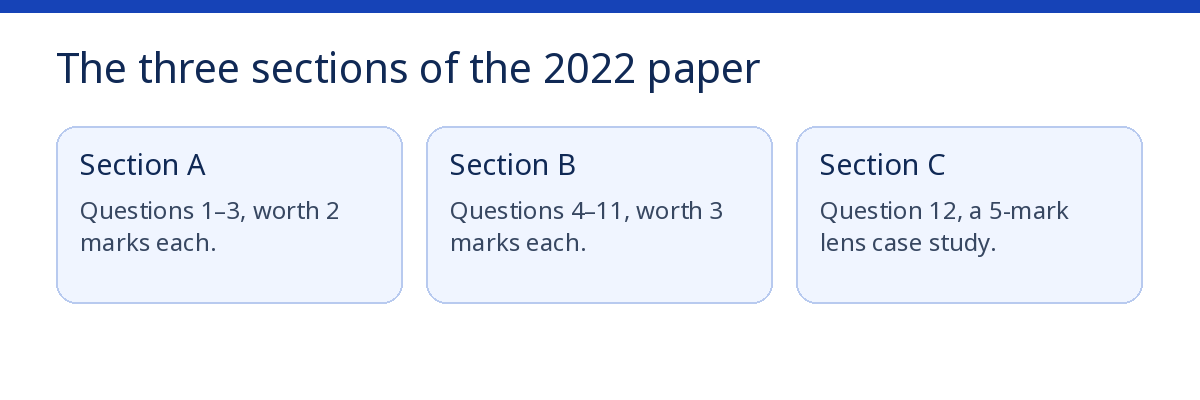
The paper has 12 compulsory questions across three sections: Section A has three 2-mark questions, Section B has eight 3-mark questions, and Section C has one 5-mark lens case study. There is no overall choice. Where an internal choice is printed, attempt only one alternative during the mock. The original instructions permit log tables if necessary but prohibit calculators. Follow those conditions if you want to practise selecting questions and doing calculations as the paper requires.

Physics Supplementary 2022 | Class 12 | Previous Year Paper | Code 55/6/1
In the StudentCurio app
A solved 2022 CBSE Class 12 supplementary Physics paper with questions and worked explanations across nuclear physics, electronic devices, optics, electromagnetic waves, atomic physics and other chapters. Useful for board-exam practice and reviewing previous-year questions.
Use Section A to sharpen short explanations
Section A brings together electromagnetic waves, the Geiger–Marsden scattering experiment, hydrogen-atom energy, semiconductor charge and the photon picture of light. The short prompts make it useful for checking whether you can give a physical reason rather than merely name a principle. For example, in a scattering explanation, distinguish an electrostatic turning point from contact between particles. In an electromagnetic-wave sketch, label the field directions and the propagation direction separately.
Keep the scope of a claim clear: The discussion of radio frequencies concerns a conventional electrical demonstration, not a general limit on observing electromagnetic waves. When reviewing that passage, notice what the experimental setup makes convenient and what the underlying physics permits. That distinction matters more than memorising an unrestricted statement about frequency.
Choose the right representation in optics
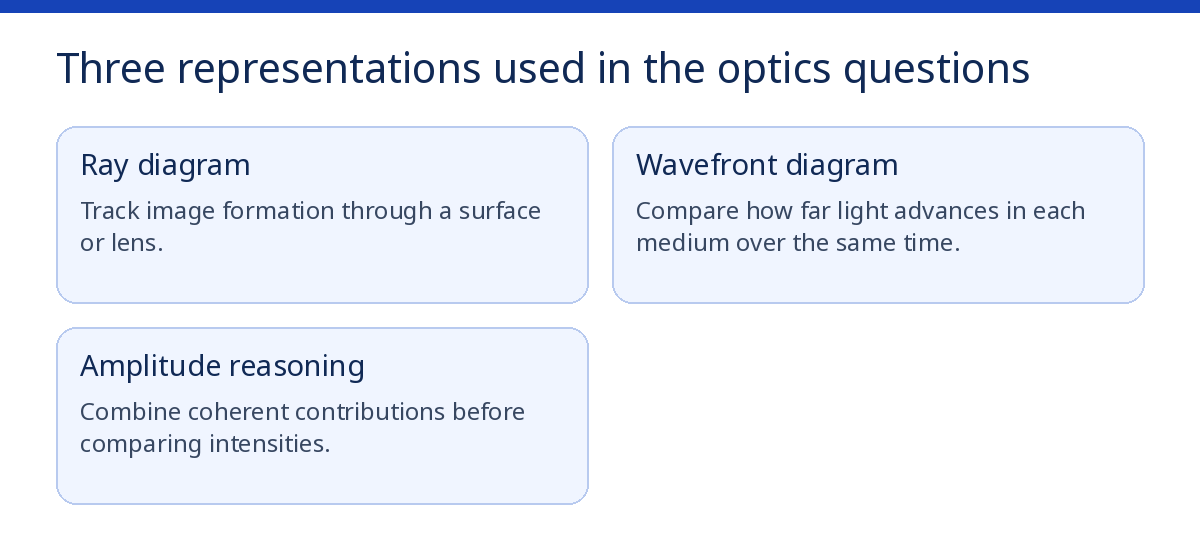
Section B asks for several kinds of optical reasoning. A compound-microscope diagram tracks an intermediate image before the eyepiece forms the final image. Refraction at a spherical surface instead calls for a diagram that fixes the interface, the normal and the distance convention. The refraction derivation uses paraxial rays, for which the small-angle approximation is appropriate. When checking your work, make sure the signed distances in the algebra agree with the geometry you drew.
Wave optics calls for a different starting point. In interference, coherent contributions combine as amplitudes before you calculate intensity; adding the separate intensities alone misses the effect of phase. In the wavefront construction for refraction, the geometry uses the distances travelled in the two media over the same time. Keep frequency and wavelength distinct when light crosses the boundary: the frequency stays fixed even though the speed and wavelength change.
Separate matter waves, photons and nuclear energy
The paper uses wavelength in two different roles. A particle’s de Broglie wavelength is tied to its momentum. In the photoelectric effect, wavelength characterises the incident light and is linked to photon energy; the threshold concerns whether an individual photon has enough energy for emission. Before using a wavelength relation, identify what the wavelength belongs to. The hydrogen questions then connect the standing-wave picture to allowed orbits and distinguish those orbits from the transitions that produce spectral lines.
The nuclear questions involve two other models: mass–energy accounting for a reaction and the approximate scaling of nuclear density. When reviewing a reaction calculation, check which masses belong to each side before interpreting the sign of the energy change. If you use atomic masses, check that the electron counts cancel rather than assuming they always do.
Connect the p–n junction to its current–voltage curve
The electronic-devices questions move from the charge balance of doped material to junction formation and then to the behaviour of a diode under bias. Keep those levels separate. A majority-carrier label describes which mobile carriers are more abundant; it does not give the net charge of the entire material. At a junction, diffusion and the resulting built-in field explain how the depletion region forms and why equilibrium is not the same as an absence of carrier motion.
When revising the current–voltage graph, label the axes and distinguish forward bias, the reverse-bias region before breakdown, and breakdown itself. Then check whether your explanation for each region describes the carriers and conditions relevant there. The mechanism that limits a small reverse current does not explain the sharp rise at breakdown.
Read the lens case study one condition at a time
The final question groups lens power, the surrounding medium, dispersion and a coaxial two-lens arrangement. Read each part for what changes. Changing the medium changes the relative refractive index even when the lens surfaces stay the same. Changing wavelength raises a dispersion question. Adding a second lens at a distance requires tracking where the first lens sends the rays and treating that image as the object for the second lens.
Before using lens power: In the thin-lens relation , use the signed focal length in metres to obtain power in dioptres. Do not infer convergence or divergence from the lens shape alone when the surrounding medium changes. For a two-lens sketch, draw both stages and check that your final rays match the image condition in the prompt.
Review the first wrong step, not just the final result
The worked pages separate the formula, the concept and the explanation in steps. Use that structure to locate the first point where your reasoning diverged: the physical model, a diagram, a sign convention or a calculation. Then attempt the unused internal alternative on its own. The two choices can test different skills, so doing well on one is not evidence that you can do the other.
This guide omits numerical readings where the extracted text obscures signs, exponents or symbols, including the electromagnetic-wave wavelength, the hydrogen energy value and the signed lens-power options. It also omits the worked page’s misleading “contact” label for a separated-lens setup. Consult the printed question pages for the original notation.
Spotted an error? Report a correction. Practise this in the app: notes, formula sheets and mind maps.













































































































































































Loading comments…